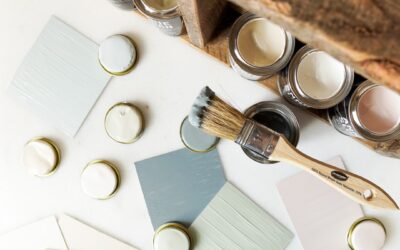
They both finish furniture in a matte, velvety way — but that is where the similarities end. Milk paint vs chalk paint is actually a comparison between a 7,000-year-old casein-based coating and a 1990s acrylic formulation by Annie Sloan. One is genuinely historic; one is brilliant marketing that created a whole industry. Knowing the real differences matters when you are picking a finish: milk paint grips raw wood and turns unpredictable on sealed surfaces; chalk paint sticks to almost anything with no prep. Here is what actually separates them and which to use for your project.
Part of our Paint & Walls guide — explore the full guide →
Ingredients and Origin
Milk paint is made from milk protein (casein), lime, and mineral pigments. The ancient Egyptians used it on tomb murals; American colonial furniture was painted with it by hand. Today it is sold as a dry powder (Old Fashioned Milk Paint, Real Milk Paint Co, Miss Mustard Seed) that you mix with water in small batches as needed.
Chalk paint is an acrylic paint with calcium carbonate additive to create a matte, ultra-flat finish. Annie Sloan trademarked the term “Chalk Paint” in the 1990s; competitors use “chalk-style” or “chalky finish” to avoid the trademark. Dixie Belle, Rust-Oleum, and Behr all sell versions today.
Finish and Texture
Milk paint dries to an ultra-matte finish that looks genuinely aged and porous. On raw wood, it can chip and craze slightly as it cures — producing the authentic aged look that chalk paint tries to simulate with distressing techniques. The texture is uneven and organic.
Chalk paint produces a more uniform matte finish straight out of the can. The surface feels slightly powdery and soft. Because it is acrylic-based, the finish is consistent and predictable — good for beginners, less interesting to artisans wanting real character.
Adhesion and Prep
Milk paint grips raw, porous surfaces best — unfinished wood, plaster, stone. On sealed surfaces (varnish, polyurethane, laminate), it will not stick at all unless you add a bonding agent (Extra Bond by Old Fashioned Milk Paint). The built-in unpredictability is why many milk paint fans love it: unexpected chipping reveals the character underneath.
Chalk paint sticks to virtually anything with zero prep — raw wood, varnished furniture, laminate, metal, even smooth plastic. This is its defining marketing claim, and it is broadly accurate. Sanding and priming are not required for most applications.
Durability Comparison
- Milk paint: Hard when fully cured — comparable to a century-old antique finish. Needs a topcoat for water resistance (hemp oil, wax, or polyurethane).
- Chalk paint: Softer and more scuff-prone without a topcoat. Chip resistance improves dramatically with 2 coats of wax (Annie Sloan Soft Wax) or matte polyurethane.
Both require a sealing topcoat for any surface that gets regular use. Dining tables, kitchen cabinets, and anything with moisture exposure need multiple coats of protective finish.
Cost Comparison
- Milk paint: $15-20 per pint (powdered, mixed on demand). One pint covers 75-100 sq ft.
- Chalk paint: $38-45 per quart (Annie Sloan); $25-32 per quart (Dixie Belle, Rust-Oleum). One quart covers 150 sq ft.
Per square foot, chalk paint costs about 30% more than milk paint. Plus you need the wax topcoat for chalk paint, adding another $25-35 per project.
Mixing and Consistency
Milk paint must be mixed fresh — typically 1 part powder to 1 part water, stirred until smooth, let sit 10 minutes, stirred again. It starts thickening within 24-48 hours and spoils within a week. Make small batches.
Chalk paint comes pre-mixed in cans, uses like any latex paint, and lasts a year or more if sealed properly. Much more convenient for beginners and one-time projects.
Color Range
Milk paint traditionally used mineral pigments limited to earthy, muted tones: ochres, terra cottas, grays, muted blues and greens. Modern brands have expanded the palette, but colors still skew historical and slightly duller than modern paint.
Chalk paint covers the full spectrum — bright colors, deep jewel tones, neons, and trendy modern hues. Annie Sloan offers about 40 standard colors; Dixie Belle has over 60.
Smell and Safety
Milk paint is odorless and zero-VOC when wet. Safe for nurseries, bedrooms, and poorly ventilated spaces.
Chalk paint has a mild latex smell (lower VOC than standard latex but not zero). Safe for most interior use but benefits from basic ventilation.
When to Choose Milk Paint
- Restoring antique or vintage wood furniture with authentic aged finish
- Reproducing historical colonial, shaker, or farmhouse pieces
- Projects where unpredictable chipping is the aesthetic goal
- Raw wood, plaster walls, mineral surfaces
- Small-batch artisan work
When to Choose Chalk Paint
- Upcycling thrift-store furniture fast
- Beginners with no prep experience
- Projects requiring vibrant modern colors
- Laminate, veneer, or previously finished surfaces
- Consistent, predictable results
A Honest Comparison Summary
Chalk paint wins on convenience, color range, and beginner-friendliness. Milk paint wins on authenticity, tradition, and character on raw wood. Neither is better overall — they are different tools. If you are doing one weekend project on a thrift flip, chalk paint is the obvious choice. If you are restoring a piece with any historical pedigree, milk paint is worth the extra effort. For kitchen cabinets, neither is ideal — a cabinet-grade acrylic enamel (Benjamin Moore Advance, Sherwin-Williams Emerald Urethane) will outperform both.