
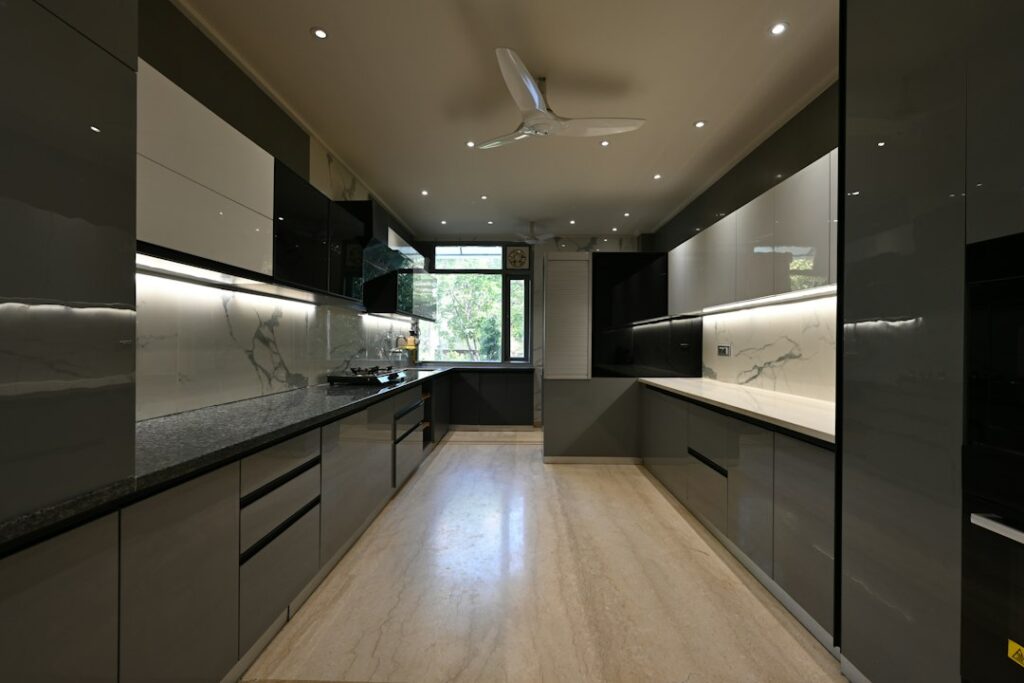
The window over your kitchen sink takes more abuse than any other window in the house. It faces daily splashes, steam from the dishwasher and pasta pot, grease from the nearby range, and a faucet that makes it hard to reach. Modern over the sink kitchen window treatments have to look clean and minimal while surviving all of that, and they still need to operate easily from a distance of 24 inches or more. Here is how to choose materials, mounting styles, and operating systems that fit a contemporary kitchen and hold up for years.
Part of our Kitchen Remodeling guide — explore the full guide →
- What Makes Modern Over the Sink Kitchen Window Treatments Different
- Best Styles for a Contemporary Sink Window
- Materials That Handle Moisture and Grease
- Measuring and Mounting for a Clean Look
- Operating Systems You Can Reach Over a Sink
- Color and Design Tips for a Modern Kitchen
- Cost Overview and Care Routine
What Makes Modern Over the Sink Kitchen Window Treatments Different
Modern design leans on clean lines, flat surfaces, and very little ornament. That rules out traditional ruffled valances, tiered café curtains with heavy trim, and swags that collect dust and grease. Instead, modern over the sink kitchen window treatments tend to be slim, tailored, and tucked tightly into the window frame so they do not compete with the backsplash, cabinet hardware, or pendant lighting.
Function drives the rest. A sink window is usually the main source of daylight in a working kitchen, so the treatment must let you control glare without blocking the view entirely. It also has to tolerate humidity levels that can spike above 70 percent when you boil water or run the dishwasher. Fabrics that absorb moisture can mildew, and wood slats can warp, so material choice matters more here than anywhere else in the home.
Best Styles for a Contemporary Sink Window
Several treatment types deliver the modern look while standing up to kitchen conditions. Each has a distinct balance of light control, privacy, and ease of cleaning.
Roller Shades
Roller shades are the default choice in many modern kitchens because they disappear into a slim roll when raised. Choose vinyl-coated polyester or PVC-free screen fabric with a 3 to 10 percent openness factor. A 5 percent screen cuts glare and UV while keeping the view outside. These materials wipe clean with a damp cloth and resist moisture. Expect $40 to $120 for a standard stock size and $120 to $300 for custom-sized with a fascia cover.
Flat Roman Shades
A flat-fold Roman shade adds softness without clutter. For a sink window, skip linen and cotton, which stain and shrink, and choose a polyester or outdoor-rated solution-dyed acrylic that resists water spots and fading. Keep the fold depth shallow, around 6 to 8 inches, so the stacked shade does not block the top of the window. Custom Roman shades typically run $150 to $400 per window.
Faux Wood and Aluminum Blinds
Faux wood blinds in a matte white or charcoal finish give crisp horizontal lines and full tilt control. They handle humidity far better than real wood. Aluminum mini blinds with 1-inch slats look sleek in black or brushed metal finishes. Both run $30 to $150 per window, but they do collect grease, so plan to wipe them down every month or two.
Cellular Shades
Cellular or honeycomb shades are a smart pick for drafty older windows because the air pockets add insulation. Use a light-filtering fabric in a solid neutral color for the modern look. Top-down, bottom-up versions let you lower the top to bring in light while keeping the lower half covered for privacy. They cost $60 to $250 per window.
Decorative Window Film
For a fully minimal look, skip the shade and apply frosted, reeded, or gradient window film to the lower portion of the glass. Film costs $20 to $60 for a typical sink window, is completely waterproof, and never gets in the way of the faucet. It works well when privacy matters but you do not need to block the sun.
Materials That Handle Moisture and Grease
A sink window treatment gets wet, often several times a day. Choose materials that dry quickly and clean easily. Here is how common options compare.
| Material | Moisture Resistance | Cleaning |
|---|---|---|
| Vinyl or PVC screen | Excellent | Wipe with mild soap |
| Polyester fabric | Very good | Spot clean or vacuum |
| Faux wood (PVC composite) | Excellent | Wipe slats individually |
| Aluminum | Excellent | Wipe or soak in tub |
| Real wood or bamboo | Poor to fair | Dust only; warps if wet |
| Cotton or linen | Poor | Dry clean; prone to mildew |
Woven natural shades made of bamboo or jute look great in a Japandi or warm-modern kitchen, but keep them only on windows that are at least 12 inches above the faucet and away from the dishwasher vent. Even then, expect a shorter lifespan than synthetic materials.
Measuring and Mounting for a Clean Look
Inside-mount treatments sit within the window frame and give the neatest, most built-in appearance, which suits modern kitchens. You need at least 1 to 2 inches of flat window depth for most roller and cellular shades, and 2 to 3 inches for blinds. Measure the width at the top, middle, and bottom of the opening and use the narrowest number. Measure height on the left, center, and right and use the longest.
Outside mounts make sense when the window frame is shallow, when you want to make a small window look bigger, or when the faucet or backsplash would interfere with an inside mount. Extend the treatment 2 to 3 inches past each side of the trim and mount it 3 to 4 inches above the frame. Just make sure the bottom rail clears the faucet by at least 1 inch when fully lowered.
Check the clearance around your faucet and soap dispenser before ordering. A tall gooseneck or pull-down faucet may block a shade from lowering all the way. In that case, a top-down shade or film on the lower glass solves the problem.
Operating Systems You Can Reach Over a Sink
Reaching across a sink and countertop to pull a cord is awkward and puts your hip against a wet counter edge. Cords also dangle into dishwater. Modern treatments offer better options:
- Cordless lift: Push up or pull down on the bottom rail. Works well if you can reach the window comfortably, generally within 24 inches of the counter edge.
- Continuous-loop chain: A beaded loop mounted on one side lets you operate the shade from the edge of the window instead of reaching over the faucet.
- Wand tilt: For blinds, a slim wand is easier to reach than tilt cords and keeps things tidy.
- Motorized shades: Battery or hardwired motors let you raise and lower the shade with a remote, wall switch, or voice assistant. Motorization typically adds $150 to $400 per window, and rechargeable battery packs last 6 to 12 months between charges.
Motorized roller shades are the most popular upgrade for sink windows in modern kitchen remodels. They remove cords completely, can be scheduled to lower during afternoon glare, and never need to be touched with wet hands.
Color and Design Tips for a Modern Kitchen
Keep colors simple. White, warm white, and light gray blend with most cabinetry and walls, while black or charcoal shades work well as a graphic accent against white subway tile or light quartz. If your cabinets are a bold color, such as navy or forest green, pull a neutral from the countertop or floor instead of matching the cabinet color exactly.
Pay attention to the hardware, too. Many roller shades come with an optional fascia or cassette that hides the roll. Choose a fascia finish that matches your faucet or cabinet pulls, such as matte black or brushed nickel, for a coordinated look. Patterns should be subtle. A fine linen-look weave or a small geometric texture adds interest without looking busy next to a patterned backsplash.
Scale matters. On a small window, a single treatment that fills the frame looks cleanest. On a wide window or a set of two or three side-by-side windows over the sink, use matching separate shades on a shared headrail so each can operate independently.
Cost Overview and Care Routine
Budget ranges for a typical 36-by-40-inch sink window look like this:
- Window film: $20 to $60, DIY in under an hour.
- Stock roller shade or faux wood blind: $40 to $120.
- Custom cellular or roller shade: $120 to $300.
- Custom flat Roman shade: $150 to $400.
- Motorized custom roller shade: $300 to $700 installed.
Professional measuring and installation typically adds $50 to $150 per window if you are not doing it yourself. Most retailers will remake custom treatments that do not fit if the installer did the measuring, which is worth paying for on expensive motorized orders.
Care is easy if you stay ahead of it. Wipe vinyl and screen shades with a microfiber cloth and a drop of dish soap every few weeks. Dust blinds weekly and wash them monthly near the range. Run the exhaust fan during cooking to reduce grease buildup on the glass and the treatment. With the right material, a smart operating system, and a clean inside mount, your sink window will look sharp and keep working for a decade or more.


