The mountain laurel shrub puts on one of the most breathtaking flower displays of any native evergreen, covering itself in late spring with clusters of intricate, cup-shaped blooms in shades of pink, white, and rose. This is Kalmia latifolia, a member of the heath family and a close relative of rhododendrons and azaleas, not to be confused with cherry laurel (Prunus laurocerasus), which is an entirely different, faster-growing screening plant. Mountain laurel is native to the eastern United States and rewards gardeners who give it the acidic, woodland conditions it evolved to love.
Hardiness and Native Range
Mountain laurel is hardy in USDA zones 4 through 9, making it one of the more cold-tolerant broadleaf evergreens available. In the wild it grows in the Appalachian understory and along the East Coast, from Maine down to the Florida panhandle and west to Indiana and Louisiana. That heritage tells you exactly what it wants: cool roots, dappled light, and moist, acidic, humus-rich soil like a forest floor. It is the state flower of both Connecticut and Pennsylvania, a testament to how deeply it belongs in eastern landscapes.
Mature Size and Growth Rate
Mountain laurel is a slow grower, and patience is part of the deal. It typically adds only a few inches to a foot per year. Over time the species reaches 5 to 15 feet tall and wide, developing a gnarled, picturesque branch structure with age. Numerous compact cultivars stay far smaller, which suits most home gardens better.
- Compact cultivars (‘Elf’, ‘Minuet’, ‘Tinkerbell’): 3 to 4 feet tall and wide
- Mid-size cultivars (‘Sarah’, ‘Olympic Fire’, ‘Carousel’): 5 to 8 feet
- Species Kalmia latifolia: 7 to 15 feet in ideal woodland conditions
Spacing
Because it grows slowly and eventually spreads wide, space plants according to their mature size rather than their nursery-pot size:
- Compact types: space 3 to 4 feet apart
- Standard shrubs: space 5 to 6 feet apart
- Naturalized groupings: allow 6 to 8 feet for a loose, woodland effect
Sun and Soil: Getting It Right
This is where most mountain laurel failures begin, so pay close attention. Mountain laurel performs best in part shade, ideally with morning sun and afternoon shade, or bright dappled light beneath high tree canopy. It will bloom more heavily in more sun, but only if you can keep the roots cool and moist; in full sun with dry soil it scorches and struggles. In deep shade it grows sparse and blooms poorly. Part shade is the sweet spot.
Soil is equally critical. Mountain laurel demands acidic soil, a pH between 4.5 and 5.5, and it insists on excellent drainage combined with steady moisture. Heavy clay and alkaline soil are its enemies. Amend generously with peat moss, pine bark fines, and leaf mold to create the loose, organic, acidic medium it craves. If your native soil is alkaline or heavy, plant in a raised bed of amended soil or choose a different shrub entirely, because fighting your soil chemistry is a losing battle here.
Planting Step by Step
Plant in early spring or fall. Dig a hole no deeper than the root ball but two to three times as wide. Because mountain laurel has fine, shallow roots, gently tease apart the outer roots of a pot-bound plant before setting it in. Position the crown slightly above grade so it never sits in water, backfill with your acidic amended soil, and water deeply. Finish with 2 to 3 inches of pine bark or pine straw mulch to keep the shallow roots cool, moist, and acidic. Keep the mulch a couple inches back from the stems.
Watering and Feeding
Consistent moisture is non-negotiable, especially in the first two to three years while the shallow root system establishes. Never let the root zone dry out completely, but never leave it waterlogged either; the plant wants moist, not soggy. During dry spells, a deep soaking once or twice a week keeps it healthy.
Feed lightly with a fertilizer formulated for acid-loving plants, the same kind sold for rhododendrons and azaleas, in early spring. Overfeeding does more harm than good with this native. If the leaves yellow between the veins, that chlorosis usually signals soil that has drifted too alkaline, and an application of soil acidifier or an acidic fertilizer helps correct it.
Pruning and Deadheading
Mountain laurel needs little pruning. The main task is deadheading: snapping off the spent flower clusters right after bloom directs energy into next year’s buds and keeps the plant tidy. Do any shaping immediately after flowering, since the shrub sets its buds for next spring in early summer, and pruning later removes those buds. Old, overgrown plants can be renewed gradually by removing a few of the oldest stems at the base each year. Wear gloves; all parts of the plant are toxic if ingested, which, on the plus side, makes it quite deer resistant.
Understanding the Spring Flower Show
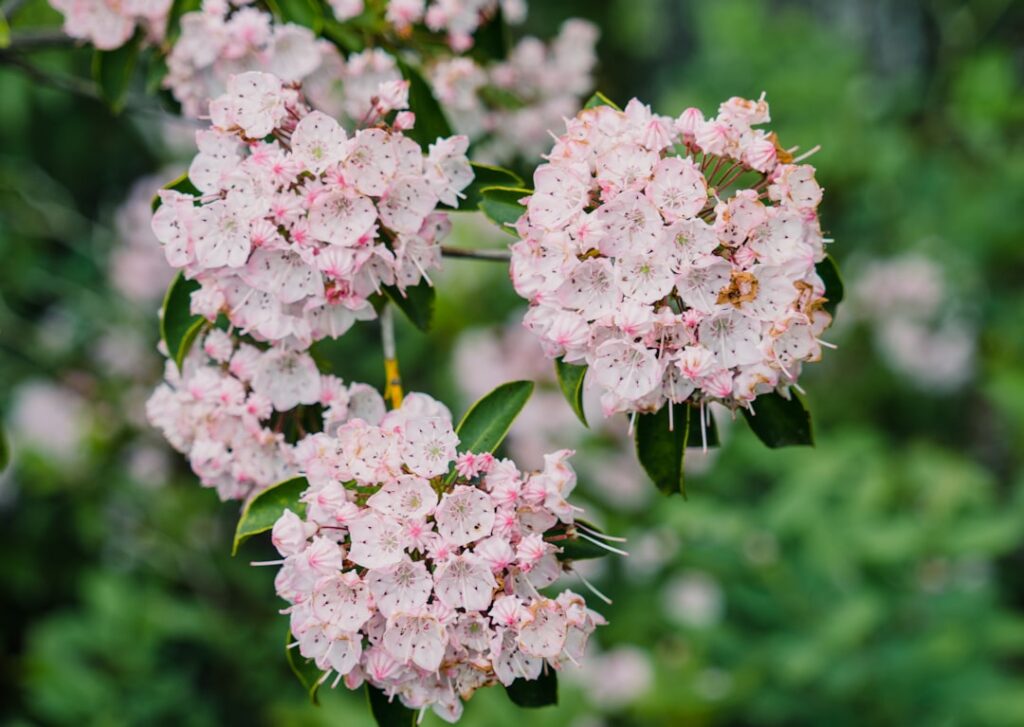
The bloom is the whole reason to grow a mountain laurel shrub, and it is worth understanding what you are looking at. In late spring, the plant covers itself in rounded clusters of flowers that open from crimped, geometric buds resembling tiny pieces of hard candy or origami. As each bud opens into a cupped, five-sided bloom, ten spring-loaded stamens are held under tension in little pockets along the petals. When a bee lands, the stamens snap forward and dust it with pollen, an ingenious pollination mechanism you can watch happen up close. Flower color ranges from pure white through soft pink to deep rose, often with intricate darker banding inside the cup.
Bloom is heaviest on plants grown in enough light, which is why part shade with some direct sun outperforms deep shade for flowering. Established plants can put on a display so dense the foliage nearly disappears beneath the flowers for a couple of weeks, one of the finest sights in the late-spring woodland garden.
Choosing the Right Cultivar
Modern breeding has produced mountain laurel cultivars with more reliable habits, better disease resistance, and a wider color range than the wild species, so it pays to choose a named selection. ‘Olympic Fire’ offers deep red buds opening to pink, ‘Sarah’ brings vivid red buds and pink-red flowers, ‘Carousel’ features striking interior banding, and ‘Elf’ and ‘Minuet’ stay compact for smaller gardens. Selecting a cultivar suited to your space and color preference, rather than a generic seedling, gives you a more predictable plant and often stronger resistance to the leaf spot that can trouble the species.
Pests and Common Problems
Given the right site, mountain laurel is fairly trouble-free, but poor conditions invite problems:
- Leaf spot: fungal spotting, worse in wet, crowded, poorly ventilated plantings
- Lace bugs: stipple the leaves; more common on plants stressed by too much sun
- Root rot: from poor drainage, a frequent killer
- Chlorosis: yellowing from soil that is not acidic enough
Notice a theme: most troubles trace back to wrong soil, wrong light, or wrong moisture. Get the site right and the plant largely takes care of itself.
Designing With Mountain Laurel
Mountain laurel is made for naturalistic and woodland gardens. Plant it along a shaded property edge, beneath tall pines and oaks, or in a mixed border with rhododendrons, azaleas, and ferns that share its acid-loving, part-shade preferences. The spring flower show is spectacular, and the glossy evergreen foliage carries the planting through the rest of the year. In a native or pollinator garden, it supports local bees while giving you a plant with real regional character.
A mountain laurel shrub asks for the right conditions up front and very little afterward. Give it part shade, acidic and well-drained soil, and steady moisture, and this native beauty will reward you each spring with flowers so finely detailed they look hand-painted, in a setting that feels like a piece of the Appalachian woods brought home.