Most homeowners discover noise problems after they move in. A new highway lane opens. The neighbor adds a pool with kids. A leaf blower service runs every Wednesday at 7 a.m. The marketing material for any noise barrier fence sold at big-box retailers promises dramatic improvement, but the physics of sound attenuation is unforgiving. A 6-foot wood fence reduces traffic noise by 3 to 5 decibels at the listener’s ear. That is real but modest. Understanding what does and does not work saves you from spending $8,000 on a fence that does not solve your problem.
Part of our Decks & Outdoor guide — explore the full guide →
- The Physics: Why Sound Is Hard to Block
- What 6-Foot Wood Privacy Fence Actually Does
- Materials Ranked by Effectiveness
- Cost Per Linear Foot in 2026
- Height: The Other Critical Dimension
- Earth Berms: Underrated Sound Barriers
- Engineered Acoustic Fences
- Acoustic Blanket Retrofit
- Don't Forget the Source Side
- Realistic Expectations
- Bottom Line
The Physics: Why Sound Is Hard to Block
Sound attenuation through a barrier follows what acoustical engineers call mass law: doubling the mass per square foot of a barrier adds roughly 6 dB of transmission loss. A standard wood privacy fence weighs about 3 to 4 pounds per square foot. A concrete sound wall weighs 80 to 100 pounds per square foot. The concrete wall blocks roughly 20 dB more sound through its surface than the wood fence.
But sound also goes over and around the barrier. The “insertion loss” – the actual quieting you experience standing behind a fence – depends on barrier height relative to the line of sight between your ear and the noise source. A 6-foot fence does almost nothing if the noise is a highway on raised grading or a second-floor neighbor’s HVAC unit.
What 6-Foot Wood Privacy Fence Actually Does
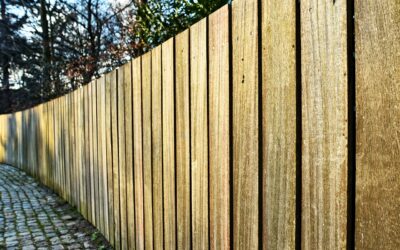
A standard cedar dog-ear privacy fence with 1/4-inch gaps between boards provides 3 to 5 dB of insertion loss for ground-level noise sources within 50 feet. That is enough to take the edge off neighbor conversation but does very little for traffic, machinery, or barking dogs.
Closing the gaps with overlapping board-on-board or shadowbox construction adds 1 to 2 dB. Adding a thin acoustic blanket between two layers of fence boards can add another 3 to 5 dB. Total realistic improvement from a high-quality wood fence is 8 to 10 dB, which is perceived as roughly half the noise.
Materials Ranked by Effectiveness
From worst to best for ground-level noise blocking:
- Chain link with privacy slats: 1 to 2 dB. Essentially zero effect.
- Standard wood privacy fence: 3 to 5 dB
- Vinyl tongue-and-groove fence: 4 to 6 dB
- Composite fence with no gaps: 5 to 7 dB
- Double-board wood with insulation between: 8 to 12 dB
- Solid masonry wall (CMU block or stuccoed): 18 to 25 dB
- Engineered acoustic fence (Acoustifence or AIL Sound Barrier): 25 to 32 dB
- Earth berm 6 feet tall: 10 to 15 dB plus aesthetic improvement
The jump from wood to masonry is dramatic and reflects the mass difference. A 6-foot CMU wall weighs 30 to 50 times more per square foot than a wood fence.
Cost Per Linear Foot in 2026
Pricing for a 6-foot tall fence, installed:
- Cedar dog-ear privacy: $35 to $55 per linear ft
- Cedar board-on-board: $50 to $75 per linear ft
- Vinyl tongue-and-groove: $45 to $75 per linear ft
- Composite (Trex Seclusions): $60 to $95 per linear ft
- Double-wall wood with acoustic blanket: $85 to $130 per linear ft
- Stuccoed CMU wall (8-inch block): $110 to $180 per linear ft
- Acoustic-specific (Acoustifence, AIL): $130 to $220 per linear ft
For 150 linear feet around a typical backyard, that range spans $5,250 for a basic wood fence to over $30,000 for a CMU wall.
Height: The Other Critical Dimension
For noise blocking to work, the fence must interrupt the direct line of sight between your ear and the noise source. For a noise source 100 feet away at ground level and an ear height of 5 feet, a 6-foot fence positioned 30 feet from you blocks the direct path. Move the noise source to a raised highway 12 feet up and the same fence does almost nothing.
Local zoning typically caps residential fences at 6 to 7 feet. Going higher usually requires a variance, a setback adjustment, or classification as a retaining wall. Check your municipal code before specifying anything taller.
Earth Berms: Underrated Sound Barriers
If you have the yard space and access to fill, an earth berm is the best dollar-per-decibel sound barrier available to homeowners. A 6-foot berm with a 4:1 slope occupies a 48-foot wide footprint – too much for most lots – but a 5-foot berm with 3:1 slope only needs 30 feet and still delivers 10 to 12 dB of attenuation.
Fill costs $15 to $30 per cubic yard delivered. For a 150-foot long, 5-foot tall, 30-foot wide berm, that is around 825 cubic yards of fill – $12,000 to $25,000 for material and placement. Topsoil cap and plantings add $5,000 to $10,000. Significant investment, but the berm also adds privacy and value the way a fence does not.
Engineered Acoustic Fences
Products like Acoustifence (made by Acoustiblok) and AIL Sound Barrier are designed specifically for noise blocking. They use a heavy mineral-filled vinyl membrane (around 4 pounds per square foot) integrated into a steel or composite frame. Insertion loss of 25 to 32 dB is achievable with proper installation.
These products are common along light industrial property lines and highway frontage but expensive for residential use. Expect $4,000 to $8,000 for 100 linear feet installed.
Acoustic Blanket Retrofit
For an existing wood or vinyl fence, retrofitting a mass-loaded vinyl (MLV) blanket sandwiched between two board layers is the most cost-effective improvement available. Acoustimac Curtain or Audimute Sound Absorption Sheets in 1 lb per sq ft weights cost around $4 to $8 per sq ft. For 150 feet of 6-foot fence (900 sq ft), material runs $3,600 to $7,200 plus installation labor of $3,000 to $5,000.
Net result: a 5 dB fence becomes a 9 to 11 dB barrier. Not dramatic, but the most you can usefully improve a wood fence.
Don’t Forget the Source Side
Sometimes the fix is closer to the noise source than the listener. A pool equipment enclosure with acoustic foam liner reduces pump noise by 15 to 20 dB at the source. An HVAC sound blanket on a neighbor’s compressor (with their cooperation) does the same. Even softscaping the source side with dense evergreen plantings disrupts sound paths usefully.
Realistic Expectations
If a noise problem is keeping you up at night, expect to need a 12 to 15 dB reduction to make the difference. That usually requires combining strategies: a tall solid fence plus a berm or dense planting plus interior window upgrades to laminated glass. A fence alone, no matter how expensive, rarely solves a serious noise problem.
Measure with a free sound meter app before and after any project. NIOSH SLM is calibrated reasonably well and provides documentation if you ever need to involve a neighbor or municipality.
Bottom Line
A standard wood privacy fence does almost nothing for traffic noise but takes the edge off conversational sounds. For real noise reduction, you need mass: double-wall wood with acoustic blanket, CMU masonry, or engineered acoustic panels. Pair the barrier with sight-line height and source-side treatment for compound benefit. Budget $80 to $180 per linear foot for a fence that meaningfully reduces noise, or invest in an earth berm if your lot allows.