
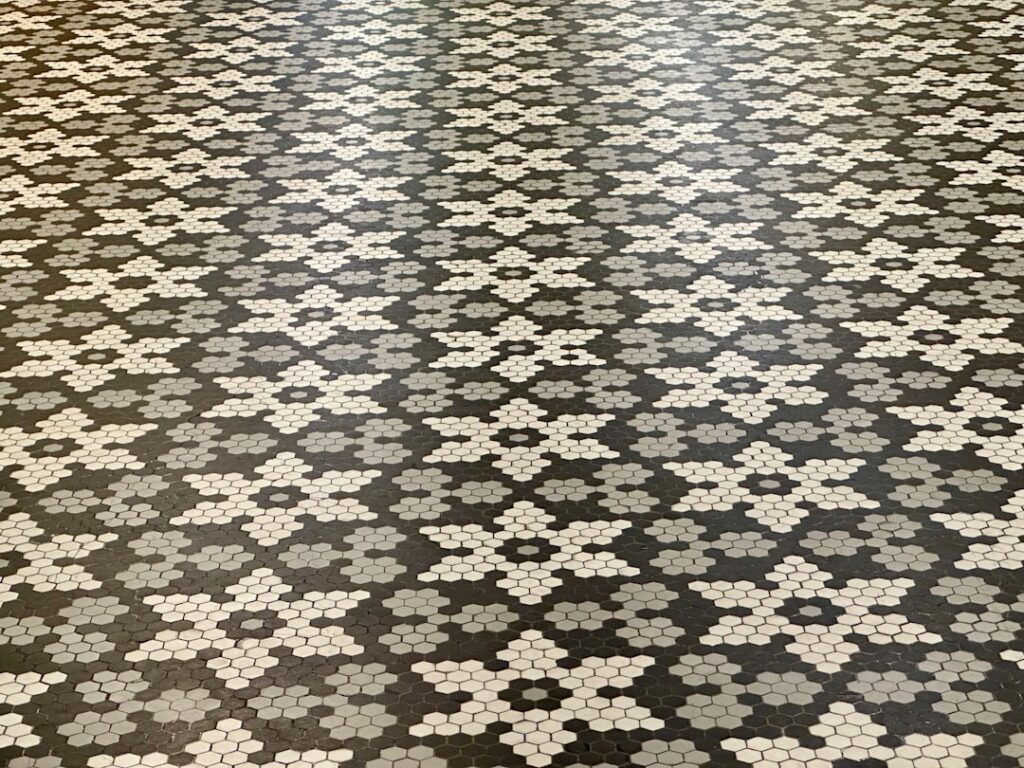
Encaustic cement tile costs $15 to $30 per square foot installed, needs sealing, and cracks if your subfloor flexes; meanwhile the printed version snaps together in an afternoon. Patterned vinyl click flooring puts Victorian mosaics, Moroccan medallions, star-and-cross layouts, and modern geometrics onto waterproof click-lock planks and tiles that float over almost any subfloor. It has become the go-to move for laundry rooms, powder baths, and kitchens that need personality without a tile budget. This guide explains how the format works, where the printed patterns hold up and where they fall short, and exactly what to check on the box before you buy.
What Patterned Click Vinyl Actually Is
Under the decorative surface, these products are ordinary rigid-core luxury vinyl: an SPC (stone plastic composite) or occasionally WPC core, a printed film layer carrying the pattern, a clear wear layer measured in mils, and click-lock edges milled around the perimeter. The difference from wood-look planks is purely the print, which mimics hand-made cement tile, patterned ceramic, terrazzo, or repeating geometric designs.
Formats matter more here than with wood looks. Tile-format pieces, commonly 12 by 24 inches or 18 by 18 inches, present the pattern the way real tile would, often with a printed faux grout line at the edges. Plank-format products, around 7 by 48 inches, print two or three tile motifs per plank. Both click together the same way, but tile formats hide the repeat better on classic layouts, while planks install faster in narrow rooms. Most lines include an attached acoustic pad and run 4 to 6.5 mm total thickness.
The Pros: Why the Format Works
The practical case is strong, especially in rooms where real cement tile struggles.
- Waterproof through and through: SPC cores do not swell, so laundry overflows and wet boots are non-events, unlike the porous cement tile these floors imitate.
- Floats over ugly floors: click vinyl installs directly over sound sheet vinyl, old tile with skim-filled grout lines, or plywood, saving demolition in bathrooms where tearing out mudset tile is a nightmare.
- Warm and quiet underfoot: vinyl runs noticeably warmer than ceramic in winter, and attached pads soften footfall.
- DIY-friendly: score-and-snap cutting, no wet saw, no thinset cure. A powder room floor is a half-day project.
- Budget: at $2.50 to $6 per square foot for materials, it undercuts genuine encaustic tile by 70 to 85 percent installed.
There is also a commitment-level argument. Bold patterned floors date themselves faster than neutral wood looks, and a floating floor can be swapped in a weekend when tastes change, which makes patterned click vinyl a lower-stakes way to try a trend than mortared tile.
The Cons: Where Printed Patterns Fall Short
Look closely and the illusion has limits. Printed grout lines have no depth; real cement tile has subtle color variation from pigment mixing that printing approximates with a repeat cycle. In a large room, your eye can catch the same “handmade” imperfection appearing every few feet. Budget lines with only 4 to 8 unique printed faces show this worst; premium products with 15 to 30 unique faces largely hide it.
Pattern alignment is the other trap. On some products, especially planks carrying partial motifs, the design must be assembled in a specific sequence for the pattern to continue correctly across rows, and every cut piece is a decision about where the repeat lands at walls and doorways. That is a planning burden straight-grain wood looks never impose. Finally, the standard vinyl caveats apply: sharp point loads can dent thinner cores, heavy appliances should not pin a floating floor in place, and dark patterns in direct sun can fade over years unless the line carries a UV-stability warranty.
Wear Layer and Core Specs That Matter
Spec-sheet numbers separate the products that still look crisp in ten years from the ones that scuff dull in three. The wear layer is the clear sacrificial coating over the print, and on a patterned floor it is doubly important because wear does not just dull the surface, it erases the design itself in traffic lanes.
- 12 mil wear layer: acceptable for powder rooms and guest baths with light traffic.
- 20 mil: the right answer for kitchens, laundry rooms, entries, and homes with dogs.
- Core thickness: 5 mm minimum for a solid feel; 6 mm or more if the subfloor has minor imperfections.
- Surface finish: ceramic-bead or urethane finishes with a matte sheen hide micro-scratches better than gloss, and matte also reads more like authentic cement tile.
- Unique faces: ask or check the spec sheet; 15-plus distinct printed variations is the threshold for convincing randomness.
Also confirm the locking profile brand or style. Reputable angle-tap and fold-down systems engage cleanly hundreds of times; no-name locks on deep-discount imports are the most common source of gapping complaints a season after install.
What It Costs
Materials for patterned vinyl click flooring run $2.50 to $4 per square foot for entry-level lines and $4 to $6 for premium products with 20 mil wear layers and larger pattern libraries. That sits about a dollar above equivalent wood-look SPC, reflecting the licensing and printing of the designs.
Professional installation adds $1.50 to $3.50 per square foot for straightforward rooms, so a 60 square foot powder room lands around $300 to $550 installed, and a 200 square foot kitchen between $900 and $1,900. DIY brings a small bathroom under $250 in materials. Order 10 percent overage rather than the usual 5 to 8 for wood looks, because pattern-matching at walls consumes extra pieces, and buy all cartons from one dye lot; print color shifts subtly between production runs.
Design and Layout Advice
Scale the pattern to the room. Big 18 inch medallion repeats overwhelm a 25 square foot powder room but look intentional in a 150 square foot kitchen; small star-and-cross or penny-round prints do the opposite. In small rooms, center the pattern on the sightline from the doorway, not on the room’s geometric center, because the eye judges symmetry from where it enters.
Contain bold patterns with calm neighbors. A patterned laundry floor meeting a wood-look hallway needs a clean transition strip at the doorway, and matching one accent color in the print to the wall or vanity color makes the floor read designed rather than busy. If you are nervous about commitment, restrict the pattern to rooms with doors; patterned floor running through open-plan space is a bolder bet that is harder to walk back.
Installation Tips
Prep and layout do most of the work. Flatten the subfloor to within 3/16 inch over 10 feet, skim-coating grout lines if going over tile, and acclimate cartons flat for 48 hours at room temperature. Dry-lay one full row in both directions to see where the pattern repeat lands at walls; shifting the start line a few inches can turn awkward sliver-cuts of half-motifs into clean pattern breaks.
Maintain a 1/4 inch expansion gap at walls, undercut door casings rather than scribing around them, and use transition moldings at doorways in runs over about 30 feet. Where planks carry sequential pattern pieces, sort them into labeled stacks before starting; sorting mid-row on your knees is how alignment errors happen. A tapping block, pull bar, and sharp utility blades are the entire specialty tool list.
The Verdict
Patterned vinyl click flooring is the rare trend product with sound fundamentals: waterproof, DIY-installable, and a fraction of the price of the cement tile it mimics. Buy a 20 mil wear layer for working rooms, insist on 15-plus unique faces so the print does not repeat obviously, and plan the layout from the doorway sightline. Used in defined spaces like baths, laundries, mudrooms, and kitchens, it delivers the most personality per dollar of any floor you can install yourself.
Prefer to explore on your own?
See how new flooring looks in your actual room in seconds — free, no signup.
Try the free Floor Studio →

