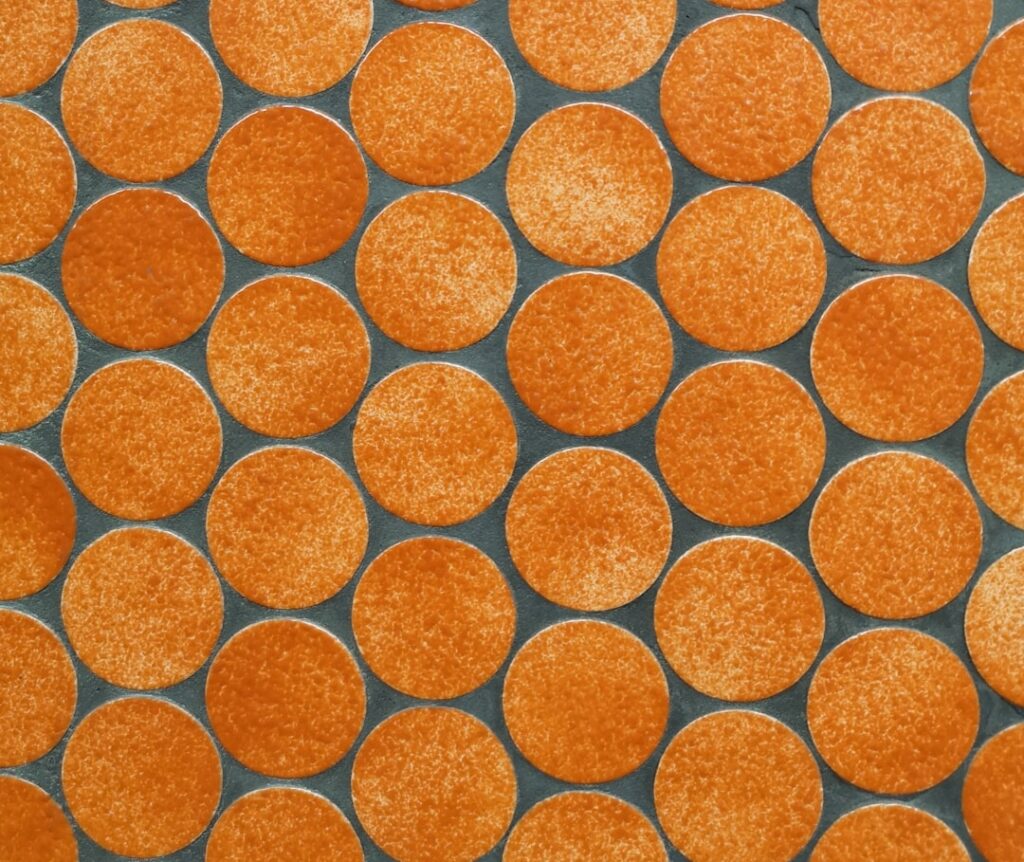
Penny round tile takes its name from the small, coin-sized circles that make up each sheet, and it has been charming American homes since the early 1900s. You will recognize it from classic hexagon-and-penny bathroom floors in older buildings, but designers have brought it roaring back for showers, backsplashes, accent walls, and statement floors. Its combination of vintage character, generous grout lines for grip, and endless color options makes it one of the most versatile mosaic tiles you can install. This guide walks through materials, costs, best uses, and the installation quirks that make penny tile a little different from standard square tile.
Part of our Tile & Grout guide — explore the full guide →
- What Is Penny Round Tile?
- Materials and Finishes
- Where to Use Penny Round Tile
- What Penny Round Tile Costs
- Installation Tips and Challenges
- Grout Choices Make or Break the Look
- Pros and Cons to Consider
- Keeping Penny Tile Looking New
- Design Ideas to Make Penny Tile Shine
- How to Estimate How Much You Need
What Is Penny Round Tile?
Penny round tile is a mosaic made of small round tiles, traditionally about 3/4 inch to 1 inch in diameter, roughly the size of a penny. Because installing hundreds of tiny individual circles by hand would be impossibly slow, manufacturers mount them on mesh-backed sheets, usually around 12 by 12 inches, so you set them a sheet at a time. The gaps between the circles create a distinctive pattern of grout that is both decorative and functional, giving floors excellent slip resistance thanks to the high ratio of textured grout to smooth tile.
Materials and Finishes
Penny rounds come in several materials, each with a different look and price point:
- Porcelain and ceramic: The most common and affordable, durable and water-resistant, offered in matte or glossy glazes and nearly any color.
- Glass: Luminous and reflective, ideal for backsplashes and shower accents, though it shows water spots and needs careful cutting.
- Natural stone: Marble, travertine, and pebble-look pennies bring organic variation but require sealing and cost more.
- Metal and mixed sheets: Stainless or blended metallic pennies add contemporary shine as accents.
Finishes range from classic white and black to bold jewel tones, muted earthy palettes, and gradient blends. Matte porcelain hides water spots and offers grip, making it a smart floor choice, while glossy glass pops on a wall.
Where to Use Penny Round Tile
Penny tile is remarkably flexible. Popular applications include:
- Bathroom floors: The original and still the best use, where dense grout lines deliver slip resistance underfoot.
- Shower floors: The many grout joints conform to the slope toward the drain and provide grip on wet surfaces.
- Backsplashes: A kitchen or bar backsplash in glossy or metallic pennies becomes a focal point.
- Accent walls and niches: A shower niche or powder-room wall in a bold color adds personality without overwhelming a space.
- Entryways and mudrooms: Durable porcelain pennies handle traffic and hide dirt in busy zones.
What Penny Round Tile Costs
Pricing depends heavily on material. As a general range for the tile alone:
- Ceramic and porcelain: $8 to $20 per square foot.
- Glass: $15 to $30 per square foot.
- Natural stone: $15 to $40 per square foot.
- Premium and designer blends: $25 to $50-plus per square foot.
Installation labor typically adds $10 to $25 per square foot because mosaic sheets take longer to align and grout than large-format tile. A small powder-room floor of 30 square feet might total $600 to $1,500 installed, while a larger project scales from there. Always buy 10 to 15 percent extra for cuts, breakage, and future repairs.
Installation Tips and Challenges
Setting penny tile rewards patience. Because it is mesh-backed, you spread thinset, press the sheet in, and continue, but the seams between sheets are where amateurs run into trouble. If the spacing between sheets does not match the spacing within a sheet, the pattern looks off. Take time to align each sheet so the circles flow continuously, adjusting individual pennies at the seams by hand. Use a white or light thinset under glass tiles so it does not show through. Back-butter stone pennies for full coverage. And on floors, press the sheets flat with a grout float or a flat board so no tile sits proud of its neighbors, which would create an uneven, uncomfortable surface.
Grout Choices Make or Break the Look
With penny tile, grout is roughly half of what you see, so the color choice is a major design decision. A contrasting grout, such as dark charcoal against white pennies, emphasizes the pattern and reads bold and graphic. A matching grout, like white with white tile, produces a softer, more seamless field. Because the grout lines are numerous and often in wet areas, most pros recommend a high-quality sanded or epoxy grout for durability and stain resistance. Epoxy grout costs more and sets fast, but it resists water and staining beautifully in showers and backsplashes. Seal cement-based grout after it cures to keep it clean.
Pros and Cons to Consider
The strengths of penny round tile are its timeless style, excellent slip resistance, and ability to curve gently over shower floors and drains. It hides dirt well and offers nearly unlimited color creativity. The trade-offs are real, though: the many grout lines mean more grout to clean and seal, installation takes longer and costs more per square foot, and the busy pattern can feel overwhelming in very large areas. For that reason, many homeowners use penny tile as a floor or accent rather than covering entire large rooms.
Keeping Penny Tile Looking New
Maintenance is straightforward but grout-focused. Sweep or vacuum floors regularly and mop with a pH-neutral cleaner rather than harsh acids that can etch stone or dull glaze. Reseal cement grout every one to two years in wet areas. If grout begins to discolor, a grout brush and an oxygenated cleaner usually restore it, and grout can be recolored with a grout stain if needed. With basic care, a penny tile floor or backsplash easily lasts decades, which is exactly why so many century-old bathrooms still wear their original penny tile today.
Design Ideas to Make Penny Tile Shine
Penny tile is a blank canvas for creativity, and a few design strategies help it read as intentional rather than busy. A classic white-and-black border, where a field of white pennies is framed by a single row of black, evokes vintage 1920s bathrooms and never goes out of style. Gradient or ombre layouts, blending from dark pennies at the floor to lighter ones as they rise up a shower wall, add subtle drama. Scattering a small percentage of accent-color pennies through a neutral field creates a confetti effect that feels playful without overwhelming the space. For a contemporary look, pair matte black pennies with contrasting white grout to emphasize the geometric grid. Because the tiles are small, they also curve beautifully into shower niches, around drains, and over gentle floor slopes, which is exactly where larger tiles fail. Using penny tile as a defined zone, such as a shower floor or a backsplash, rather than covering every surface, keeps the pattern feeling special.
How to Estimate How Much You Need
Ordering the right quantity prevents costly delays and dye-lot mismatches. Start by measuring the length and width of each surface you plan to tile and multiplying to get the square footage, then add up all the areas. Because penny tile comes in mesh sheets rated by coverage, divide your total square footage by the coverage per sheet to find how many sheets you need. Always add 10 to 15 percent extra for cuts, breakage, and a stash of spares for future repairs, since matching a specific color and dye lot years later can be difficult or impossible. For intricate layouts with many cuts, lean toward the higher end of that overage. Buying all your tile in one order from the same production run ensures color consistency, because even small dye-lot differences can be noticeable across a finished floor.
Whether you want authentic period charm in a Craftsman bathroom or a fresh, colorful backsplash in a modern kitchen, penny round tile delivers character, grip, and durability in one small package. Choose the right material for the location, plan your grout color carefully, and take your time aligning the sheets, and you will have a surface that looks intentional, timeless, and unmistakably handcrafted.
Prefer to explore on your own?
See how new flooring looks in your actual room in seconds — free, no signup.
Try the free Floor Studio →