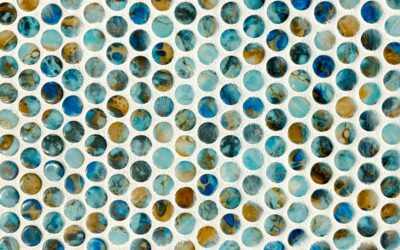
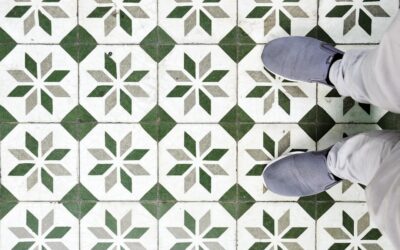
Designers reach for 1-inch tile when they want a floor or wall to read like a textile rather than a hard surface. The visual is delicate, the grout-to-tile ratio flips compared with large-format work, and the install demands a different toolkit. Whether you are spec’ing 1 tile for a shower floor, an accent backsplash, or a powder room feature wall, the buying decisions live in mosaic mesh quality, material choice, and grout chemistry rather than the tile face itself.
Part of our Tile & Grout guide — explore the full guide →
- What “1 Tile” Actually Means
- Why It Belongs on Shower Floors
- Material Choices
- The Grout Conversation Changes
- Mesh Quality Affects the Install
- Setting Standards
- Shower Pan Install Step-By-Step
- Where 1 Tile Does Not Belong
- Brand Lines to Consider
- Cost for a 16 Sq Ft Shower Floor
- Maintenance Reality
- The Final Word
What “1 Tile” Actually Means
The 1-inch category covers a surprising variety: 1-inch square mosaic, penny round (3/4 inch or 1 inch diameter), 1-by-2 mini brick, hex 1 inch, fish scale 1 inch, and the newer 1-inch dot trend. Most ship pre-assembled on 12-by-12-inch fiberglass mesh sheets, with 81 to 144 pieces per sheet depending on geometry. Pricing runs $7 to $24 per sq ft for porcelain and ceramic, $14 to $40 per sq ft for natural stone and glass.
Why It Belongs on Shower Floors
The grout lines between 1-inch tile create unmatched slip resistance. Even when individual tiles are slick, the dozens of grout joints per square foot give bare feet plenty of grip. A 1-inch porcelain hex with a matte finish typically clears DCOF 0.65 wet, well above the ANSI A137.1 0.42 wet minimum for showers. The small footprint also conforms to a sloped shower pan better than larger tiles, eliminating lippage at the slope transitions.
Material Choices
- Porcelain mosaic: 0.5 percent or less water absorption, PEI 4-5. $7 to $12 per sq ft.
- Ceramic mosaic: 3 to 7 percent absorption, walls and light residential floors only. $4 to $9 per sq ft.
- Glass mosaic: zero absorption, light-reflective, brittle. Walls and backsplashes only. $10 to $35 per sq ft.
- Marble penny round: porous, needs sealing every 18 months. $14 to $30 per sq ft.
- Slate mosaic: textured surface, excellent slip resistance, needs annual sealing. $9 to $18 per sq ft.
The Grout Conversation Changes
A single sq ft of 1-inch tile has roughly 6 to 8 linear feet of grout joint, compared with about 2 linear feet for 12-by-12 tile. That means you need 3 to 4 times the grout volume and your grout choice becomes 3 to 4 times more important. Cementitious grout will stain in showers and shows wear in high-traffic floors. For 1-inch tile, epoxy grout (Laticrete SpectraLOCK Pro Premium, Mapei Kerapoxy IEG CQ) is worth every extra dollar.
Budget $2 to $3 per sq ft for epoxy grout supply alone. The labor adds another $2 to $3 per sq ft because the small joints require careful float work.
Mesh Quality Affects the Install
Look at the back of the mosaic sheet. Cheap product uses a thick yellow paper backing that disintegrates when wet, leaving paper fibers in the thinset. Premium mosaics use a fiberglass mesh with dot-mount adhesive. The fiberglass should cover 30 to 40 percent of the back of each tile, no more. Too much mesh prevents thinset from bonding to the tile body and creates hollow spots that crack within a year.
Setting Standards
For floor mosaics, use a polymer-modified thinset rated ANSI A118.4 or higher. For shower walls and wet areas, push to A118.15 (improved bond) thinsets like Laticrete 254 Platinum or Mapei Ultraflex 3. Trowel the thinset with a 1/4-by-3/16-inch V-notch trowel, then flatten the ridges before setting the mosaic sheet. Beat the sheet in with a hard rubber float; do not use a beat block as it telegraphs through the small tiles.
Shower Pan Install Step-By-Step
- Build the shower pan with a sloped foam base (Schluter Kerdi-Shower-T) or a hot-mopped mortar bed at 1/4 inch per foot slope to the drain.
- Waterproof with sheet or liquid membrane. Water-test for 24 hours.
- Snap a centerline through the drain.
- Spread polymer-modified thinset starting at the perimeter. Work in 2-by-2 sections so the thinset does not skin over.
- Set mosaic sheets aligning to the centerline. Make small cuts at the perimeter with tile nippers or a small wet saw.
- Beat in with a rubber float, then check that all sheets are flush before the thinset sets.
- Wait 24 hours, clean the joints, and apply epoxy grout in 4-by-4 sections.
Where 1 Tile Does Not Belong
High-traffic main living areas. The grout-to-tile ratio means more cleaning, more wear, more potential for failure. Outdoor applications below freeze line, where individual tile bonds can pop in freeze-thaw cycles. Counter tops, where small joints trap food. Save the 1-inch product for shower floors, accent walls, backsplashes, powder room floors, and decorative borders.
Brand Lines to Consider
Daltile Keystones 1-inch hex porcelain at $8.99 per sq ft delivers a commercial workhorse. Marazzi Antique Memory penny round porcelain runs $10.49 per sq ft for a more decorative look. Walker Zanger Studio Moderne 1-inch ceramic mosaic sits in the design-tier at $24 per sq ft. Bedrosians Cloe ceramic 1-by-2-inch mini brick mosaic, popular for backsplash accents, comes in around $15 per sq ft.
Cost for a 16 Sq Ft Shower Floor
- Mid-range porcelain 1-inch hex mosaic: $9 per sq ft = $144
- Polymer-modified thinset: $35 for 1 bag
- Epoxy grout: $80 for 1 unit
- Schluter Kerdi pan and membrane: $200
- Pro install at $14 per sq ft (small tile premium): $224
Total: about $680 for a 16 sq ft shower floor done correctly. Worth every dollar in slip resistance and design feel.
Maintenance Reality
1 tile floors live or die by grout maintenance. Annual cleaning with a pH-neutral cleaner like Stonetech Klenz keeps cementitious grout looking new for years. Epoxy grout shrugs off household chemicals indefinitely. Either way, never use bleach or acidic cleaners that erode the grout binder. With basic care, a well-installed 1-inch tile shower floor lasts 25-plus years.
The Final Word
1 tile delivers visual depth, slip resistance, and design character that large-format tile cannot match. The install is fussier, the grout choice matters more, and the price per sq ft runs higher. For the right space, in the right room, with the right grout, the result is a floor or wall that announces craftsmanship every time you walk into the room.
Prefer to explore on your own?
See how new flooring looks in your actual room in seconds — free, no signup.
Try the free Floor Studio →