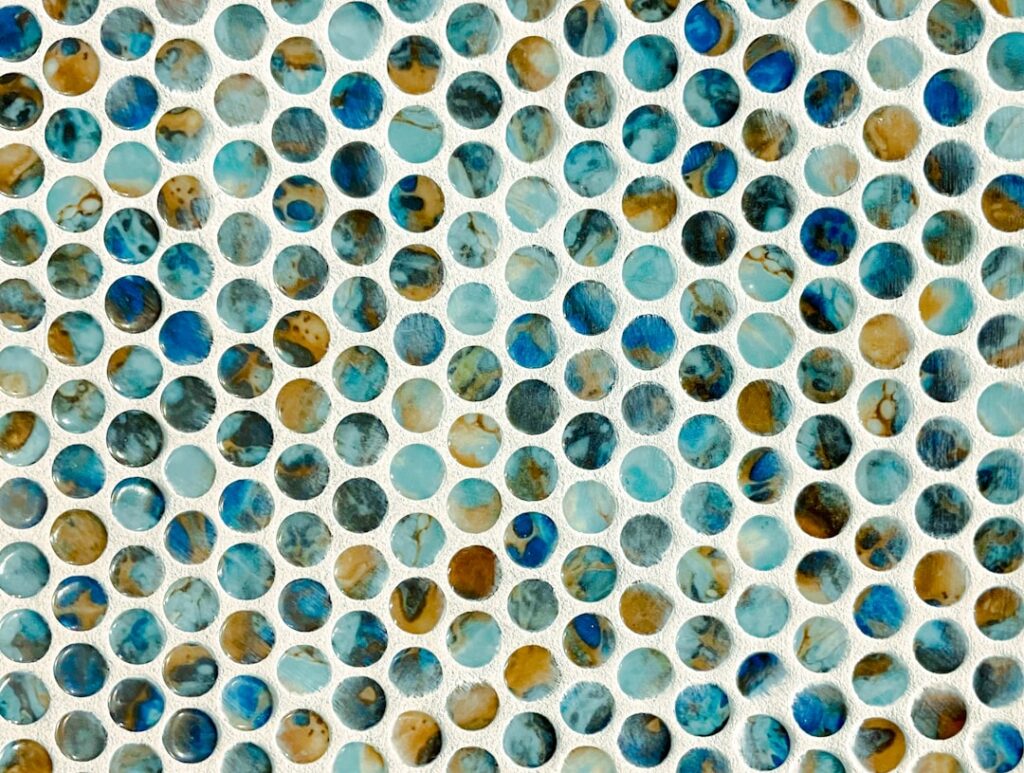
Named for the coin it resembles, this little round tile has bounced in and out of fashion for over a century, and it’s back in a big way. Penny mosaic tile gets its charm from those small circular pieces, typically 3/4 inch to 1 inch across, mounted on mesh sheets so you can set a whole square foot at a time. The result is a surface dense with grout lines, which reads as both vintage and surprisingly modern depending on the color and setting. I’ve laid it in old-house bathrooms to match the original 1920s look and in sleek new powder rooms where it feels fresh.
Part of our Tile & Grout guide — explore the full guide →
That abundance of grout lines is the whole story with penny tile. It’s what gives the tile its texture and grip, and it’s also what makes cleaning and grout choice more important than with any large-format tile.
What Penny Tile Is
Penny tile is a mosaic made of small round tiles, historically the size of a penny, arranged in a tight grid on a mesh or paper backing. Each 12-by-12-inch sheet holds well over a hundred individual rounds already spaced for you, which turns an otherwise impossibly tedious installation into a manageable one. The rounds don’t tessellate perfectly the way squares do, so the gaps between them create the signature dense grout pattern.
Because it’s a mosaic, penny tile follows curves and slopes better than rigid large tile, which is part of why it’s a favorite on shower floors that pitch toward a drain.
Materials You’ll Find
Penny rounds come in several materials, each with its own feel and price:
- Porcelain and ceramic: The most common and durable, available glazed in dozens of colors, and the easiest to maintain.
- Glass: Reflective and vivid, great for accents, though it needs unsanded grout to avoid scratching.
- Natural stone (marble, slate): Elegant and organic, but porous and requiring sealing.
- Matte vs. glossy porcelain: Matte hides water spots and adds floor grip; glossy pops on walls.
For floors, porcelain in a matte finish is my default. It’s tough, low-maintenance, and the many grout lines give it excellent traction underfoot.
Best Places to Use It
Penny tile has a few natural homes. Bathroom floors are the classic application, where the vintage look and the slip resistance from all those grout lines make it both charming and practical. Shower floors are ideal because the small mosaic conforms to the slope toward the drain, and the grout texture keeps bare feet from slipping. It also makes a striking backsplash, an accent border, or a laundry-room floor.
I’d be cautious using penny tile across a very large floor, since the grout maintenance scales up with the area. It’s most rewarding in a bathroom, mudroom, or accent zone rather than a whole open-plan level.
The Grout Question
Grout defines penny tile more than the tile color itself. Because there’s so much grout, its color dramatically changes the look. A contrasting grout, like dark gray with white rounds, emphasizes the polka-dot pattern for a graphic, retro effect. A matching grout blends the field into a softer, more uniform texture. White tile with white grout gives that timeless clean bathroom look, though white grout on a floor stains and needs sealing.
Use unsanded grout for the narrow joints typical of penny tile, and strongly consider an epoxy grout on floors and showers. Epoxy resists staining and never needs sealing, which is a real advantage given how much grout you’re dealing with.
Installation Tips
Setting penny tile rewards patience. Spread a smooth, even bed of white thinset with a 3/16-inch notched trowel, then flatten the ridges slightly so they don’t push up between the rounds. Press each sheet with a grout float to seat it evenly, and check that the spacing between sheets matches the spacing within them, or you’ll see a visible seam where sheets meet.
Back-buttering helps on glass and stone. Take extra care aligning the sheet edges, because misaligned seams are the most common and most visible penny tile mistake. Let thinset cure a full 24 hours before grouting.
Cleaning and Upkeep
The grout lines are where dirt collects, so regular cleaning keeps penny tile looking its best. Sweep or vacuum grit, then mop with a pH-neutral cleaner. A soft brush works grime out of the grout without wearing it down. If you used cement grout, seal it after installation and reseal annually; epoxy grout skips this step entirely.
On stone penny tile, seal the tile itself as well and avoid acidic cleaners that etch the surface. Glazed porcelain needs no sealing beyond the grout.
Color and Pattern Ideas
Penny tile is a blank canvas, and the design possibilities go far beyond a plain white floor. The most classic look is solid white rounds with a contrasting dark grout, which delivers that unmistakable early-1900s bathroom charm. Flip it for a modern take by using matte black penny tile with a light grout for a graphic, high-contrast floor that hides dirt well. Soft grays, greiges, and muted blues have become popular for a calmer, contemporary feel.
Because the tiles are small, you can create patterns and inlays that larger tile can’t manage. A common design move is a border or accent motif, like a simple stripe, a Greek key, or a scattered flower pattern, worked into a white field using individual colored rounds. Sheets often come pre-mixed in random multicolor blends, or you can order single colors and lay out your own pattern, though that dramatically increases labor. A single accent color set into a field of white makes a subtle, custom statement without much added cost.
Blends and gradients are another way to add depth. Some manufacturers offer sheets that mix two or three tonal shades, giving the floor a soft, dappled texture rather than a flat color. For a shower or a small powder room, a marble or stone penny blend in creams and grays reads luxurious and organic. If you want vintage authenticity in an older home, hexagon and penny rounds in white with a thin black border strip echo the original tilework almost exactly. Whatever direction you choose, remember that grout color will dominate the finished look, so decide on the tile and grout combination together rather than treating grout as an afterthought.
What It Costs
Penny tile is reasonably priced for a mosaic. Porcelain and ceramic penny sheets run $6 to $15 per square foot, glass climbs to $15 to $30, and natural stone lands at $12 to $35. Installation adds $10 to $20 per square foot, and because setting mosaic and aligning seams takes skill and time, labor can be higher than for large tile. A small 40-square-foot bathroom floor typically comes to $650 to $1,400 installed.
For the money, penny mosaic tile delivers a distinctive, high-texture look with genuine slip resistance. Choose porcelain and epoxy grout for the lowest upkeep, mind your seam alignment during installation, and you’ll have a floor with real character that holds up for decades.
Prefer to explore on your own?
See how new flooring looks in your actual room in seconds — free, no signup.
Try the free Floor Studio →