
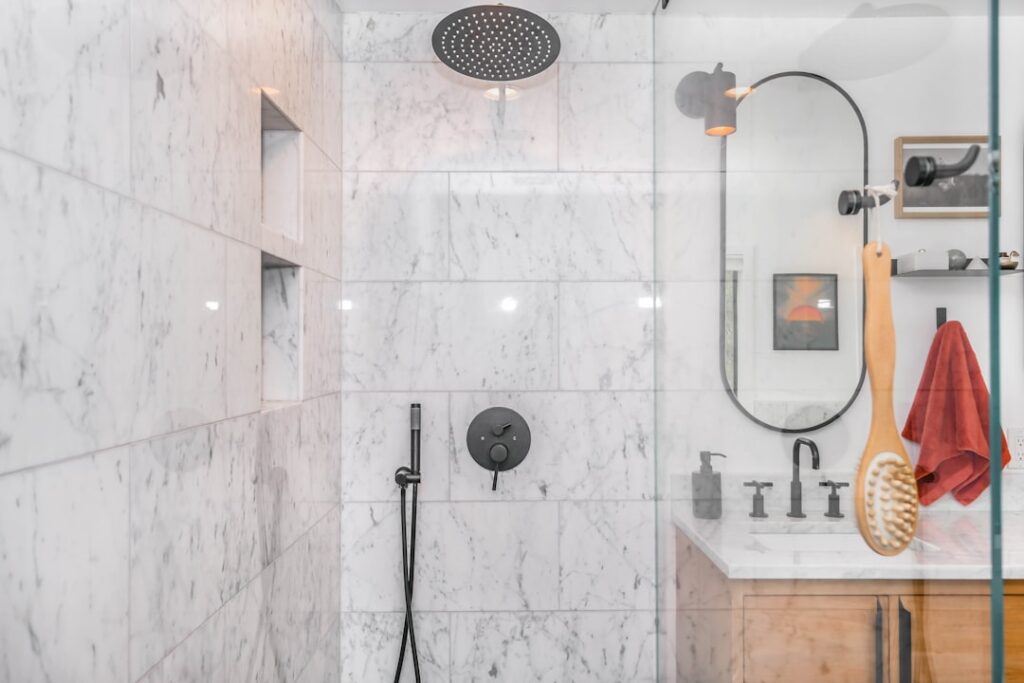
Tile does not waterproof a shower, but the right tile makes everything behind it last longer and look better doing it. Porcelain tile for shower walls is the default recommendation from most tile professionals because it absorbs less than 0.5 percent of its weight in water, shrugs off daily soaking, and never needs sealing the way natural stone does. It also costs barely more than standard ceramic anymore, with solid options starting around $3 per square foot. This guide covers why porcelain earns that recommendation, which sizes and finishes work best in a shower, what has to go behind the tile, and what the whole project realistically costs.
Part of our Bathroom Remodeling & Flooring guide — explore the full guide →
Why Porcelain Beats the Alternatives in a Shower
Porcelain is ceramic’s denser sibling: finer clays fired at higher temperatures, producing a vitreous body that water essentially cannot penetrate. The ANSI standard for porcelain requires water absorption of 0.5 percent or less, versus 3 to 7 percent or more for ordinary wall ceramic. In a shower that gets hit with 15,000 gallons of water a year, that density pays off in several ways:
- Dimensional stability: porcelain barely expands or contracts with moisture and temperature swings, so grout joints stay tighter.
- Stain and chemical resistance: glazed porcelain ignores hard water minerals, soap scum removers, and most cleaners.
- No sealing, ever: unlike marble or travertine, which need penetrating sealer every year or two, glazed porcelain is maintenance-free apart from cleaning.
- Durability: the glaze on quality porcelain resists scratching from shower caddies, razors, and cleaning brushes better than soft ceramic glazes.
Standard ceramic still works on shower walls and saves a little money, but the price gap has narrowed enough that porcelain is usually worth it. Natural stone looks spectacular and costs you a sealing routine plus stricter cleaning rules for the life of the shower.
Best Sizes and Formats for Shower Walls
Large-format tile dominates modern shower design for a practical reason: fewer grout lines mean less cleaning and fewer places for mildew to take hold. The workhorse size is 12×24 inches, usually set in a horizontal stacked or offset pattern. Going bigger, 24×48 and slab-look panels create a nearly seamless look but demand a very flat wall (within 1/8 inch over 10 feet) and an experienced setter. A few sizing guidelines:
- 12×24 and 24×24: the sweet spot for most showers; manageable weight, contemporary look, forgiving availability.
- 3×6 and 4×12 subway: classic, cheap to buy, more expensive in labor per foot because of the joint count.
- Offset patterns: keep the offset to one-third rather than 50 percent on large format, since long tiles bow slightly in firing and a half offset amplifies lippage.
- Shower floors: if the same porcelain line offers a 2×2 mosaic, use it on the pan; small tiles follow the slope and the extra grout lines add slip resistance.
Finish matters too. Glossy glaze brightens small bathrooms and wipes clean easily; matte hides water spots better. Textured “structured” finishes belong on floors, not walls, where they just collect soap film.
Waterproofing: What Has to Go Behind the Tile
Here is the point that saves showers: grout and porcelain slow water down, they do not stop it. Vapor and some liquid water will reach whatever is behind the tile, so the wall assembly itself must be waterproof. Never tile over bare drywall or greenboard in a shower. The accepted systems are:
- Cement backer board plus liquid membrane: screw down 1/2 inch cement board, tape the seams with alkali-resistant mesh and thinset, then roll on two coats of a liquid-applied membrane like RedGard or Hydro Ban ($50 to $90 per gallon, roughly 50 square feet per gallon at two coats).
- Foam board systems: Wedi or GoBoard panels are waterproof cores that just need sealed seams and fastener spots; lighter and faster than cement board, at a higher material price.
- Sheet membranes: Schluter Kerdi bonded over drywall or backer board creates a continuous waterproof layer with banded seams; a full tub-surround Kerdi kit runs $300 to $500.
Whichever route you take, waterproofing must integrate with the pan or tub flange and any niche, and inside corners and the tub joint get flexible sealant, not grout.
Installation Details That Separate Good from Bad
Porcelain’s density makes it harder to bond, so use a polymer-modified thinset rated for porcelain (ANSI A118.4 or better), never mastic in a shower. Back-butter large-format tile and aim for 95 percent mortar coverage in wet areas; hollow spots become cracked tiles and mildew pockets. Use a 1/2 inch square-notch trowel for 12×24 tile, leveling clips to control lippage, and 1/8 to 3/16 inch joints unless the tile is rectified, which allows 1/16 inch. Plan the layout so cut tiles land in the least visible corner and the row meeting the ceiling is more than half a tile tall. Cutting porcelain requires a wet saw with a quality diamond blade; snap cutters struggle above entry-level thickness, and hole saws for the valve need diamond grit.
Grout and Long-Term Maintenance
High-performance cement grout with a consistent-color formula (Mapei Ultracolor Plus FA, Custom Prism) resists most staining and costs $20 to $35 a bag. Epoxy or single-component grouts like Spectralock or Fusion Pro cost two to three times more but never need sealing and hold color in showers exceptionally well; they are worth the upgrade on a shower you plan to keep 20 years. Afterward, maintenance is squeegeeing the walls after showers, running the exhaust fan for 20 minutes, and cleaning with a pH-neutral cleaner. Avoid oil-based “shine” products that build film on the glaze.
What It Costs
Porcelain wall tile itself runs $3 to $15 per square foot for most quality lines, with designer and slab-look panels above that. Professional installation of a tub surround or shower, including backer board and waterproofing, typically lands at $10 to $25 per square foot of labor, so a standard 60 to 90 square foot tub surround totals roughly $1,200 to $3,500 installed, and full walk-in showers with a tiled pan and niche commonly reach $3,500 to $7,500. DIYers can bring a surround in for $500 to $1,200 in materials, but the waterproofing is the part you cannot get wrong, so study the specific system’s instructions before committing.
The Bottom Line
Choosing porcelain tile for shower walls gets you the most durable, lowest-maintenance wet-area surface per dollar: near-zero absorption, no sealing schedule, and glaze that stands up to decades of cleaning. Put your attention and budget on what is behind it, a genuine waterproofing system, proper thinset coverage, and a quality grout, and a porcelain shower will still look sharp when the rest of the bathroom is ready for its next remodel.
Prefer to explore on your own?
See how new flooring looks in your actual room in seconds — free, no signup.
Try the free Floor Studio →

