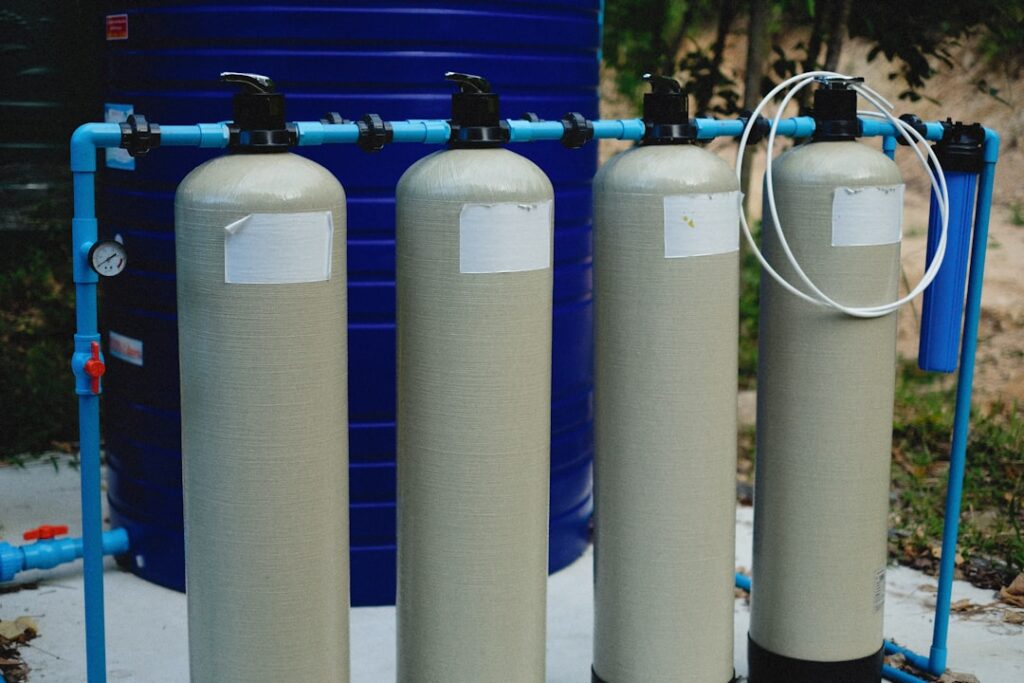
If you live full-time in an RV, keep a boat at a hard-water marina, or rent an apartment where you can’t touch the plumbing, a portable water softener solves the spotty-dishes, crusty-showerhead, film-in-the-tub problem without a permanent install. It’s a compact resin tank you hook to your incoming water line, and when it’s used up you recharge it with ordinary table salt in your driveway. No electricity, no drain plumbing, no landlord conversation.
- What a Portable Softener Actually Does
- Typical Size and Capacity
- Flow Rate You Can Expect
- What It Costs
- Manual Regeneration With Table Salt
- Who Should Buy One
- Portable vs. Whole-House: Know the Trade-Offs
- Installation Is Genuinely Plug-and-Play
- Single-Tank vs. Dual-Tank Units
- Care and Storage Between Trips
- The Bottom Line
What a Portable Softener Actually Does
Hard water is loaded with dissolved calcium and magnesium. A portable water softener runs that water through a bed of resin beads that grab the calcium and magnesium and swap in sodium — the same ion-exchange process a full house system uses, just shrunk down. The result is soft water that lathers easily, rinses clean, and stops the white scale that eats water heaters and clogs RV fixtures.
The key difference from a whole-house unit is size and power. A portable has no electric timer, no motorized valve, and no dedicated floor drain. You regenerate it by hand when the capacity runs out, which for most units is a five-minute job.
Typical Size and Capacity
These units are built to sit in tight spaces. A common single-tank portable is roughly 10 inches in diameter and 18 to 22 inches tall, weighing 9 to 12 pounds empty. Grain capacity typically runs around 8,000 grains for the smallest units up to 16,000 grains for the popular mid-size models, with dual-tank units reaching 32,000 grains for bigger rigs or two people who shower daily.
Here’s how capacity translates to real use. Take your water’s hardness in grains per gallon (a hardness test strip tells you — many campground and city supplies run 10–25 GPG). Divide the unit’s grain capacity by that number to get gallons between recharges. A 16,000-grain unit on 15 GPG water gives you roughly 1,000 gallons before it needs salt — that’s often one to two weeks for a couple in an RV.
Flow Rate You Can Expect
Portable softeners deliver about 3 to 4 GPM, which is plenty for an RV shower, a galley sink, and an ice maker. You won’t run a whole house on one, and if you open two fixtures wide at once you may notice a slight pressure drop. For a single bathroom and a kitchen, flow is a non-issue. The units are rated to around 100 PSI, well above the 40–60 PSI most campground and city hookups supply.
What It Costs
This is one of the best value upgrades in the RV and marine world. Expect these prices:
- 8,000-grain compact units: $120–$180. Good for a solo traveler or occasional use.
- 16,000-grain mid-size units: $150–$250. The sweet spot for most RVers and boaters — On The Go and Watts brands dominate here.
- 32,000-grain dual-tank units: $280–$350. For big fifth-wheels, two-person full-timers, or harder water.
Add a few dollars a month for salt and you’re done. There’s no filter cartridge to replace and no power draw, so ongoing cost is genuinely just salt.
Manual Regeneration With Table Salt
This is what makes a portable so practical — you don’t need special softener salt pellets. Plain table salt or granulated food-grade salt works because it dissolves fast. Here’s the routine when your water starts feeling “hard” again (spotty dishes, weak lather):
- Disconnect the unit from your water hookup and take off the top cap.
- Pour in the salt. A 16,000-grain unit typically takes about 2 pounds — roughly two cups of table salt. Check your model’s label for the exact amount.
- Add a little water if the instructions call for it, reseat the cap, and let it sit for the brine to soak the resin — usually 20 to 30 minutes.
- Slow-rinse. Reconnect and run water through at a trickle for 10 to 15 minutes to flush the brine and displaced hardness out the outlet. Run it to a drain or onto gravel, not your fresh tank.
- Back in service. Once the water runs clear and tastes salt-free, hook it back to your rig.
Start to finish, regeneration takes about 30 to 45 minutes, most of it hands-off soak time. Your actual effort is maybe five minutes.
Who Should Buy One
A portable water softener is the right call for several groups:
- RVers and full-timers moving between campgrounds with wildly different water quality. Soft water protects your water heater, faucets, and the seals in your rig.
- Boat owners at marinas with hard dock water, especially for washdowns that would otherwise spot the gelcoat.
- Renters and apartment dwellers who can’t install a permanent system but want soft water at the kitchen or bathroom.
- Small homes and tiny houses where a full 40,000-grain cabinet system is overkill.
Portable vs. Whole-House: Know the Trade-Offs
A portable water softener is not trying to replace a 40,000-grain cabinet system, and it’s important to buy it for what it is. The whole-house unit regenerates itself automatically on a timer or meter, handles 10 to 15 GPM for multiple bathrooms at once, and never asks you to lift a bag of salt more than once a month. A portable trades all of that convenience for the ability to move, to skip installation, and to work where you can’t touch the plumbing. If you own a stick-built home and hate the manual recharge, a permanent system is the better tool. If you move, rent, or float, the portable wins because the permanent system simply can’t go where you go.
There’s also a middle path some people miss: keep a portable as a backup or a dedicated softener for a single appliance, like a tankless water heater or an ice machine, even in a house with hard water you’re not ready to fully treat. It’s a cheap way to protect one expensive appliance from scale.
Installation Is Genuinely Plug-and-Play
Most units have standard garden-hose threads on the inlet and outlet. For an RV, connect your city water hose to the softener inlet and a short hose from the outlet to your rig’s city water connection. Add an inline sediment filter ahead of it if the source water is dirty — grit shortens resin life. That’s the whole install: two hose connections and you’re softening water in under five minutes.
Single-Tank vs. Dual-Tank Units
Most portables are single-tank, which means when the resin is exhausted you have hard water until you regenerate. That’s fine if you can spare 30 minutes and don’t mind planning around it. Dual-tank units switch automatically to a second resin bed when the first runs out, so you never lose soft water mid-shower. They cost more and weigh more — a 32,000-grain dual unit can hit 25 pounds empty — but for a two-person full-time rig where an interrupted shower is a real annoyance, the extra capacity and continuity are worth it. For weekend use or a solo traveler, a single 16,000-grain tank is plenty.
Care and Storage Between Trips
Resin doesn’t like to dry out completely or freeze. If you’re storing a portable water softener over winter, keep a little water in it and stash it somewhere above freezing — a frozen resin bed can crack the tank. For long storage, some owners run a sanitizing rinse to keep bacteria from growing in the damp resin. Before the first trip of the season, do a fresh regeneration to wake the resin back up. Treated right, the resin bed lasts 5 to 10 years before it loses enough capacity to warrant a rebed, and rebed kits run $30 to $50.
The Bottom Line
For $150 to $350 you get soft water anywhere you can connect a hose, with no electricity, no plumbing, and no drain line. Match the grain capacity to your water hardness and household size, keep a box of table salt on hand, and spend five minutes recharging it every week or two. For anyone living or traveling outside a permanently plumbed home, a portable water softener is one of the smartest small investments you can make.