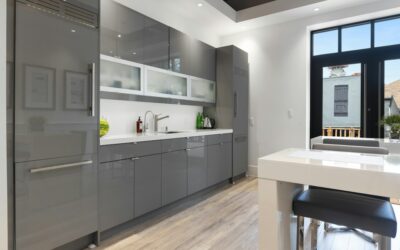
If you have shopped for a kitchen in the last decade, you have looked at recessed panel cabinet doors whether you knew the term or not. That clean door with a flat center that sits lower than the frame around it — that is a recessed panel. It is the quiet workhorse of modern American kitchens, and the Shaker door everyone talks about is simply its most famous member.
Part of our Kitchen Remodeling guide — explore the full guide →
Here is what they actually are, how they are built, and where they fit best.
What Makes a Panel “Recessed”
The name describes the geometry. On a recessed panel door, the center panel is set back — recessed — behind the plane of the surrounding frame. Run your hand across one and you feel a step down into the flat center, then a step back up to the outer rails and stiles. Compare that to a raised panel door, where the center is carved so it bulges forward, often with decorative profiles. Recessed reads calm and flat; raised reads traditional and busy.
Because that center sits flat and low, these doors photograph clean and pair with almost any hardware. That visual simplicity is the whole reason they took over.
Shaker Doors Are a Recessed Panel Subtype
People use “Shaker” and “recessed panel” interchangeably, but Shaker is one specific style within the family. A true Shaker door has square, unadorned inside edges with no decorative bead or ogee where the frame meets the panel. It is the most minimal recessed door you can buy, rooted in the plain, functional furniture of the Shaker religious communities.
Other recessed panels dress up that inner edge with a small routed profile — a bead, a cove, or a step. Those variations lean transitional or traditional while keeping the flat-panel core. So every Shaker is a recessed panel, but not every recessed panel is a Shaker.
Five-Piece Construction Explained
Most quality recessed doors are built the same way, and it is worth understanding because it affects durability and price. The classic method is called five-piece construction:
- Two stiles — the vertical side pieces of the frame.
- Two rails — the horizontal top and bottom pieces.
- One center panel — the flat middle that floats in a groove cut into the frame.
The panel floats on purpose. It is not glued tight, so it can expand and contract with humidity without cracking the joints. That is the mark of a well-made wood door. Cheaper doors skip this — a one-piece MDF slab routed to look like a Shaker is technically a single piece of board, which is fine for painted cabinets but not the same animal.
Recessed vs Raised Panel: Which to Choose
This question comes up constantly, so here is the honest breakdown.
- Style direction — Recessed suits modern, transitional, farmhouse, and contemporary kitchens. Raised panel leans classic, formal, and traditional.
- Cleaning — Recessed doors have fewer curves and grooves to trap grease and dust. The one detail to watch is the inside corner of the recess, which needs an occasional wipe. Raised panels have more nooks around the carved profile.
- Resale — Recessed and Shaker doors are the safer bet right now. They read current to almost every buyer, while ornate raised panels can date a kitchen.
- Cost — Recessed is usually a touch cheaper because the panel machining is simpler.
Materials and Finishes
Recessed panel doors come in several material grades, and the choice drives both look and budget. Solid wood frames with a veneered or solid center take stain beautifully, so if you want visible oak, maple, or walnut grain, go this route. For painted kitchens, MDF is often the smarter buy — it has no grain to telegraph through paint and stays dead flat, which is why so many painted Shaker doors are MDF.
On finish, painted white and off-white still dominate, but soft greens, muted blues, and warm greige are increasingly popular. A satin or semi-gloss enamel wears best on these doors because the flat panel wipes clean without highlighting brush texture.
Cleaning and Everyday Upkeep
The flat face of a recessed door is genuinely easy to keep clean, which is a big part of the appeal in a working kitchen. A damp microfiber cloth and a little mild dish soap handle most grease and fingerprints. The spot that needs attention is the inside corner where the recessed panel meets the frame — grease-laden dust collects in that groove over months, especially near the stove. An old toothbrush or a cloth wrapped over a butter knife clears it out in seconds.
Skip the abrasive scrubbing pads and harsh degreasers on painted or finished doors. They dull the sheen and, over time, cut through the finish at the edges where you touch the door most. If you have painted Shaker doors, keep a little touch-up enamel on hand — the bottom rail near the pulls is the first place to show wear, and a quick dab keeps them looking new for years.
Hardware That Suits the Style
Because the door itself is so simple, hardware does a lot of the talking on a recessed panel kitchen. That is a gift — you can shift the entire feel of the room by swapping pulls. A few reliable pairings:
- Bar or bin pulls — Clean, linear hardware reinforces the modern and transitional read most people are after.
- Round knobs — Simple knobs on the uppers with pulls on the drawers keep a farmhouse or cottage kitchen soft.
- Matte black or brass — Both finishes pop against a painted Shaker door and let you set a warm or crisp tone without touching the cabinets.
Mounting position matters on these doors. On a five-piece door, set knobs in the corner of the stile and rail, not floating out on the panel, so the hardware reads intentional and lines up cleanly across the run.
What Recessed Panel Doors Cost
Pricing swings hard with material and whether you are buying doors alone or full cabinets. Rough numbers from recent jobs:
- Replacement doors only — Painted MDF Shaker doors run about $30 to $80 per door; solid wood stained doors run $70 to $200-plus depending on species.
- Full stock cabinets — A modest recessed-panel kitchen in stock cabinetry might land at $5,000 to $12,000 installed.
- Semi-custom and custom — Expect $15,000 to $35,000 and up once you are choosing exact sizes, species, and finishes.
One cost-saver worth knowing: because recessed panels are so widely produced, replacement doors are easy to source in standard sizes, and manufacturers turn painted Shaker doors around quickly. That availability keeps prices competitive and makes a partial update — say, swapping just the doors on an island or a run of base cabinets — realistic on a modest budget.
If your boxes are solid and only the doors look tired, a door-and-drawer-front swap — sometimes called refacing — gets you brand-new recessed panels for a fraction of a full replacement.
Why They Dominate Modern Kitchens
Trends come and go, but recessed panel cabinet doors have stayed on top for a simple reason: they are the neutral that goes with everything. Pair them with brass pulls and they read warm and transitional. Hang them with matte black hardware and slab counters and they go fully modern. Paint them a soft sage and they turn cottage-cozy.
There is also a practical reason designers keep coming back to them. A flat panel forgives an imperfect wall and an out-of-square room better than a fussy raised profile does, and it pairs with any countertop from butcher block to honed marble to a bold quartz. When a kitchen has to appeal to future buyers as well as the current owner, that neutrality is worth real money at resale.
That flexibility, plus the easy cleaning and honest construction, is why recessed panel cabinet doors suit so many kitchens. They are the safe choice that rarely feels like a compromise, and years from now they will still look like a decision made on purpose rather than a trend you got talked into.