A remote blower range hood moves the fan motor away from the cooking area, but it does not make the entire ventilation system silent. Air rushing through a restrictive duct, vibration crossing framing, and turbulence at the hood can remain plainly audible even when the motor sits in an attic, on an exterior wall, or on the roof.
Part of our Kitchen Remodeling guide — explore the full guide →
The useful decision is not simply where to buy the blower. It is whether the hood, blower, duct, controls, discharge point, and available service route can operate as one documented system. Resolve that path before cabinets, ceilings, or decorative covers make the difficult parts unreachable.
- What a Remote Blower Range Hood Changes
- Determine Where the Blower Actually Lives
- Let the Duct Route Control the Design
- Separate Motor Noise From Airflow Noise
- Match Capture, Air Supply, and Controls as One System
- Reserve Service Access Before Finishes Close
- Coordinate Structure, Weatherproofing, and Discharge
- Approve the System Only When Every Part Is Documented
What a Remote Blower Range Hood Changes
A remote blower range hood moves the motor out of the hood canopy and into the duct run or onto an exterior wall or roof. The visible hood becomes a capture shell only, which is why kitchens choose this layout mainly to cut perceived noise at the cooktop.
Airflow planning does not change. Residential capture commonly needs about 300 to 600 CFM, and wide or high-output cooktops can call for 600 to 1200 CFM or more, sized to the equipment rather than a guess. Many codes require dedicated makeup air once exhaust passes roughly 400 CFM, and the duct is typically 6 to 10 inches to keep static pressure and noise down. Confirm the blower rating, duct size, and makeup-air trigger for your exact setup before committing to the run.
Determine Where the Blower Actually Lives
“Remote” describes distance from the hood, not one universal product arrangement. An inline blower sits within the duct run, often in an attic or another accessible utility area. An exterior blower mounts at the wall or roof termination. Product terminology varies, so confirm the location, permitted orientation, environmental limits, and compatible hood controls in the exact installation documents.
Start with a section drawing from the cooking surface to the outdoors. Mark the hood, duct route, framing, insulation, access doors, discharge point, electrical connection, and every location where a technician would need to release fasteners or remove a component. A blower that fits between joists but cannot be removed without cutting the ceiling is not truly serviceable.
Location changes the kind of noise you manage. An attic unit may place the motor farther from the cook but closer to a bedroom ceiling. A wall-mounted unit can transmit vibration into siding or framing. A roof unit adds weather exposure and roof-access concerns. Compare the whole path, not just the straight-line distance from the stove.
Let the Duct Route Control the Design
A remote blower cannot compensate for a duct route that the selected equipment does not permit. Use the duct material, diameter, maximum equivalent length, transition shape, and termination specified by the hood and blower manufacturer. Equivalent length accounts for the extra resistance created by elbows and fittings; a short route with several abrupt turns can behave like a much longer straight run.
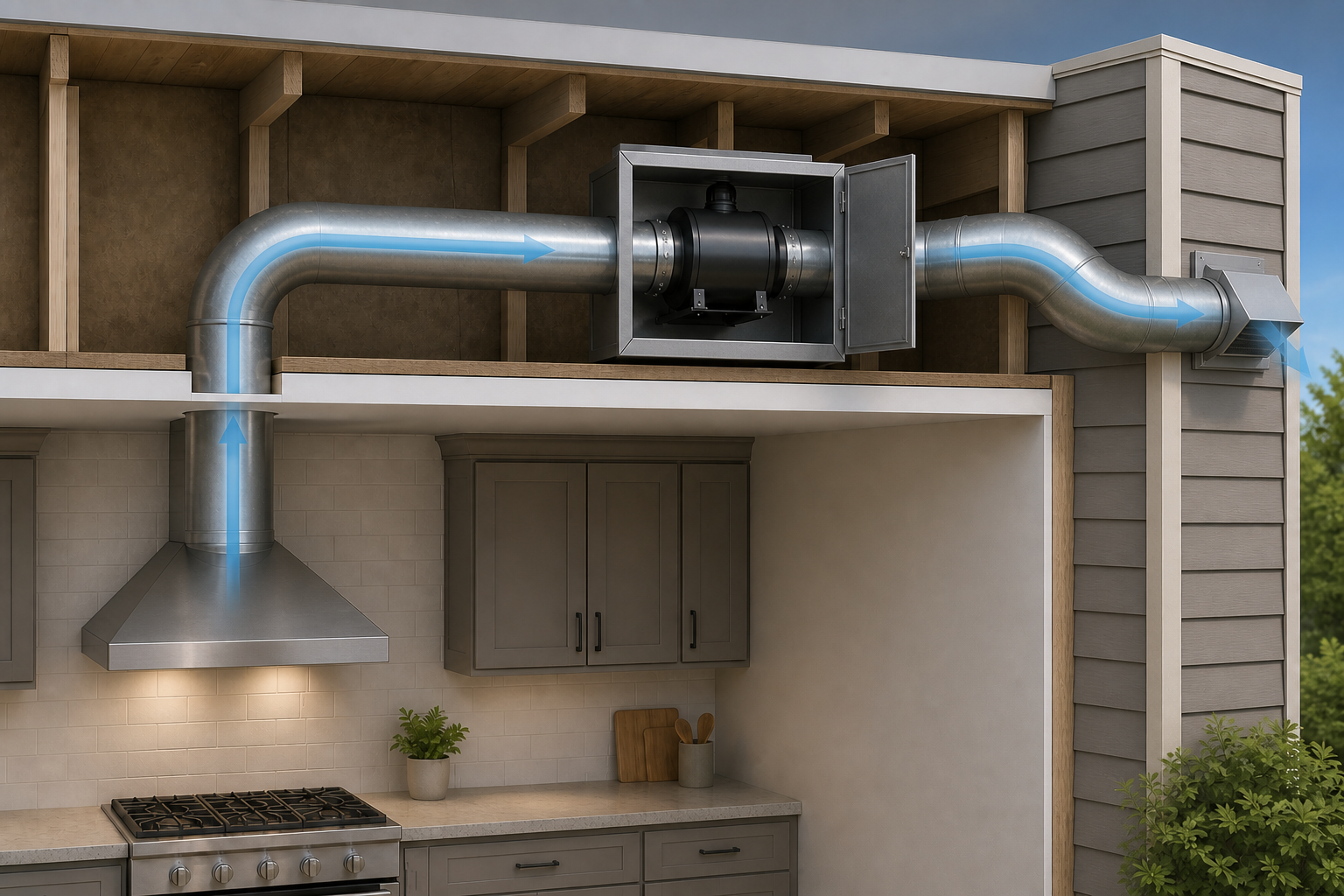
Favor a direct path with smooth interior surfaces and gradual transitions where the listed system allows them. Avoid crushing a round duct into a narrow ceiling cavity or reducing its size merely to clear framing. Those compromises increase air speed and turbulence, which can raise noise while reducing actual airflow at the hood.
Condensation and grease also influence routing. Duct sections should be arranged as the manufacturer directs so residue does not collect in an unintended low point or drain toward an electrical component. Where the route crosses an unconditioned space, the project team should resolve insulation and condensation control for the local climate and assembly. Do not wrap or conceal the duct until required inspections and leakage checks are complete.
| Blower location | Planning advantage | Condition to resolve |
|---|---|---|
| Accessible inline space | Motor is separated from kitchen | Working clearance and vibration isolation |
| Exterior wall | Short discharge may be possible | Weather exposure and wall transmission |
| Roof | Keeps motor outside living space | Roof flashing, access, and outdoor rating |
Do not choose a blower location until a qualified installer has checked structure and the complete duct route. Cutting or drilling structural members requires specific approval, and concealed combustible construction can impose constraints that a floor plan does not show. The cleanest-looking line on paper is not automatically a permitted route.
Separate Motor Noise From Airflow Noise
Range-hood sound comes from several places. The motor and fan create mechanical sound. Moving air creates hiss and roar at filters, transitions, elbows, and the discharge cap. Loose metal can rattle, while rigid connections may carry vibration into cabinets, drywall, or roof framing. Relocating the motor addresses only the first source.
Listen for the type of failure you are trying to prevent. A low hum that seems to come through a wall points toward structure-borne vibration. A sharp rush at the hood often points toward velocity or restriction. Pulsing, fluttering, or a damper that chatters may indicate an airflow or termination problem. Diagnosis belongs to a qualified ventilation technician, but describing the sound accurately makes the service call more useful.
Higher advertised airflow is not a substitute for a coordinated design. The usable result depends on the installed duct resistance and the blower’s documented performance with the chosen hood. Ask for performance information at realistic system resistance rather than comparing only a maximum free-air number.
Set a realistic sound goal for adjacent rooms as well as the kitchen. Stand where bedrooms, offices, and outdoor seating lie relative to the proposed blower, duct, and termination. Framing cavities and hard exterior surfaces can carry or reflect sound in unexpected directions. When quiet operation is a priority, ask the project team how vibration connections, mounting surfaces, and discharge placement will be evaluated before equipment is concealed.
Match Capture, Air Supply, and Controls as One System
The hood still has to capture the plume before the remote blower can move it outdoors. Hood geometry, mounting position, cooking appliance, heat output, and cooking style all affect capture. Follow the appliance and hood manufacturers’ required dimensions and compatibility information; do not substitute a generic mounting-height rule for the exact documents.
A powerful exhaust system can also affect pressure inside the house. The need for replacement air, interlocks, or other provisions depends on equipment, building tightness, other combustion appliances, and locally adopted requirements. A qualified HVAC professional should assess ventilation and air balance, while a licensed electrician handles the specified power, disconnecting means, controls, and local electrical compliance.
Confirm that the hood control is designed to operate the selected remote blower. Speed controls, relays, and wiring arrangements are not interchangeable merely because plugs or wire colors appear similar. If the system includes automatic operation, verify how it behaves after a power interruption and how a technician can shut it down safely for service.
Reserve Service Access Before Finishes Close
Filters, grease paths, dampers, electrical enclosures, and the blower itself need different kinds of access. The kitchen user should be able to remove and clean the range hood filters without tools or dismantling decorative trim. A technician needs safe working room at concealed mechanical and electrical components, not a small inspection hole several feet away.
Decorative construction can quietly defeat this plan. A custom range hood cover may conceal transitions and controls, but it should not trap heat, block specified ventilation openings, or turn routine inspection into demolition. Coordinate removable panels and fasteners with the hood’s required clearances and service instructions.
Think through replacement as well as maintenance. Motors, control modules, dampers, and duct connections do not last forever. Before approving the framing, ask how the largest serviceable component leaves its space. If the answer involves removing stone, cabinets, roofing, or a finished ceiling, revise the access strategy.
Coordinate Structure, Weatherproofing, and Discharge
Exterior equipment and penetrations cross several trades. A roof-mounted blower needs a support and flashing approach compatible with the roofing assembly, plus safe future access. A wall-mounted blower needs a weather-resistive connection that manages bulk water without blocking required drainage. These details should be designed by the appropriate roofing, building-envelope, and structural professionals rather than improvised around the appliance.
Place the discharge where exhausted grease, odor, and moisture will not be drawn straight into an operable window or another intake. Required separation distances and acceptable termination locations vary by product and jurisdiction. Confirm the exact instructions and locally adopted requirements before the opening is made.
Use a preconstruction coordination check:
- The hood and blower are documented as compatible components.
- The entire duct route follows the specified size, material, fittings, and length limits.
- The blower and every connection remain safely accessible.
- Structure, insulation, weather control, and exterior discharge have been reviewed.
- HVAC and electrical professionals have resolved air balance, controls, and power.
If an existing system is noisy or weak, do not assume a larger remote motor is the cure. A proper range hood repair assessment should distinguish motor trouble from blocked filters, a stuck damper, control faults, duct restrictions, or poor capture geometry.
Approve the System Only When Every Part Is Documented
A good remote-blower plan can move the strongest mechanical sound away from conversation and cooking, but distance alone does not guarantee quiet or effective capture. Approve the layout when the manufacturer confirms component compatibility, the duct route is within stated limits, and service access is practical without damaging finished work.
The final field check is simple: trace the system from the cooking plume to the outdoor termination and name who can reach every component along the way. If the route depends on an unverified control, a squeezed duct, inaccessible equipment, or an improvised roof or wall penetration, stop before finishes close. A remote blower range hood works best when it is treated as a complete ventilation system, not a motor placed out of sight.