A National Kitchen and Bath Association survey put the median 2025 spend at $42,800 for a midrange kitchen remodel and $84,200 for a higher-end one. Renovating a kitchen is the most expensive remodel most homeowners ever take on, and the projects that go over budget almost always blow up in the same three places — electrical, plumbing rough-in, and surprise structural work behind old cabinets. This guide walks the realistic path from first sketch to punch list so you don’t add yours to the cautionary statistics.
Part of our Kitchen Remodeling guide — explore the full guide →
- Set the Budget Before the Pinterest Board
- Realistic Timeline From Demo to Cleanup
- Cabinets: Where the Budget Goes
- Countertops: Material vs Maintenance
- Flooring Choices That Survive a Kitchen
- Electrical and Plumbing You’ll Need to Upgrade
- Where to Save and Where to Spend
- Permits, Inspections, and the GC Question
- Pulling It All Together
Set the Budget Before the Pinterest Board
Industry rule of thumb says a kitchen remodel should land between 5 and 15 percent of your home’s value. Spend less and you’ll cut corners; spend more and you won’t recoup it at resale. For a $400,000 home, that’s $20,000 to $60,000. Cabinets typically eat 35 to 40 percent of the budget, labor 20 to 25 percent, counters 10 to 15 percent, appliances 10 to 15 percent, and the remainder splits across flooring, lighting, plumbing fixtures, and finish work.
Reserve 15 to 20 percent for contingencies, not the 10 percent that most articles quote. Behind every old kitchen lurks at least one surprise — undersized electrical service, galvanized pipe corroded inside the walls, subfloor rot under the dishwasher, or insufficient framing to hang the upper cabinets you picked. None of those show up until demo day.
Realistic Timeline From Demo to Cleanup
A full gut renovation runs 8 to 14 weeks from the day demo starts. Demo and disposal take three to five days. Rough electrical, plumbing, and HVAC stretch one to two weeks, including inspections. Drywall and paint primer add another week. Flooring goes in next, then cabinets (which often require a two-week lead time even after delivery for the install crew’s schedule). Counter templating happens after cabinets are anchored; fabrication and install run two to four weeks. Final electrical, plumbing trim, backsplash tile, appliances, and punch list close out the project.
The phase that derails timelines is countertops. Slab selection, templating, fabrication, and install can’t happen until cabinets are fixed in place, and any change order on cabinet layout pushes the counter date back by two to three weeks.
Cabinets: Where the Budget Goes
Three quality tiers exist regardless of brand. Stock cabinets ship in standard sizes, ready to install, and run $80 to $200 per linear foot. Semi-custom adjust depths, widths in 3-inch increments, and door styles for $150 to $400 per linear foot. Full custom builds to exact spec at $500 to $1,200 per linear foot, with millwork and finish options unavailable anywhere else.
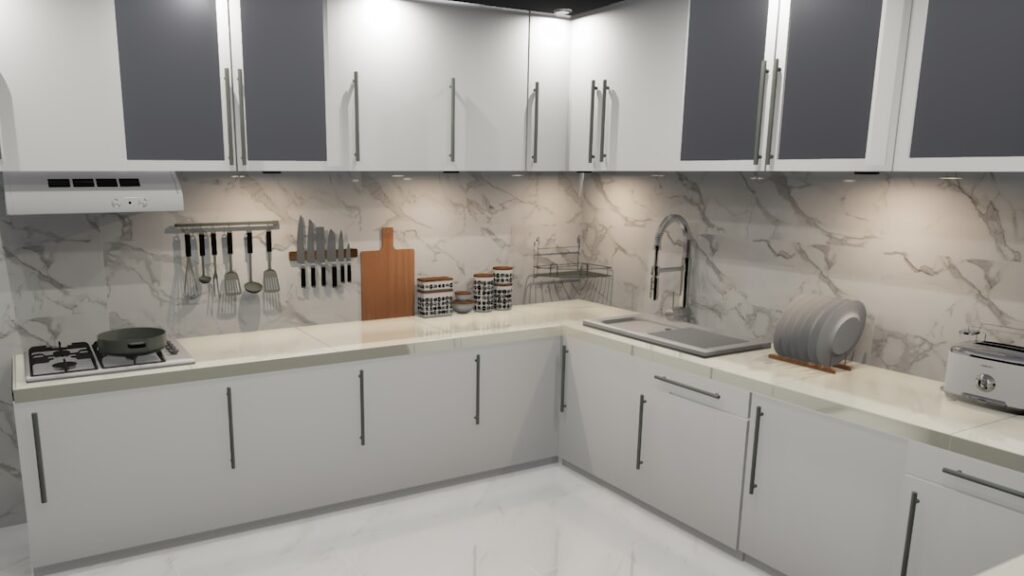
For a 12-foot run of uppers and 12-foot run of base cabinets in a typical L-shaped kitchen, that’s roughly 24 linear feet. Stock comes in at $1,920 to $4,800, semi-custom $3,600 to $9,600, and full custom $12,000 to $28,800. Door style and box construction (3/4-inch plywood beats particleboard every time) matter more than brand name. Inspect a sample box for full-extension soft-close drawer slides, dovetailed drawer boxes, and adjustable hinges before signing.
Countertops: Material vs Maintenance
Quartz dominates 2026 kitchen installs because it’s nonporous, doesn’t need sealing, and matches any aesthetic. Pricing runs $55 to $120 per square foot installed depending on edge profile and slab thickness. Cambria and Caesarstone sit at the top; Silestone and MSI fill the middle; private-label slabs from big-box stores anchor the entry tier.
Granite still has fans for warm, organic looks and runs $40 to $100 per sq ft installed. It needs annual sealing with a product like Miracle 511. Marble looks gorgeous but etches under lemon juice and red wine — choose it only if you’ll accept patina. Butcher block at $40 to $75 per sq ft brings warmth at lower cost but demands monthly mineral oil. Solid surface (Corian) at $50 to $100 has fallen out of favor but cleans up easily and seams invisibly.
Flooring Choices That Survive a Kitchen
Kitchens punish floors. Standing water from dishwashers, dropped pots, dragged stools, grease splatter, and 24/7 traffic mean material choice matters more than in any other room. Porcelain tile in 12 by 24 or 24 by 24-inch formats wins on durability and water resistance at $4 to $10 per sq ft installed. Luxury vinyl plank with a 20-mil-plus wear layer and SPC core (COREtec, Shaw Floorte Pro, Mannington Adura Max) handles the demand at $5 to $9 installed and feels warmer underfoot.
Engineered hardwood works if you accept water risk; pick a brand with a topical urethane finish at least 7 layers thick. Solid hardwood belongs out of kitchens unless you commit to immediate spill cleanup. Skip laminate entirely — the HDF core swells permanently under standing water.
Electrical and Plumbing You’ll Need to Upgrade
Older kitchens often run on a single 15-amp circuit serving everything. Current code typically requires two 20-amp small-appliance circuits, a dedicated 20-amp microwave circuit, a dedicated 20-amp dishwasher circuit, a 50-amp range circuit if electric, GFCI protection on every counter outlet, and AFCI protection throughout. Adding all that to an old panel can require a service upgrade — figure $2,500 to $5,000 if you need to move from 100 to 200 amps.
Plumbing-wise, expect to replace galvanized supply lines with PEX or copper if your house is older than 1985. Trap arm placement under sinks rarely matches new cabinet layouts and gets rerouted. Add a dedicated dishwasher supply if you’re moving the appliance, and budget for a new garbage disposal — the old one is never worth saving.
Where to Save and Where to Spend
- Spend on: Cabinet box construction, countertops you’ll touch daily, appliances you use most (range and dishwasher), and a quality range hood properly vented outdoors
- Save on: Pendant lighting (replaceable later), cabinet hardware (pull replacement is 30 minutes per cabinet), backsplash tile (subway tile under $3 per sq ft looks identical to designer SKUs), and trim work
- Splurge selectively: Integrated panel-ready dishwashers and refrigerators look custom but cost 30 to 50 percent more. Worth it on resale-priority homes; skip on rentals
Permits, Inspections, and the GC Question
Any kitchen renovation moving plumbing, gas, or electrical needs permits in nearly every US municipality. Skip them and you’ll fail home inspection at resale, voiding the cost of half your improvements. Permit fees run $250 to $1,500 depending on jurisdiction and scope. Inspections happen at rough-in and final stages.
General contractor markup runs 15 to 25 percent on labor and materials. For a $50,000 kitchen, that’s $7,500 to $12,500 to coordinate trades, manage the schedule, and own warranty issues. Worth it for most homeowners. If you self-GC, you’re effectively taking a part-time job — pulling permits, scheduling six trades, dealing with delivery issues, and handling the punch list yourself.
Pulling It All Together
The kitchen remodels that come in on budget and on time share three traits: realistic budgets with 15 to 20 percent contingency, decisions locked before demo starts (every appliance, fixture, cabinet, and finish ordered), and a single accountable contractor running the schedule. Skip any of those and the project drifts. Plan tight, decide early, and renovating a kitchen becomes a defined project rather than the multi-month nightmare it can turn into.