Layering an area rug over wall-to-wall carpet looks great until the rug starts creeping toward the wall every time someone walks across it. Rug tape for carpet is the simplest fix for that problem, holding the rug flat and preventing the curled corners that catch toes and vacuum heads. Unlike rug grippers made for hard floors, the carpet-specific versions use a hook-and-loop or aggressive double-sided adhesive that bites into looped fibers. Get the right product and the rug stays put for months without bunching.
Why Rugs Slide on Carpet in the First Place
A rug on a hard floor stays in place mostly through friction and weight. On carpet, that friction disappears. The smooth backing of an area rug glides over carpet pile like a sled on snow, and the softer the carpet, the worse it gets. Plush and frieze carpets are the biggest offenders because the long fibers compress and roll under the rug.
This movement does more than annoy you. A sliding rug bunches into ridges that become trip hazards, and the constant shifting grinds dirt between the two textiles, wearing both faster. Curled corners are the next problem, since rug edges that lift off carpet are a leading cause of household falls, especially in homes with older adults.
Types of Rug Tape for Carpet
Not every product labeled “rug tape” works on carpet. Here are the main options that actually grip pile:
- Hook-style carpet tape: One side has tiny plastic hooks that grab carpet loops like the rough half of hook-and-loop. This is the most reliable type for carpet-on-carpet and usually costs $10 to $20 for a multi-strip pack.
- Double-sided cloth adhesive tape: A fabric-reinforced tape with sticky adhesive on both faces. It works but can leave residue and loses grip faster on deep pile. Expect $8 to $15 per roll.
- Reusable gel grip pads: Washable polyurethane squares you press onto rug corners. They are mess-free and repositionable, running about $12 to $18 for a set of eight.
- Rug-to-carpet gripper sheets: Full-coverage pads with a spiked underside designed specifically for carpeted floors, ideal for larger rugs that slide as a whole.
How to Choose the Right Product
Match the tape to your carpet pile and your rug size. For low-pile or commercial-grade carpet, hook-style tape grips best. On thick plush carpet, corner gel pads or a full gripper sheet often outperform strip tape because they spread the holding force over a wider area.
Consider the rug too. A heavy wool rug needs less help than a lightweight cotton flatweave that catches air under foot traffic. For runners in hallways, where slipping is most dangerous, use continuous strips down both long edges rather than just corner pieces.
How to Apply Rug Tape Correctly
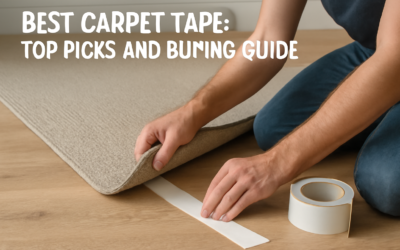
Application takes about ten minutes and makes the difference between tape that holds and tape that peels off in a week.
- Vacuum both the carpet and the rug backing so adhesive bonds to clean fibers, not dust.
- Flip the rug over and lay your tape strips along the perimeter, with extra pieces at each corner where curling starts.
- Peel the backing and press the tape firmly onto the rug for several seconds.
- Position the rug exactly where you want it, then peel the second liner and press the whole rug down, working from the center outward to push out air.
- Walk the edges and apply body weight along every taped seam to set the bond.
Give adhesive tapes a few hours before heavy traffic so the bond fully cures.
Mistakes to Avoid
The most common error is using hard-floor rug grippers on carpet. Those rubber-coated pads need a smooth surface to grip and do nothing on pile. Another mistake is skipping the corners. Edges curl first, so reinforce them even if the center holds fine.
Avoid leaving cheap adhesive tape in place for years. Over time the adhesive can bake onto carpet fibers and pull them loose when removed. If you want a long-term solution with no residue risk, choose the reusable gel pads or a hook-style product instead.
Removing Tape and Cleaning Up Residue
To remove hook-style tape, simply lift the rug; the hooks release from carpet loops without leaving marks. For adhesive tape that left a sticky film, dab a little rubbing alcohol or a citrus-based adhesive remover on a cloth and work it gently into the spot, then blot. Test any solvent on a hidden patch of carpet first to make sure it does not affect the color.
If a strip of double-sided tape clings stubbornly to the carpet, do not yank it, which can rip out fibers. Warm the adhesive first with a hair dryer on low for a few seconds to soften it, then peel slowly at a shallow angle. Any remaining gum usually responds to a second round of adhesive remover and gentle agitation with a soft brush.
Rug Tape vs. a Full Rug Pad
Tape is not your only option, and for some situations a full rug pad designed for carpet is a better fit. A carpet-to-carpet rug pad, often a thin pad with a gripping underside, spreads holding force across the entire rug rather than concentrating it at strips and corners. That can be the difference for a large or heavy rug that wants to migrate as a whole rather than just curl at the edges.
The trade-off is cost and bulk. Tape is cheaper, nearly invisible, and easy to apply, which makes it the right call for smaller rugs and for stopping corner curl. A full pad costs more and adds a little height, but it also adds cushioning and protects both textiles from wear. Many homeowners combine the two: a pad for overall stability plus a couple of corner grippers where curling persists.
Special Cases and Pro Tips
A few scenarios call for extra attention. In rooms with radiant-heat or in very humid climates, choose a tape rated to hold under warmth and moisture, since some cheap adhesives soften and let go when warm. For runners on carpeted stairs, use a hook-style product and reinforce the nose of each tread where slipping is most dangerous. And if you reposition a rug seasonally, the reusable gel grippers are the most practical choice because they peel up and re-stick without losing their hold.
One more pro tip: buy a little more tape than you think you need. It is tempting to economize with just four corner squares, but a rug that gets daily traffic almost always benefits from tape along the full length of high-use edges. The extra few dollars prevents the curling and creeping that make a rug look sloppy and, more importantly, create a tripping hazard.
The Bottom Line
For most homeowners, hook-style or reusable gel rug tape solves the sliding-rug problem cleanly and affordably, usually for under $20. Reserve full gripper sheets for large or especially slippery rugs, and always reinforce the corners. With the right product applied to clean surfaces, your layered rug will stay flat, safe, and exactly where you placed it.