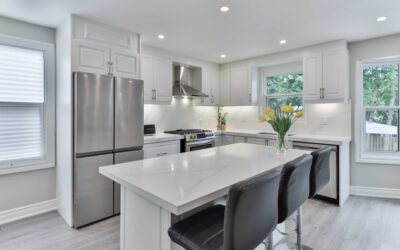
All-white kitchens peaked around 2019, and the next design wave has a clear winner: soft green cabinets paired with warm off-whites. A sage green and cream kitchen feels calm, photographs well in every light, and (unlike navy or forest green) doesn’t darken a small space. This guide covers the specific paint colors that nail the look, which countertops fight the palette versus enhance it, and the hardware and lighting choices that tie everything together on realistic budgets.
Part of our Kitchen Remodeling guide — explore the full guide →
Why This Palette Is Replacing All-White
White kitchens photograph flat and show every smudge. Sage and cream give the room dimension: the cream reads as the bright layer, the sage adds depth, and warm wood or brass accents make both feel intentional. Real estate data from 2024 already shows green-cabinet listings commanding 3 to 5 percent more time-on-zillow engagement than white equivalents.
The combo also ages better. Sage is rooted in historical English and Scandinavian kitchens, so it doesn’t carry the decade-specific stamp that, say, gray cabinets from 2016 do now.
Sage Green Cabinet Paint Picks
Not every sage reads correctly. Some go too yellow (washed-out), others lean blue (cold), and some turn gray under LED light. The colors below have been tested across real kitchens:
- Benjamin Moore Saybrook Sage HC-114: the most forgiving, slightly muted, works with warm or cool cream
- Farrow and Ball Lichen 19: deeper and earthier, better for lower cabinets with cream uppers
- Sherwin-Williams Evergreen Fog SW 9130: moodier, beautiful under warm LED
- Benjamin Moore October Mist 1495: softer and dustier, pairs well with light cream
- Sherwin-Williams Softened Green SW 6177: chalky and traditional, great for shaker cabinets
Always sample at least 8 by 10 inches on a cabinet door and look at it under morning light, midday light, and your actual kitchen fixtures. Sage shifts noticeably between 2700K and 3500K LED.
Cream Counterpart Colors
Stark white cabinets fight sage. Choose a warm off-white with yellow or pink undertones rather than pure white or gray-white:
- Benjamin Moore White Dove OC-17: the industry standard cream, slight warm undertone
- Sherwin-Williams Alabaster SW 7008: warmer, almost beige, beautiful with natural wood floors
- Farrow and Ball Pointing 2003: classic off-white with depth
- Benjamin Moore Swiss Coffee OC-45: creamy and soft, works with both warm and cool sage
- Sherwin-Williams Creamy SW 7012: warm ivory, great for walls when cabinets are sage
Avoid decorator white, bright white, or pure white on walls in this palette. They create a harsh edge against sage and make cream cabinets look dingy by comparison.
Cabinet Layout: Two-Tone Applications
You have three main layouts to choose from:
- Sage lowers, cream uppers: the most common, grounds the room and keeps eye-level airy
- All sage perimeter, cream island: the island becomes a bright focal point
- All cream perimeter, sage island: reversed version, works in brighter kitchens with good natural light
- Sage on a hutch or pantry wall, cream everywhere else: low-risk way to introduce the color
Paint the cabinet interiors the same as the exteriors for a finished look. If you hate the idea of repainting inside, match them to the adjacent wall color.
Countertop Pairings
This is where good sage kitchens go bad. The wrong counter fights the palette and looks wrong in every photo.
Counters that work:
- Honed or polished white marble (Carrara, Calacatta): classic and high-contrast
- White or cream quartz with soft gray veining: Cambria Brittanicca Warm, Silestone Et. Statuario
- Butcher block walnut or white oak: warms up sage considerably
- Soapstone or honed black granite: dramatic but balanced, good with cream walls
- Warm cream quartz with very subtle veining for seamless backsplash-to-counter flow
Counters that clash: busy speckled granite (especially anything with yellow or red), very cool bluish quartz, and glossy black anything. Saturated green counters with sage cabinets turn the kitchen into a single hue.
Hardware Finishes
Aged brass and unlacquered brass are the clear winners. The warmth balances the cool of the sage and connects visually to wood flooring and cream. Polished nickel works too but reads more traditional.
Skip matte black unless the kitchen skews modern and the sage is darker (like Lichen). Brushed nickel fades into the palette and looks safe rather than intentional; it’s not wrong, just uninspired.
Mix at most two finishes: for example, aged brass cabinet pulls and matte black faucet. Any more and the eye gets confused.
Backsplash Options
Three backsplash approaches that never miss:
- White or cream zellige tile: the handmade variation gives the kitchen soul
- Warm-white subway tile with sage grout: pulls the color up onto the wall subtly
- Full-height marble or marble-look slab behind the range: luxurious, timeless
- Cream running-bond brick look tile: casual and warm
Avoid busy geometric patterns, colorful glass, or any tile with a strong pattern. Sage cabinets carry the visual weight; the backsplash should be a quiet foundation.
Flooring That Ties It Together
Warm wood flooring is almost required. White oak, natural maple, or a honey-toned hickory all work. Avoid gray-washed, very dark stained, or red-toned floors like cherry or Brazilian cherry; they pull the palette in directions that fight the sage.
For large-format tile, cream limestone-look porcelain or a warm travertine look carries the cream tones to the floor. Gray tile turns the room cold instantly.
Lighting Strategy
Warm 2700K LED is non-negotiable. Cool 4000K LED makes sage look muddy and cream look pink. Replace any kitchen bulbs before you judge the paint colors; this alone fixes a lot of buyer’s remorse.
Pendant fixtures over an island look best in warm materials: aged brass, milk glass, or natural rattan. Two or three pendants in the 6 to 10 inch diameter range at 30 to 36 inches above the countertop hit the right proportions.
Budget Reality
A full sage-and-cream kitchen refresh runs:
- Paint existing cabinets only (DIY): $250 to $500 in materials, one week
- Paint plus new hardware and faucet: $700 to $1,500
- Paint plus new quartz counter and subway backsplash: $4,000 to $9,000
- Full kitchen gut with new sage shaker cabinets: $25,000 to $60,000 depending on size
For most homeowners, painting existing boxes and adding new hardware and a warmer faucet hits the sweet spot. That’s a real transformation for under $1,500 and keeps the kitchen relevant for another decade.