A patio that bakes in the afternoon sun goes unused by July, no matter how much you spent building it. The right shade solutions for patio spaces can drop the surface temperature by 15 to 20°F and add weeks of usable season to your outdoor living area. The challenge is matching the solution to your climate, budget, and how much permanence you want. This guide breaks down every major option, what it costs, and where each one shines.
Part of our Decks & Outdoor guide — explore the full guide →
Start With the Sun, Not the Catalog
Before you buy anything, watch how the sun crosses your patio. A west-facing patio gets brutal late-afternoon heat and needs vertical shade, not just an overhead structure. A south-facing space benefits most from overhead coverage. Note where the sun sits at 3 p.m. in midsummer, because that’s when you most want to sit outside and when the heat is worst.
This 10-minute observation saves expensive mistakes. A beautiful pergola that lets in the low afternoon sun does nothing for an evening cocktail on a west-facing deck.
Also measure the space honestly. Sketch the patio dimensions and note any obstacles, gutters, the roofline, and door swings, since these dictate where you can anchor an awning or set posts. Knowing you have, say, a 14 by 16 foot patio with a 9-foot eave height narrows your options far faster than browsing photos online.
Pergolas: Structure and Style
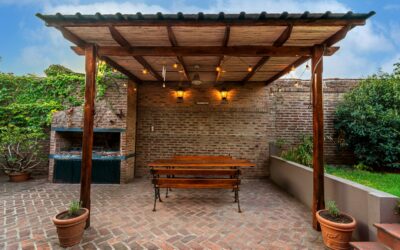
A pergola is the workhorse of patio shade, an open framework of posts and crossbeams that defines the space and supports climbing plants, fabric, or louvered roofing. Traditional wood pergolas cost $3,000 to $8,000 installed for a 12 by 12 foot footprint, while aluminum kits run $1,500 to $4,000.
Standard open-rafter pergolas only filter roughly 50 percent of direct sun. To get real shade, add a retractable canopy, climbing wisteria or grapevine, or upgrade to a louvered roof.
Louvered (Adjustable) Pergolas
Motorized aluminum louvered pergolas let you tilt the slats from fully open to fully closed and even shed rain. They’re the premium option at $6,000 to $15,000 installed, but they deliver complete control and stand up to wind far better than fabric.
Retractable Awnings
For shade you can deploy only when you want it, a retractable awning mounts to the house wall and extends 8 to 14 feet over the patio. Manual crank models start around $400 to $1,200; motorized units with wind sensors run $1,500 to $4,500 installed.
The big advantage is flexibility. Retract it in a storm or to let winter sun warm the house, then extend it for a hot afternoon. Look for an acrylic fabric like Sunbrella, which resists fading and carries warranties up to 10 years.
Shade Sails
Triangular and rectangular shade sails offer the most bang for the buck, often the cheapest of the genuinely effective shade solutions for patio coverage. A quality HDPE fabric sail blocks up to 95 percent of UV and costs $50 to $300 per sail, plus posts or wall anchors.
- Coverage: Overlap multiple sails at different heights for both shade and a modern, dynamic look.
- Tension: Anchor points must handle real load; set 4×4 posts in concrete footings 18 to 24 inches deep.
- Drainage: Angle the sail at least 10 degrees so rain sheds rather than pooling.
- Limitation: Most are not waterproof and should come down before heavy snow or high winds.
Patio Umbrellas
The simplest, most affordable, and most movable option remains the humble umbrella. A standard market umbrella covers a small bistro set, while a cantilever (offset) umbrella with a 10 or 11 foot canopy shades a full dining table without a center pole in the way.
Budget $80 to $200 for a basic market umbrella and $200 to $700 for a sturdy cantilever model. Choose solution-dyed acrylic canopies over cheaper polyester, which fades within a season or two. Always weight the base properly; a 10-foot cantilever needs 150 pounds or more of base weight to survive a gust.
Plants and Natural Shade
The most beautiful shade is the kind that grows. A deciduous tree like a red maple or a fast-growing pergola vine cools the air through transpiration, not just by blocking sun, and it lets winter light through once the leaves drop.
- Climbing vines: Wisteria, trumpet vine, and grape cover a pergola in 2 to 3 seasons.
- Potted bamboo or tall grasses: Create movable vertical screens for west sun.
- Shade trees: Plant 15 to 20 feet from the house to cool without dropping debris on the patio.
Matching the Solution to Your Climate
Climate should steer your final choice. In the windy Plains or coastal areas, fabric sails and umbrellas struggle, so a louvered pergola or solid roof is worth the premium. In hot, dry regions like the Southwest, maximum UV blocking matters most, favoring dense shade cloth and solid structures. In humid Southern climates, prioritize airflow with an open pergola plus a ceiling fan rather than a sealed roof that traps heat.
Quick Cost Comparison
- Patio umbrella: $80 to $700, instant, fully portable.
- Shade sail: $150 to $800 installed, high UV block, weather-limited.
- Retractable awning: $400 to $4,500, flexible, house-mounted.
- Wood/aluminum pergola: $1,500 to $8,000, permanent, partial shade.
- Louvered pergola: $6,000 to $15,000, full control, rain-shedding.
One more factor to weigh is permits. A freestanding umbrella or shade sail needs nothing, but a permanent attached pergola or solid patio cover often requires a building permit and must meet setback and wind-load codes, especially in hurricane-prone coastal counties. A quick call to your local building department before you buy materials can spare you a teardown order later.
The smartest patios usually layer two approaches: a permanent structure for the bones, plus a movable umbrella or retractable element to chase the sun. Start with how you actually use the space, and the right combination becomes obvious.