Muted greens have become the go-to color for people who want something softer than gray but less sweet than a true sage. Sherwin Williams Cascade Green (SW 0066) sits right in that zone: a soft gray-green with a faint cool lean, deep enough to read clearly as a color but light enough to use on all four walls. On the manufacturer’s color page it has an LRV of 42.9, sits in the Green color family as part of the Historic Color collection, and is approved for interior and exterior use.
That middle LRV is the important number. Cascade Green reflects a bit under half the light that hits it, so it feels calm and grounded without making a room dark. It works on cabinets, in bedrooms and offices, on exterior siding or shutters, and anywhere you want a green that behaves almost like a neutral.
- Sherwin Williams Cascade Green at a Glance
- Understanding the Undertone
- Where to Use Cascade Green
- Coordinating Colors and Pairings
- Cascade Green vs Nearby Sherwin-Williams Greens
- How to Test, Prep and Paint
- Cascade Green in Historic and Modern Homes
- Troubleshooting
- When to Hire a Painter
- Frequently Asked Questions
Sherwin Williams Cascade Green at a Glance
These values come from the Sherwin-Williams page for SW 0066. Hex and RGB numbers are screen approximations; always check a physical sample in your own light.
| Spec | Value | What it means |
|---|---|---|
| Color number | SW 0066 | Use this code when ordering |
| LRV | 42.9 | Medium; noticeable color without darkening a room much |
| Hex / RGB | #ACB19F / 172, 177, 159 | Green leads slightly, with heavy gray content |
| Color family | Green (Historic Color collection) | Part of the maker’s historic palette, suited to older homes |
| Undertone | Gray-green, slightly cool, muted | Reads soft and natural, not minty or olive |
| Interior / exterior | Both | Walls, cabinets, doors, siding, shutters |
| Best sheens | Matte or eggshell walls, satin cabinets, satin or semi-gloss doors | Higher sheen deepens the color slightly and adds durability |
| Coordinating colors | La Luna Amarilla (SW 9016), Adaptive Shade (SW 7053) | Manufacturer-listed pairings |
Understanding the Undertone
The RGB values tell the story: green is the highest channel, but only by a few points, and blue is lower than red and green. That combination makes a muted green with a lot of gray. In practice, Cascade Green rarely looks bright or saturated. It looks like dried herbs, eucalyptus leaves or weathered painted wood.
Compared with yellow-leaning sages, it feels a bit cooler and grayer. Compared with blue-greens, it feels earthier. That balance is why it sits well with both warm woods and cool whites.
How light changes it
- North-facing rooms: cool light brings out the gray, so it can look like a green-gray or even soft slate. Warm bulbs help.
- South-facing rooms: warm daylight brings out the green and a touch of yellow, making it feel fresher.
- Evening light: under warm 2700K bulbs it reads cozy and earthy; under 5000K daylight bulbs it gets cooler and grayer.
- Exteriors: bright sun washes colors out, so it will look lighter and grayer on siding than on a chip.
Where to Use Cascade Green
Kitchen cabinets
Muted greens are a popular cabinet color, and Cascade Green suits both shaker and flat-panel doors. It pairs well with brass, bronze and matte black hardware, white or warm marble-look counters, and wood floors. Use a cabinet enamel in satin for a wipeable finish. Lower cabinets in Cascade Green with white uppers is a lighter option for small kitchens.
Living rooms and bedrooms
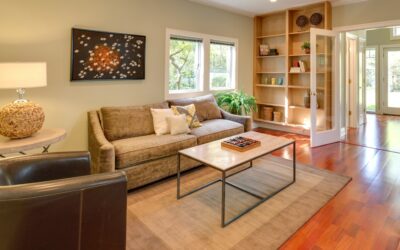
On all four walls, it gives a calm, enveloping feel without feeling heavy in a well-lit room. Matte or eggshell is ideal. Pair it with oak or walnut floors, linen textiles and warm white trim.
Home offices and dens
Medium greens are restful on the eyes for long work sessions. Consider color-drenching (walls, trim and ceiling in the same color) for a cozy, modern look.
Bathrooms
Cascade Green looks fresh with white tile and natural wood vanities. In small, windowless baths, add strong warm lighting so the color doesn’t turn gray-flat.
Exterior siding, doors and shutters
As a whole-house siding color, it fits cottages, bungalows, farmhouses and historic homes. With white trim and a dark roof it reads classic; with black windows it reads more modern. It also works as a front door or shutter color on white or cream siding.
Coordinating Colors and Pairings
The manufacturer lists two coordinating colors:
- La Luna Amarilla (SW 9016): a soft yellow that warms the green and suits sunny kitchens or adjoining rooms.
- Adaptive Shade (SW 7053): a deeper warm neutral (LRV about 21) for doors, cabinets or accents beside Cascade Green.
Other combinations that work:
- Warm whites for trim and ceilings keep the scheme soft. Stark blue-white trim can make it look colder.
- Natural wood in oak, walnut or pine flooring and furniture.
- Terracotta, rust and blush accents for an earthy palette.
- Deep greens or charcoal on an accent wall, island or front door for depth.
- Brass and aged bronze fixtures and hardware.
Cascade Green vs Nearby Sherwin-Williams Greens
LRVs here come from each color’s Sherwin-Williams page.
| Color | LRV | How it compares |
|---|---|---|
| Cascade Green (SW 0066) | 42.9 | Soft gray-green, slightly cool and muted |
| Svelte Sage (SW 6164) | 41.3 | Similar depth but warmer and more khaki, with a red-yellow lean |
| Clary Sage (SW 6178) | 41.0 | Similar depth, a little more yellow-green and less gray |
| Evergreen Fog (SW 9130) | 30.4 | Noticeably darker, grayer and moodier |
If Cascade Green looks too cool in your room, Svelte Sage or Clary Sage give a similar weight with more warmth. If you like the gray-green character but want more drama, Evergreen Fog goes about a step and a half darker.
How to Test, Prep and Paint
- Sample big. Use peel-and-stick swatches or two coats on white poster board at least 12 by 12 inches.
- Test against your fixed finishes. Put samples next to flooring, counters, tile and trim.
- Watch it through a day. Check morning, midday and evening, and with lights on.
- Compare side by side. Hang Clary Sage or Svelte Sage next to it to confirm you have the undertone you want.
- Prep thoroughly. Patch, sand and clean. On cabinets, degrease, scuff-sand and use a bonding primer.
- Use a tinted primer if needed. Over a dark or strongly colored wall, a gray-tinted primer helps reach full color in two coats.
- Apply two full coats. Keep a wet edge and roll in consistent sections to avoid lap marks.
Paint quantities and cost
A gallon generally covers about 350 to 400 square feet per coat on smooth, primed walls. A 12 by 14 foot room with 8 foot ceilings needs about 2 gallons for two coats. Kitchen cabinets for an average kitchen usually take 1 to 2 gallons of cabinet enamel plus primer. Paint cost depends on the product line, with premium and cabinet-grade enamels at the higher end of the general price range.
Cascade Green in Historic and Modern Homes
Because it sits in the Historic Color collection, Cascade Green is a natural fit for older houses: Victorian trim schemes, Craftsman bungalows and farmhouses where period-appropriate colors matter. On a historic exterior, consider it as the main body color with a creamy white trim and a deeper green or oxblood accent on the door and window sashes. If your home is in a historic district, check with the local review board before repainting, since some districts approve exterior colors.
In modern spaces it reads differently. Paired with flat-panel cabinets, white quartz and black fixtures, it looks clean and current rather than vintage. Sherwin Williams Cascade Green also works in modern bedrooms as a single-color drench, where trim, doors and walls all share the same shade in different sheens, matte on the walls and satin on the trim, for a soft, tailored look.
Troubleshooting
- “It looks gray.” Common in north light and under cool bulbs. Use warmer bulbs and warm whites on trim, or try a warmer sage.
- “It looks too yellow.” Strong afternoon sun or warm wood floors can push it yellow. Test with cooler trim.
- “It looks darker than the chip.” Large areas look deeper than small samples, especially in shaded rooms.
- Cabinet finish chipping. Usually poor adhesion. Degrease, sand and prime properly, and allow full cure time before heavy use.
- Uneven sheen. Spot-prime patches and apply even second coats.
When to Hire a Painter
Walls are usually a comfortable DIY job, but cabinets and exteriors are where pros earn their fee. Sprayed cabinet finishes look smoother and last longer, and exterior work involves ladders, scraping and weather timing. For homes built before 1978, test existing paint for lead before sanding or scraping and use lead-safe practices or a certified contractor. Get two or three written quotes that list prep, primer, coats and paint grade.
Sherwin Williams Cascade Green is a versatile muted green: medium in depth, gray enough to act like a neutral, and approved for both interiors and exteriors. Sample it in your own light and pair it with warm whites and natural wood for a calm, timeless look.
Frequently Asked Questions
What is the LRV of Cascade Green?
The manufacturer lists it at 42.9, a medium value. It reads as a clear color without making a room feel dark.
Is Cascade Green a sage green?
It is a sage-family gray-green, but slightly cooler and grayer than many yellow-leaning sages.
Can Cascade Green be used on exteriors?
Yes. The manufacturer lists it for interior and exterior use. Outdoors it will look lighter and grayer in full sun.
Is Cascade Green good for kitchen cabinets?
Yes. Its muted tone pairs well with brass or black hardware, white counters and wood floors. Use a satin cabinet enamel over a bonding primer.
What colors go with Cascade Green?
The manufacturer pairs it with La Luna Amarilla (SW 9016) and Adaptive Shade (SW 7053). Warm whites, natural wood, terracotta and brass also work well.
What is a darker alternative to Cascade Green?
Evergreen Fog (SW 9130) has a similar gray-green feel with an LRV of about 30.4, so it reads noticeably deeper.