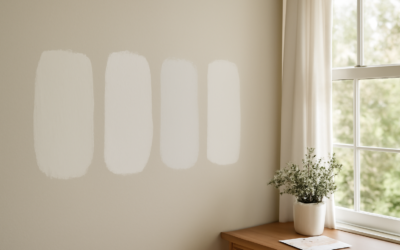
Ibis White is one of those whites people notice only when they compare it side by side: next to a stark white it looks gently warm, and next to a cream it looks clean. Ibis White Sherwin Williams (SW 7000) has a light reflectance value (LRV) of 84 on Sherwin-Williams’ color page, which puts it among the brighter whites in the fan deck. Sherwin-Williams describes it as a cool, bright white with glowing red and violet undertones.
Those undertones are subtle. Ibis White has a faint rosy, slightly violet softness rather than the yellow of a cream, so it reads airy and fresh instead of buttery. It is rated for interior and exterior use and sits on color strip 260 (location 260-C2).
- Ibis White Sherwin Williams at a Glance
- Undertones: Warm, but Not Cream
- Best Rooms for Ibis White
- Sheen Choices
- Coordinating Colors for Ibis White Sherwin Williams
- Ibis White vs Extra White, Pure White and Snowbound
- Exterior Use
- Using Ibis White as a Whole-House Color
- Painting Tips and Troubleshooting
- Cost and When to Hire a Pro
- Frequently Asked Questions
The full spec breakdown, how the undertones behave in different light, the best rooms and sheens, coordinating colors, and how it compares with Extra White, Pure White and Snowbound all follow.
Ibis White Sherwin Williams at a Glance
The numbers come from Sherwin-Williams’ own SW 7000 color page. Undertone and room notes are practical guidance; always confirm with a physical sample.
| Spec | Value | What it means |
|---|---|---|
| Color number | SW 7000 | Use the number when ordering |
| LRV | 84 (listed as 84.425) | A bright white that bounces plenty of light |
| Color family | White | Shelved with the whites |
| Hex / RGB | #F2ECE6 / 242, 236, 230 | Digital approximation; screens vary |
| Undertone | Red and violet (maker calls it a cool, bright white) | A soft blush without looking yellow |
| Location number | 260-C2 | Find it on strip 260 |
| Use | Interior and exterior | Walls, ceilings, trim, cabinets, siding |
| Best rooms | Bedrooms, living rooms, north-facing rooms, kitchens | Bright enough for dim rooms, warm enough to avoid feeling cold |
Undertones: Warm, but Not Cream
Many warm whites lean yellow, which can look dated or dingy in some light. Ibis White’s warmth comes across more as a soft blush or a faint violet-gray, which is why people often describe it as a “clean warm white.” Its high LRV means the undertone stays quiet most of the time.
- North-facing rooms: Cool light can bring out a slight beige or soft pinkish-gray cast. Because the color is bright, the room still feels light, which makes it a good candidate for north rooms that look cold in stark white.
- South- and west-facing rooms: Warm sunlight makes it glow. In very strong afternoon sun it can look a touch peachy; that is normal for warm whites.
- East-facing rooms: Crisp in the morning, softer and slightly warmer later in the day.
- Artificial light: Warm bulbs (2700K) emphasize the warmth. Neutral 3000K to 3500K bulbs keep it closest to the chip.
Surrounding finishes matter. Red-toned wood floors or terracotta tile will reinforce the warm undertone. Gray stone and cool metals will make it look cleaner.
Best Rooms for Ibis White
Bedrooms
The soft warmth feels restful, and the brightness keeps small bedrooms open. Pair with linen, oak and muted textiles.
Living rooms
Works as a whole-house wall color in open plans. It reflects light well without the glare of a stark white, and it sits comfortably beside both warm woods and gray sofas.
Kitchens
A strong choice for cabinets when you want white that does not look clinical. Test it against your countertop; very cool white quartz can make it look slightly pink by comparison.
Bathrooms
Flattering for skin tones under vanity lighting. Use a bath-rated, moisture-resistant finish.
North-facing and dim rooms
An LRV of 84 helps these rooms feel brighter, and the warmth offsets cool daylight. It is often a better pick here than a cooler, grayer white.
Sheen Choices
- Flat or matte: Ceilings and low-traffic walls. Softest look, hides flaws.
- Eggshell: Standard for most living spaces and bedrooms.
- Satin: Kitchens, baths, hallways and kids’ rooms.
- Semi-gloss or gloss: Trim, doors and cabinets. Use a cabinet-grade or trim enamel for a hard, smooth finish.
Using Ibis White on both walls and trim in different sheens creates a calm, tonal look where the trim is defined by sheen instead of color.
Coordinating Colors for Ibis White Sherwin Williams
Sherwin-Williams lists coordinating colors on the SW 7000 page, including:
- Malted Milk (SW 6057): A soft, warm neutral that pairs naturally with the blush undertone. Good for adjoining rooms or a gentle accent wall.
- Hushed Auburn (SW 9080): A deeper, earthy red-brown for a front door, accent wall or cabinetry that leans into the warmth.
Other pairings that suit Ibis White: warm greiges and taupes, dusty blues and sage greens for contrast, natural wood, unlacquered brass, and black window frames. For exteriors, it pairs well with warm stone, brick with pink or buff tones, and deep charcoal or navy shutters.
Ibis White vs Extra White, Pure White and Snowbound
Each LRV comes from that color’s Sherwin-Williams page.
| Color | LRV | How it compares to Ibis White |
|---|---|---|
| Ibis White (SW 7000) | 84 | Bright white with a soft, warm blush |
| Extra White (SW 7006) | 86 | Slightly brighter and cooler; crisp, clean white |
| Pure White (SW 7005) | 84 | Same brightness; the maker notes the slightest yellow undertone, so it reads creamier and less rosy |
| Snowbound (SW 7004) | 83 | Nearly the same brightness; a soft white with a slightly different, cooler cast |
Ibis White vs Extra White: Extra White is the cooler, crisper choice and is popular for modern trim and ceilings. Ibis White is softer and better for whole rooms where a crisp white would feel cold.
Ibis White vs Pure White: These share an LRV of about 84, so the difference is undertone. Sherwin-Williams gives Pure White the slightest yellow undertone, while Ibis White carries red and violet undertones, so side by side Pure White reads creamier and Ibis White slightly rosier.
Ibis White vs Snowbound: Very close in brightness. Snowbound tends to read slightly cooler and grayer in many rooms, while Ibis White keeps a gentle warmth. Put both samples on the same wall to decide.
Exterior Use
Outdoors, bright sunlight washes out undertones, so Ibis White usually reads as a clean, soft white on siding. Its warmth helps it avoid the bluish look that some cool whites take on in shade. Pair it with black or bronze windows for contrast, or with natural wood accents for a softer, traditional look. Always test a large sample board on both the sunny and shaded sides of the house.
Using Ibis White as a Whole-House Color
One reason designers like a bright warm white is that it can run through an entire home without feeling flat. Ibis White adapts to each room’s light: brighter in sunny rooms, softer in shaded hallways, and still clearly white in both. That consistency makes open floor plans easier, since there is no awkward line where one wall color stops and another starts.
For a cohesive scheme, keep walls and ceilings in Ibis White (flat on ceilings, eggshell on walls) and use the same color in semi-gloss on trim and doors. Add depth with one or two accent colors drawn from its coordinates, such as Malted Milk in a dining room or Hushed Auburn on a front door or kitchen island. If you prefer more contrast, keep Ibis White on walls and switch trim to a crisper white. Sample both approaches in your main living space before deciding, because the change in undertone is easiest to judge where you spend the most time.
Painting Tips and Troubleshooting
- Sample generously. Use large samples, at least 12 by 12 inches, on several walls and check them at different times of day.
- Prep thoroughly. White paint shows every dent and patch. Clean, fill, sand and spot-prime.
- Use the right tools. A quality paint roller kit with a 3/8-inch nap cover for smooth walls, a 2 to 2.5 inch angled brush for cutting in, and a tray liner.
- Apply two coats. A gallon covers about 350 to 400 square feet per coat. Over dark colors, prime first.
- Box multiple gallons together to keep color consistent.
Common problems:
- Looks pink: Usually from warm bulbs or red-toned floors. Try neutral 3000K to 3500K bulbs, or choose a more neutral white such as Pure White.
- Looks beige in north light: Normal for a warm white. If it bothers you, sample a cooler option like Extra White.
- Trim and walls clash: If trim is a cooler white, Ibis White walls may look dingy beside it. Use the same white in a higher sheen, or a coordinating warm white.
- Patchy finish: Spot-primed areas can flash through. Prime patches and roll the full wall with a wet edge.
Cost and When to Hire a Pro
The color itself does not change price; product line does. Plan on mid-range to premium per-gallon pricing for a good interior paint. A 12 by 14 foot room with 8-foot ceilings usually needs about 2 gallons for two coats on walls, plus about a quart or more for trim.
DIY works well for walls and ceilings in most rooms. Hire a professional painter for cabinet refinishing, high or vaulted ceilings, and exterior work above the first floor. In homes built before 1978, test existing paint for lead before sanding or scraping and follow lead-safe practices.
Frequently Asked Questions
What is the LRV of Ibis White?
Sherwin-Williams lists Ibis White SW 7000 at an LRV of 84 (84.425). That makes it a bright white that reflects most of the light hitting it.
Does Ibis White have pink undertones?
It has a soft warm cast that can read slightly rosy or violet, especially under warm bulbs or next to cool surfaces. In most rooms it simply reads as a clean, warm white.
Is Ibis White good for trim?
Yes. It works for trim and doors, especially when walls are warm neutrals or Ibis White itself in a lower sheen. For a crisper contrast with cool walls, Extra White may suit better.
Is Ibis White warmer than Pure White?
Not exactly. Both have an LRV of about 84, but they differ in undertone: Pure White has the slightest yellow undertone, while Sherwin-Williams calls Ibis White a cool, bright white with red and violet undertones.
Can Ibis White be used on a house exterior?
Yes. Sherwin-Williams lists it for interior and exterior use. Outdoors it typically reads as a soft, clean white.