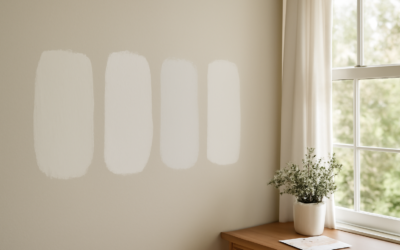
Choosing a white sounds easy until four swatches that all look identical on the counter turn yellow, gray or stark once they hit the wall. Shell White Sherwin Williams (SW 8917) sits in a useful middle ground: a soft, warm white with a light reflectance value (LRV) of 83.2 according to the manufacturer’s color page. Its RGB mix (240, 235, 224) has a touch more red and green than blue, which gives it a gentle creamy warmth without tipping into obvious yellow.
In practice that means Shell White looks clean and bright in most light while avoiding the chilly, clinical feel of a pure, cool white. Sherwin-Williams files it in the White color family and rates it for interior and exterior use. It suits whole-house walls, trim, kitchen cabinets and siding, though in very warm, south-facing rooms it can read a bit creamier than some people expect.
- Shell White Sherwin Williams Specs at a Glance
- Shell White Undertones in Different Light
- Best Rooms and Uses for Shell White
- Coordinating Colors and Pairings
- Shell White vs Pure White, Alabaster and Greek Villa
- How to Test Shell White
- Painting Tips, Tools and Coverage
- Troubleshooting Common Shell White Issues
- Cost and When to Hire a Pro
- Frequently Asked Questions
The specs, undertones, best rooms, sheen choices, coordinating colors and a side-by-side with Pure White, Alabaster and Greek Villa are what tell you whether it is the right white for your space.
Shell White Sherwin Williams Specs at a Glance
All figures come from the Sherwin-Williams color page for SW 8917. LRV runs from 0 (black) to 100 (pure white). Most popular painting whites land in the low to mid 80s, and Shell White fits right in that band.
| Spec | Value | What it means |
|---|---|---|
| Color number | SW 8917 | Order by this number for the exact formula in any sheen |
| LRV | 83.2 | Light and bright, but softer than a stark white |
| Color family | White | Grouped with the brand’s whites; strip 264, position C1 |
| Undertone | Warm, soft cream | Cozy in most light; creamier in strong sun |
| Hex / RGB | #F0EBE0 / 240, 235, 224 | Lower blue value creates the gentle warmth |
| Use | Interior and exterior | Walls, ceilings, trim, cabinets and siding |
| Best rooms | Living rooms, bedrooms, kitchens, north light | Warms up cool light without looking yellow |
| Typical sheens | Flat ceilings, matte or eggshell walls, satin or semi-gloss trim | Higher sheens look slightly brighter and cleaner |
Exact sheen choices vary by product line, so check the current product data sheet for the line you plan to use.
Shell White Undertones in Different Light
Shell White is warm, but subtly so. Next to a bright, cool white like Extra White, its creamy side becomes obvious; on its own, most people simply see a soft white. How it behaves depends on the light:
- North-facing rooms: cool, indirect light tames the warmth, and Shell White often looks like a balanced, slightly soft white. This is where it performs best, because cool whites can look gray and dull here.
- South-facing rooms: strong warm sun brings out the cream. It stays pleasant, but expect a cozier, more ivory look in the afternoon.
- East and west rooms: warmer during direct sun, more neutral in the opposite half of the day.
- Bulbs: 2700K bulbs make it feel candlelit and warm; 3000K to 3500K keeps it balanced; very cool daylight bulbs can make it look slightly flat.
Neighboring colors shift it too. Warm wood floors and brass hardware harmonize with the cream. Strong cool grays or blue tile next to it can make Shell White look more yellow by contrast, so test it beside any fixed cool finishes.
Best Rooms and Uses for Shell White
Living rooms and bedrooms
Shell White is an easy whole-room wall color. It brightens without glare and plays well with linen, wood, leather and woven textures. In bedrooms it gives a calm, soft backdrop that does not feel sterile.
Kitchens and cabinets
On cabinets, it reads as a soft white that pairs well with warm butcher block, cream or veined quartz, and brass or black hardware. Against very cool white counters, sample first; the cabinet may look creamier than the counter.
Trim and ceilings
It works as a trim color with warm wall colors such as greiges, taupes and soft greens. With a cool gray wall, a cleaner white usually looks crisper on trim. As a ceiling color it adds a subtle warmth that keeps rooms from feeling cold.
Exteriors
Outdoors, full sun washes whites out, so Shell White tends to look brighter and less creamy than it does inside. It suits farmhouse, cottage and traditional exteriors, especially with dark windows, wood accents or a deep front door.
Coordinating Colors and Pairings
The SW 8917 page lists two coordinating colors, both of which show the warm, earthy direction Shell White leans toward:
- Backdrop (SW 7025): a deep, warm brown-gray (LRV about 20.2). Use it for an accent wall, lower cabinets, a front door or exterior shutters for strong but warm contrast.
- Gris Morado (SW 9156): a medium gray with a soft purple cast (LRV about 26.2, filed in the purple family). It makes an unexpected, sophisticated accent in a bedroom or powder room.
Beyond those, Shell White looks good with sage and olive greens, warm greiges, terracotta, natural oak, walnut, rattan, aged brass and matte black. For a whole-house plan, use Shell White on trim and ceilings and carry a warm mid-tone neutral on the walls.
Shell White vs Pure White, Alabaster and Greek Villa
All four are popular warm-leaning whites with nearly identical LRVs, so the differences come down to undertone. LRVs are from the Sherwin-Williams color pages.
| Color | LRV | Undertone | How it compares |
|---|---|---|---|
| Shell White (SW 8917) | 83.2 | Soft warm cream | Middle of the pack; warm but not yellow |
| Pure White (SW 7005) | 84.0 | Barely warm, near neutral | Cleaner and less creamy; the safest all-purpose option |
| Alabaster (SW 7008) | 82.2 | Warm, creamy | Slightly darker and creamier; can look ivory in sun |
| Greek Villa (SW 7551) | 84.2 | Warm, soft | Very close to Shell White; a touch brighter |
Among these, Shell White Sherwin Williams sits in the warm middle. Choose Shell White for a warm, welcoming white that still looks like white rather than cream. Choose Pure White if you want a cleaner trim or cabinet color that works with both warm and cool palettes. Choose Alabaster for a slightly creamier, softer look in cool or north-facing rooms. Choose Greek Villa if you like Shell White but want it marginally lighter; in most rooms the two are hard to tell apart without a side-by-side sample.
How to Test Shell White
- Use large samples. Peel-and-stick sample sheets or two coats on white poster board show undertones far better than chips.
- Compare against a true white. Hold the sample next to plain printer paper. The cream will show, which helps you judge how warm is too warm.
- Test it in place. Put samples on the darkest wall and on the brightest wall, plus next to trim, cabinets and countertops.
- Check at different times. Look in morning light, afternoon sun and at night under your actual bulbs.
- Sample the competitors. Place Pure White and Alabaster swatches beside Shell White; the differences are small but visible together.
Painting Tips, Tools and Coverage
Whites show roller marks and thin spots less than mid-tones, but they also reveal patched areas and stains. Prime patches, water stains and bare wood before painting. A gallon typically covers about 350 to 400 sq ft per coat on smooth, sealed drywall, and two coats are standard.
A complete paint roller kit speeds up a whole-room job: a 9-inch frame, a 3/8-inch nap cover for smooth walls or 1/2-inch for textured surfaces, a deep tray and an extension pole. Add an angled sash brush for cutting in, painter’s tape, a putty knife and spackle, and drop cloths. For cabinets and trim, a fine foam or microfiber mini roller helps leave a smooth finish.
- Clean greasy kitchen surfaces with a degreaser and let them dry before priming cabinets.
- Lightly sand glossy trim and cabinets so the new coat bonds.
- Box all gallons together for uniform color across walls.
- Keep the room ventilated during painting and drying.
Troubleshooting Common Shell White Issues
It looks too yellow. Usually the cause is strong afternoon sun or warm bulbs combined with warm floors. Switch bulbs to 3000K to 3500K or move to Pure White for a cleaner look.
Trim looks dingy next to the walls. If walls are a crisp, cool white and trim is Shell White, the trim can look dirty. Keep warm whites with warm whites, or paint walls and trim in the same color with different sheens.
Stains bleed through. Water stains, knots and smoke damage need a stain-blocking primer before any white goes on.
Cabinets look uneven. Brush marks and roller texture show on smooth doors. Use a self-leveling cabinet enamel, thin coats and full dry time between coats.
Cost and When to Hire a Pro
For a typical 12 by 12-foot room, budget roughly two gallons of interior paint plus primer for patches, along with a roller kit and supplies. Paint for one room usually totals somewhere in the low hundreds of dollars depending on the product line.
Professional painters generally charge a few dollars per square foot of wall area, with cabinets and exterior work priced higher because of the prep involved. Consider a pro for kitchen cabinet refinishing, tall stairwells, or two-story exteriors. In homes built before 1978, have existing paint tested for lead before sanding or scraping, and use lead-safe work practices or a certified contractor if it is present.
Confirm the current color details and sheen availability on the manufacturer’s color page before ordering, since product lines change over time.
Frequently Asked Questions
Is Shell White warm or cool?
Shell White (SW 8917) is a warm white. Its blue value is slightly lower than its red and green, which gives it a soft cream undertone that becomes more noticeable in strong, warm sunlight.
What is the LRV of Shell White?
Sherwin-Williams lists the LRV at 83.2. That makes it a light, bright white that is still soft enough to avoid glare on large wall areas.
Is Shell White good for kitchen cabinets?
Yes, especially with warm wood, brass hardware and cream or warm-veined counters. Sample it next to very cool white countertops first, since the cabinets may look creamier by comparison.
How is Shell White different from Alabaster?
The two are close, but Alabaster is slightly darker (LRV about 82.2) and a bit creamier. Shell White looks a touch cleaner while still reading warm.
Can you use Shell White on a house exterior?
Yes. The manufacturer rates it for interior and exterior use. Outdoor sun makes whites look brighter, so test a sample board on the siding before committing.