Ponding water kills more flat-roof coatings than sun, hail, and foot traffic combined — and silicone is the one chemistry that simply does not care. A silicone roof coating can sit under a permanent birdbath for years without softening, re-emulsifying, or peeling, which is why it has taken over the commercial roof-restoration market in the past decade. It is also expensive, slippery, dirt-hungry, and famously incompatible with every other coating you might apply later. This guide lays out both columns of the ledger, with real coverage rates and 2026 prices, so you can decide whether silicone is the right rescue for your roof.
Part of our Roofing guide — explore the full guide →
- How Silicone Coatings Work
- The Pros: Where Silicone Earns Its Price
- The Cons: What the Sales Brochure Skips
- What Silicone Roof Coating Costs
- Silicone vs. Acrylic: The Two-Minute Decision
- Application Notes That Prevent Failures
- How Long a Silicone System Actually Lasts
- DIY Notes for Small Roofs
- The Verdict
How Silicone Coatings Work
Silicone roof coatings are moisture-cure systems: the solvent flashes off and the polymer crosslinks by pulling humidity out of the air, curing into an inorganic rubber membrane. That inorganic backbone is the whole story. UV radiation, which slowly chews through the carbon chains in acrylics and urethanes, has almost nothing to attack in a silicone film, so the coating erodes at a fraction of the rate. Modern products are “high-solids” — 90 percent or more solids by volume — meaning a gallon of liquid leaves nearly a gallon of cured rubber behind. Most roofs reach the specified 20 to 30 dry mils in a single heavy coat of 2 to 3 gallons per 100 square feet, where acrylics need two coats to get there.
The Pros: Where Silicone Earns Its Price
- Ponding water immunity. The only mainstream coating warrantied under standing water. Dead-flat roofs with sagging decks and slow drains are silicone territory by default.
- Exceptional UV stability. Erosion rates are so low that 15- and 20-year warranties are routine, and field roofs commonly outlast them.
- Single-coat application. High-solids formulas cut labor time and weather risk roughly in half versus two-coat acrylic systems.
- Wide temperature tolerance. Application is possible from about 35°F up, and light moisture during cure is far less catastrophic than with water-based coatings.
- Renewability. When it finally wears thin, you wash it and apply more silicone — no tear-off, ever, as long as the roof beneath stays dry.
The Cons: What the Sales Brochure Skips
- Nothing else sticks to it. Cured silicone rejects acrylics, urethanes, adhesives, and asphalt products. Once a roof is siliconed, it is siliconed for life — a real constraint if a future owner wants a different system.
- Dirt pickup. The surface holds airborne grime, and a bright-white roof can drift gray in two or three years, sacrificing part of its reflectivity unless washed.
- Dangerously slick when wet. HVAC techs hate silicone roofs for a reason. Spec walk pads to every piece of rooftop equipment — this is a genuine liability issue, not a nitpick.
- Tears under abuse. Silicone’s tensile strength is modest; it resists weather better than it resists dropped tools and dragged equipment. High-traffic roofs do better with polyurethane.
- Cost and mess. Material runs roughly double acrylic, solvent-based formulas have odor, and overspray is nearly impossible to remove from cars and windows — sprayer jobs need serious masking on windy sites.
What Silicone Roof Coating Costs
Material in 2026 runs $2.25 to $4.50 per square foot of roof for name-brand high-solids products — GacoRoof and Gaco S42, Henry 887 Tropi-Cool, GE Enduris, and Progressive Materials HS 3200 are the ones estimators quote most. In pail terms, expect $250 to $450 per 5-gallon bucket covering 150 to 250 square feet at spec thickness. Professionally installed systems, including power washing, seam reinforcement, and primer where needed, land at $2.50 to $5.00 per square foot — so a 2,000-square-foot flat roof runs $5,000 to $10,000 against $12,000 to $24,000 for replacement. DIY is realistic on small residential flat roofs: a 400-square-foot porch roof costs about $400 to $700 in materials and a long afternoon with a ¾-inch nap roller.
Silicone vs. Acrylic: The Two-Minute Decision
Choose silicone when the roof ponds water, when you want a one-coat installation, or when you are buying the longest warranty available. Choose acrylic when the roof drains well and slopes — metal roofs especially — when budget leads the decision, or when you value easy water cleanup and repaintability. Acrylic’s application details and coverage math are in our elastomeric roof coating guide, and the full four-chemistry comparison, including when a coating is the wrong answer entirely, is in our roof coating overview. One rule overrides preference: if a moisture scan shows saturated insulation under the membrane, no coating chemistry saves it — that roof needs the options in our flat roof replacement guide.
Application Notes That Prevent Failures
Silicone is forgiving of weather and brutal about contamination. The roof must be genuinely clean — power washed, degreased if there is kitchen exhaust anywhere nearby, and adhesion-tested with a small patch. Weathered EPDM and TPO usually need a rinsable primer or specific surface prep per the manufacturer’s data sheet. Treat every seam, fastener, and penetration with silicone mastic or fabric first, then apply the field coat at the specified rate, verifying with a wet-film gauge as you go. Thickness is the warranty: 20-year coverage typically requires 30 dry mils, and skimping a third of the material quietly converts your 20-year roof into a 12-year one. Finally, mark your calendar for an annual rinse and drain check — a $200 wash keeps the reflectivity you paid for. If leaks appear later, patching is easy, but remember the compatibility rule and reach for silicone sealant, not asphalt cement; our roof sealant guide maps which products bond to what.
How Long a Silicone System Actually Lasts
Warranty tiers tell the physical story: 10-year warranties typically spec around 20 dry mils, 15-year around 25, and 20-year around 30, because silicone erodes at a slow, roughly linear rate — about half a mil to a mil per year depending on climate — until the film thins to failure. Field roofs coated in the early 2000s are still in service where the millage was honest. The practical implications: first, thickness at installation is destiny, so verify it; second, the system is renewable indefinitely — when erosion approaches the reinforcement or substrate, a wash and a fresh 15 to 20 mils restores the clock at roughly 60 percent of original cost, with no tear-off ever entering the conversation as long as moisture surveys stay clean. Annual upkeep is modest: rinse the surface, clear drains, and patch mechanical damage with silicone mastic the week you find it rather than the season after.
DIY Notes for Small Roofs
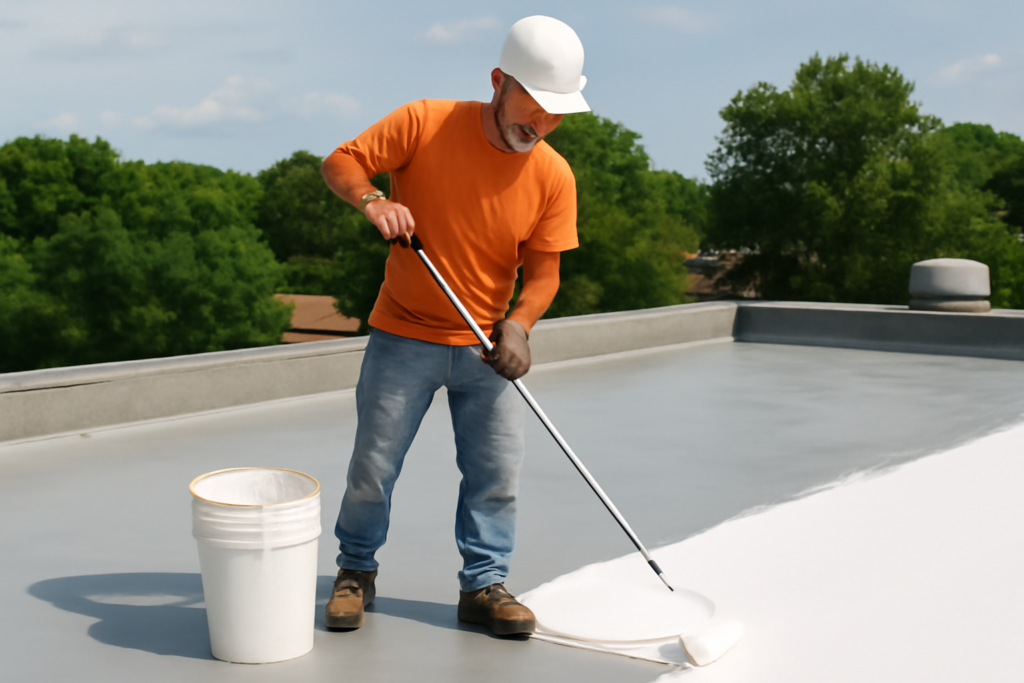
Homeowners tackle silicone successfully on porch roofs, flat garage roofs, and RVs, with a few chemistry-specific habits. Buy high-solids product and a solvent-resistant ¾-inch nap roller (cheap covers dissolve and shed lint into the film), wear clothes you will throw away, and keep mineral spirits handy for tools — water cleanup does not exist in this aisle. Work the details first with brush-grade silicone and polyester fabric at seams, then roll the field in one generous pass at the pail’s specified coverage, back-rolling to an even film. Humidity is your friend (moisture-cure), but dew and rain within the first two hours can glaze the finish. Two warnings deserve repeating: the roof will be dangerously slick when wet forever after, so add granules or walk pads on any path you will actually use, and mask absolutely everything downwind if you spray — silicone overspray on a neighbor’s car is an insurance claim, not a cleanup.
The Verdict
Silicone is the premium answer to a specific problem: flat roofs that hold water and owners who want to restore once and stop thinking about it. If that describes your building, the extra dollar per square foot over acrylic is money well spent. If your roof drains cleanly, save the premium — and either way, insist on measured millage, because with silicone you are buying thickness, not marketing.