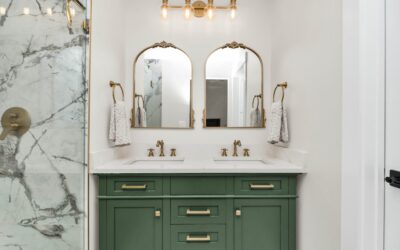
The average powder room or guest bath in an American home measures between 35 and 50 square feet, and a full gut renovation in that footprint runs $9,000 to $18,000 in 2025. Most homeowners do not need that. A focused small bathroom makeover that keeps the existing plumbing locations, refreshes high-impact surfaces, and swaps fixtures can transform the room for $1,200 to $3,000 in materials and one weekend of work. This guide walks through the upgrades that move the needle, the ones that waste money, and the order to tackle them in.
Where the Money Actually Goes in a Small Bath
In a 5×8 bathroom, three elements occupy more than 80% of your visual field: the floor, the vanity wall, and the tub or shower surround. Spend your budget on those and almost everything else can stay. Toilet, towel bars, lighting, and trim are easy add-ons that compound the perceived upgrade.
The trap homeowners fall into is moving plumbing. Relocating a toilet flange, sink drain, or tub valve adds $1,500 to $4,000 in plumbing labor and often triggers permit and inspection requirements. Unless the existing layout is genuinely unworkable, leave the rough-in alone.
The High-Impact Upgrades
These four projects deliver the most visible change per dollar in a small bathroom:
- New vanity and faucet: $300 to $900 at Home Depot, Lowe’s, or Wayfair for a 24 or 30-inch unit with cultured marble or quartz top, plus $80 to $250 for a quality faucet.
- Floor tile replacement: $200 to $600 in materials for porcelain or LVT covering 35 to 50 square feet, with one extra weekend day for install.
- Paint and lighting: $80 for a gallon of mildew-resistant paint plus $80 to $250 for a new vanity light fixture.
- Shower regrout and re-caulk: $40 in materials, one afternoon, and the result reads as “new tile” to anyone visiting.
Add a new toilet ($180 to $400) if yours is older than 1995 (pre-low-flow) or showing surface stains, and a frameless mirror ($60 to $200) to replace a builder-grade mirror clip-mounted to the wall.
Sequencing the Project
Order matters. Doing things in the wrong sequence forces you to redo work or damages new surfaces. Follow this sequence:
- Demo the vanity and old floor tile (Saturday morning).
- Patch and skim drywall as needed (Saturday afternoon).
- Prime and paint walls and ceiling (Sunday morning, two coats).
- Install new floor tile or LVT (Sunday afternoon, with cure time overnight).
- Set vanity, hook up plumbing, install faucet (Monday evening).
- Caulk perimeter, install lighting, hang mirror, install accessories (Tuesday evening).
Most small baths can be completed over a long weekend if the materials are staged in advance. The wild card is if you find rotted subfloor under the toilet, which adds 4 to 6 hours of repair work.
Floor Material Choices
For a small bathroom, three floor materials cover 95% of practical scenarios. Porcelain tile in 12×24 format (around $3 to $6 per square foot in materials) gives the most premium look and lasts indefinitely with proper grout. Luxury vinyl plank (LVP) at $2.50 to $5 per square foot installs in an afternoon over the existing subfloor and tolerates minor moisture. Sheet vinyl at $1 to $2 per square foot is the cheapest functional option but reads as builder-grade.
Avoid laminate in any bathroom. Even waterproof-rated laminates fail at the seams over time when condensation drips off the toilet tank or splashes from the tub.
Paint Colors That Work in Tight Spaces
Conventional advice says small rooms need light colors to feel bigger. That is partly true but oversimplified. A small bath actually benefits from one of two extremes: pure light (Sherwin-Williams Alabaster, Benjamin Moore Simply White) for a clean spa feel, or saturated dark (Benjamin Moore Hale Navy, Farrow & Ball Inchyra Blue) for a jewel-box effect that hides the small dimensions.
The colors that fail are mid-tone beiges and grays. They highlight every dingy corner and read as builder-grade in any photo. Use a satin or eggshell finish on walls and a semi-gloss on trim and the back of the door for moisture resistance and washability.
Lighting and Ventilation Updates
The single fastest visual upgrade in a small bath is replacing the lighting. Builder-grade vanity bars with three exposed bulbs above the mirror date the room instantly. A 24 or 30-inch linear LED vanity light with a frosted shade ($80 to $200) and 3000K color temperature flatters skin tones and reads as a fresh fixture.
While you have the ladder out, check the bathroom fan. If it is rated under 80 CFM or louder than 1.5 sones, replace it with a Panasonic WhisperCeiling FV-0511VQ1 (110 CFM, 0.3 sones, around $200). Adequate ventilation prevents the mold and grout discoloration that aged your last bathroom.
The Upgrades to Skip
Two popular upgrades return very little visual or functional value. Heated floors ($600 to $1,200 installed) feel great on a January morning but no buyer notices them at sale time and they do not photograph. Smart mirrors with built-in displays ($400 to $1,200) date faster than any other component and rarely work after 5 years of humidity exposure.
Spend that money on tile quality and a real stone or quartz vanity top instead. Both photograph and both add resale value when the time comes.
FAQ
How much does a small bathroom makeover cost? A cosmetic refresh keeping plumbing in place runs $1,200 to $3,000 in materials. A full renovation with new tile, vanity, toilet, and lighting runs $4,000 to $7,000 DIY or $9,000 to $18,000 with a contractor.
Can I do a small bathroom makeover myself? Yes, if you can paint, install LVT or tile, and connect a toilet and faucet. Skip DIY for jobs requiring drain or supply line relocation.
What is the most expensive part of a bathroom remodel? Labor, then tile and stone surfaces. Plumbing relocation if needed comes third.
Should I tile to the ceiling in a small bathroom? Floor-to-ceiling tile in the shower makes the room feel taller. Wainscot tile to chair-rail height (36 to 48 inches) is a more affordable middle ground.