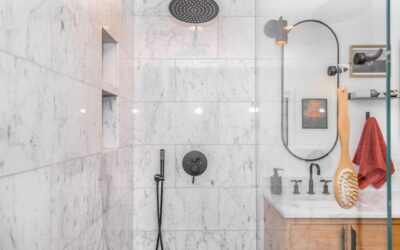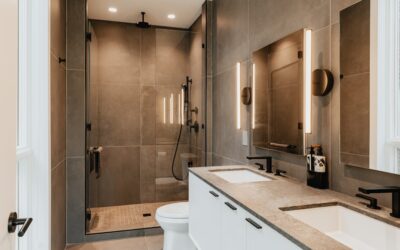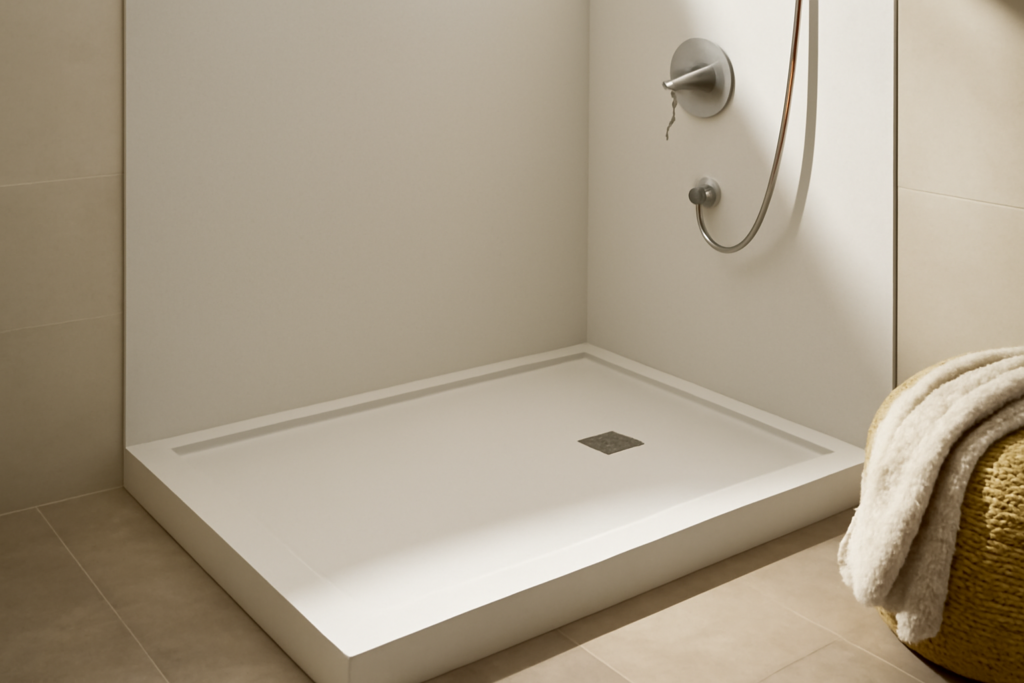
Between the flexing of a $200 acrylic base and the labor bill of a fully tiled mud pan sits a category that has quietly taken over mid-range and high-end bathroom remodels. A solid surface shower pan is a dense, non-porous slab of mineral-filled resin — the same material family as Corian countertops — molded into a ready-to-install shower floor with integral slope, threshold, and drain placement. It looks like honed stone, feels warm and solid underfoot, never needs grout maintenance, and installs in a day. Here is what the material actually is, how it stacks up against the alternatives, what it costs, and what to check before you buy one.
Part of our Bathroom Remodeling & Flooring guide — explore the full guide →
What “Solid Surface” Actually Means
Solid surface is a composite of roughly 60 to 70 percent natural mineral filler — usually alumina trihydrate derived from bauxite — bound in acrylic or polyester resin. Unlike gelcoat fiberglass or vacuum-formed acrylic, the material is homogeneous all the way through: the color and pattern at the surface continue through the full thickness, typically 3/4 inch to 1-1/2 inches in a pan. That through-body composition is the source of its two defining virtues. Scratches and stains have no laminate layer to breach, so damage sands out with fine-grit paper the way a Corian counter renews. And the slab is rigid enough to feel like stone underfoot, with none of the hollow flex and creak that gives away a budget acrylic base.
Manufacturers in this space include Swanstone (a longtime category leader), Transolid, Tile Redi’s solid-surface lines, Wetstyle, and the house brands behind many “stone resin” pans sold online. Terminology overlaps: “stone resin” and “engineered stone” pans are chemically close cousins — crushed mineral in resin with a gelcoat or through-body finish — and the buying criteria below apply to them equally.
Solid Surface vs. Acrylic, Fiberglass, and Tile
Against acrylic and fiberglass, the differences are structural. A fiberglass pan runs $150 to $300 and flexes underfoot unless perfectly bedded in mortar; its gelcoat scratches and yellows within a decade of hard use. Acrylic is a step up in gloss retention at $200 to $500 but shares the thin-shell construction. Solid surface pans weigh two to four times more, span 100 to 250 pounds for a typical size, and feel monolithic. Expect 20 to 30 years of service with trivial maintenance.
Against a custom tiled mud pan, the comparison flips to labor and risk. A tiled pan offers unlimited size and design freedom, but it depends entirely on the installer’s waterproofing — the pan liner or membrane work — and it introduces a floor full of grout lines to seal and scrub for decades. A quality tile pan costs $1,500 to $3,500 installed by the time you count the mud work, membrane, tile, and labor. A solid surface pan hits a similar or lower installed price with zero grout on the floor and a factory-molded slope that cannot be botched. The trade is design freedom: you pick from the maker’s sizes, colors, and drain locations rather than composing your own floor.
Sizes, Configurations, and Prices
- Standard alcove sizes: 60×30, 60×32, 60×36, 48×36, 48×32, and 36×36 inches cover most tub-to-shower conversions. Street prices run $500 to $1,100 depending on size and brand.
- Neo-angle and corner units: 36×36 and 38×38 neo-angle pans for corner enclosures, $450 to $900.
- Barrier-free and low-threshold: Pans with 3/4-inch to 1-inch curbs or fully zero-entry profiles for aging-in-place remodels, $700 to $1,500.
- Custom cuts: Several fabricators cut solid surface pans to order — any footprint, offset drains, ramped entries — at $1,200 to $2,500. This is the option tile used to own exclusively.
Drain location is part of the SKU: center, offset, left, right, or linear at the entry or back wall. Matching the new pan’s drain to the existing plumbing saves hundreds in drain-line relocation, so measure the current drain’s center from both walls before shopping.
Installation: Easier Than Tile, Fussier Than Acrylic
A solid surface pan installs over a clean, level subfloor, almost always in a full bed of mortar or the manufacturer’s specified structural adhesive — even when the instructions call the pan self-supporting, bedding eliminates voids and the remote chance of a stress crack. The sequence is straightforward: dry-fit and check for level in both directions, connect and test the drain with the gasket system supplied, trowel the bed, set the pan with a slight twist, weight it overnight, then flash the wall panels or tile over the pan’s integral flange or sealant joint per the maker’s detail. A capable DIYer with a helper (remember the weight) can set one in a day. Budget $300 to $700 for professional installation on a ready subfloor; complete tear-out-to-done shower conversions built around these pans typically land between $3,500 and $8,000.
Two checks prevent the common failures. Verify subfloor level within 1/4 inch over the pan’s span — these slabs do not bend to follow a humped floor, and shimming afterward is miserable. And test-fit the drain height early; solid surface pans are thicker than the acrylic they often replace, which can require a drain coupling adjustment below the floor.
Living With One: Cleaning and Repair
Maintenance is where the material pays rent. The surface is non-porous, so soap scum and hard-water film wipe off with a non-abrasive cleaner or a vinegar-water spray; there is no grout to reseal, mold has nowhere to root, and matte finishes hide water spots well. Deeper scuffs, dulling, or even a careless dropped-tool gouge respond to progressive sanding — 320 to 600 grit followed by a Scotch-Brite pad restores the factory matte, something impossible with gelcoat products. Avoid pure acetone soaks and harsh drain chemicals sitting on the surface, and skip abrasive powders on gloss finishes. Most brands back residential pans with 25-year-to-lifetime limited warranties, which tells you how the actuaries rate the material.
Buying Checklist: Separating Quality From Marketing
Product pages in this category lean hard on the words “stone” and “luxury,” so vet the substance instead. Confirm the material is through-body — same composition top to bottom — rather than a gelcoat skin over resin; ask the seller directly if the listing is vague, and treat a refusal as an answer. Check the published weight: a genuine solid surface 60×32 pan should weigh at least 120 pounds, and a 60-pound “stone resin” pan of the same size is telling you its true construction. Look for a reinforced or double-thick drain zone, since that is where stress concentrates. Verify the threshold height suits your door hardware and any accessibility plans. Read the warranty for the word “residential lifetime” versus a bare 1-year term — the gap between those two phrases is the gap between material grades. Finally, confirm the pan ships freight with a real damage-claim window, and inspect every edge before signing for delivery; a hairline corner crack from shipping is the single most common defect, and it is claimable only on the day it arrives.
Where It Falls Short
Fairness requires the con list. Weight makes second-floor solo installs genuinely hard. Color and pattern selection, while growing, cannot match tile’s infinity — most lines run white, bone, gray, and a handful of stone-look patterns. Very long custom pans can exceed $2,000, eroding the cost edge over tile. Resin-bound surfaces can be damaged by extreme heat, so a curling iron parked on the curb is a bad habit. And bargain “stone resin” imports with thin gelcoat over a resin core are not true through-body solid surface; they clean up the same day one but repair like fiberglass. Ask specifically whether color runs through the full thickness before trusting a low price.
The Bottom Line
For a remodel that wants a grout-free floor, stone-like solidity, and a one-day install without betting the house on a mud-pan’s waterproofing, a solid surface shower pan is the strongest value in the category. Spend $500 to $1,100 for a standard size from an established brand, match the drain location to your plumbing, bed it fully in mortar, and the shower floor becomes the one part of the bathroom you never think about again.