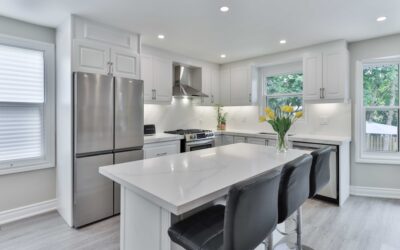
Single-color kitchens look dated within five years; well-designed two tone kitchens stay relevant for fifteen because the contrast adds depth that one color cannot match. The trick is knowing which 70/30 color split works in your specific layout — and which combinations end up looking like a designer mistake. After remodeling kitchens for nearly two decades, I have seen what stands up to time and what photographs well at signing day but ages poorly. Here is the playbook.
Part of our Kitchen Remodeling guide — explore the full guide →
- The Core Concept
- Most-Loved Pairings That Hold Up
- Pairings That Look Dated Fast
- The Island as the Color Break
- Choosing the Right Combination for Your Light
- Counter and Backsplash Coordination
- Hardware: One Finish or Two?
- Cost of a Two-Tone Update
- Painting Steps That Actually Hold Up
- Real-Estate Considerations
- Common Mistakes to Avoid
- Final Tips From the Field
The Core Concept
A two-tone kitchen uses different cabinet colors in distinct zones. The most common splits:
- Upper cabinets one color, lower cabinets another (70 percent of two-tone kitchens)
- Island a contrasting color from the perimeter cabinetry
- Pantry or floor-to-ceiling units in a third tone
- Range wall accent in a different shade
The visual rule: one color should dominate (60-70 percent of the cabinet square footage), while the second provides accent. A 50/50 split competes for attention and reads chaotic in real-world lighting.
Most-Loved Pairings That Hold Up
White uppers with navy lowers — classic, timeless, and forgiving for resale. Sherwin-Williams Pure White (SW 7005) paired with Naval (SW 6244) reads as both casual and formal depending on hardware. Brass pulls warm it up; stainless cools it down.
White uppers with sage green lowers — softer than navy, currently rising in popularity. Try Benjamin Moore Decorator’s White (OC-149) with Saybrook Sage (HC-114). Pair with natural oak open shelves to add a third texture.
Cream uppers with charcoal lowers — adds warmth without yellow. Benjamin Moore White Dove (OC-17) with Kendall Charcoal (HC-166) is a forgiving combination that suits transitional and modern farmhouse styles.
Wood uppers with painted lowers — this design keeps natural texture in the eye line. Quarter-sawn white oak with painted black or deep blue lowers reads custom and high-end.
Pairings That Look Dated Fast
- Espresso brown uppers with cream lowers — peaks 2008
- Yellow oak uppers with anything — full-replacement territory
- Two saturated colors (red + green, blue + orange) — too aggressive for daily living
- White uppers with high-gloss black lowers — reads contractor-grade flip
- Three colors plus an accent — visual noise that ages poorly
The Island as the Color Break
The simplest two-tone application is a contrasting island against neutral perimeter cabinets. Painting just the island lets you experiment with bolder colors — emerald green, deep navy, even oxblood — without committing the entire kitchen.
Budget impact is also lower. Repainting 8 cabinet doors and a 4-foot island base runs $300-$600 in materials versus $2,000-plus for the entire kitchen.
Choosing the Right Combination for Your Light
North-facing kitchens get cool blue-gray light. Avoid cool gray or icy white pairings — the room reads grim. Use warmer whites (Behr Navajo White, Sherwin-Williams Alabaster) and pair with greens, terracottas, or soft browns.
South-facing kitchens get warm yellow-tinted light. Cool blues and grays balance the warmth nicely. Avoid stacking warm-on-warm (cream uppers with brown lowers in a south-facing room reads muddy by 4 pm).
East-facing kitchens look sharp in the morning, dim by afternoon. Lean toward higher contrast pairings (white plus deep navy) to maintain visual definition all day.
Counter and Backsplash Coordination
The countertop becomes the bridge between the two cabinet colors. Calacatta-style quartz with both gray and warm vein tones bridges almost any pairing. Solid-color quartz (white or black) creates more visual separation, making each cabinet color stand alone.
Backsplash in a third color is risky. Stay within the same family — if uppers are white and lowers are navy, use white subway tile, white herringbone, or a pale gray-blue zellige. A bold backsplash pattern adds a fourth visual element that competes with the cabinet colors.
Hardware: One Finish or Two?
Most two tone kitchens look best with one consistent hardware finish across all cabinets. Brass, brushed nickel, or matte black ties the room together regardless of cabinet color split.
Mixing finishes (brass on uppers, black on lowers) works only when the rest of the kitchen has matching mixed metals — pendant lights, faucet, appliance pulls. Otherwise it looks like a mistake during cabinet installation.
Cost of a Two-Tone Update
- Repaint existing cabinets DIY: $300-$700 in materials
- Repaint existing cabinets professionally: $3,500-$7,000
- Replace cabinet doors only (refacing): $4,500-$9,000
- Full cabinet replacement: $12,000-$35,000
- Island-only paint accent: $200-$500 DIY
For most homeowners, painting is the fastest ROI. Quality paint job lasts 8-12 years.
Painting Steps That Actually Hold Up
- Remove doors, drawer fronts, and hardware. Label everything
- Clean with TSP or Krud Kutter to remove kitchen grease
- Sand lightly with 220-grit sandpaper to give the surface tooth
- Prime with bonding primer (Zinsser BIN or Stix)
- Apply two coats of urethane-acrylic cabinet paint (Benjamin Moore Advance, Sherwin-Williams Emerald Urethane)
- Allow 7 days cure before regular use to avoid fingerprint marks
- Reinstall hardware with new screws if the originals are stripped
Real-Estate Considerations
Two-tone kitchens generally sell well — buyers view them as updated and intentional. The exception is highly saturated or trendy color pairings (terracotta, mustard yellow). For homes you plan to sell within 3-5 years, stick to neutral combinations with broad appeal: white plus navy, white plus charcoal, cream plus sage.
For your forever home, paint what you love. The cost of repainting in 8 years if your taste shifts is modest compared to living with a color you tolerate.
Common Mistakes to Avoid
- Choosing colors from sample chips without testing on actual cabinet doors
- Skipping the bonding primer — paint peels at the door edges within a year
- Splitting colors at random — uppers/lowers and island are the only natural breaks
- Picking trend-of-the-moment colors (Pantone color of the year) for whole-kitchen application
- Forgetting to paint the inside of cabinet doors and the cabinet boxes
Final Tips From the Field
Buy quart samples of three top color combinations. Paint a poster board with each pairing and live with them in the kitchen for a week. Look at them in morning, afternoon, and evening light — including under the actual kitchen lighting, which changes everything. Only commit after one week of viewing.