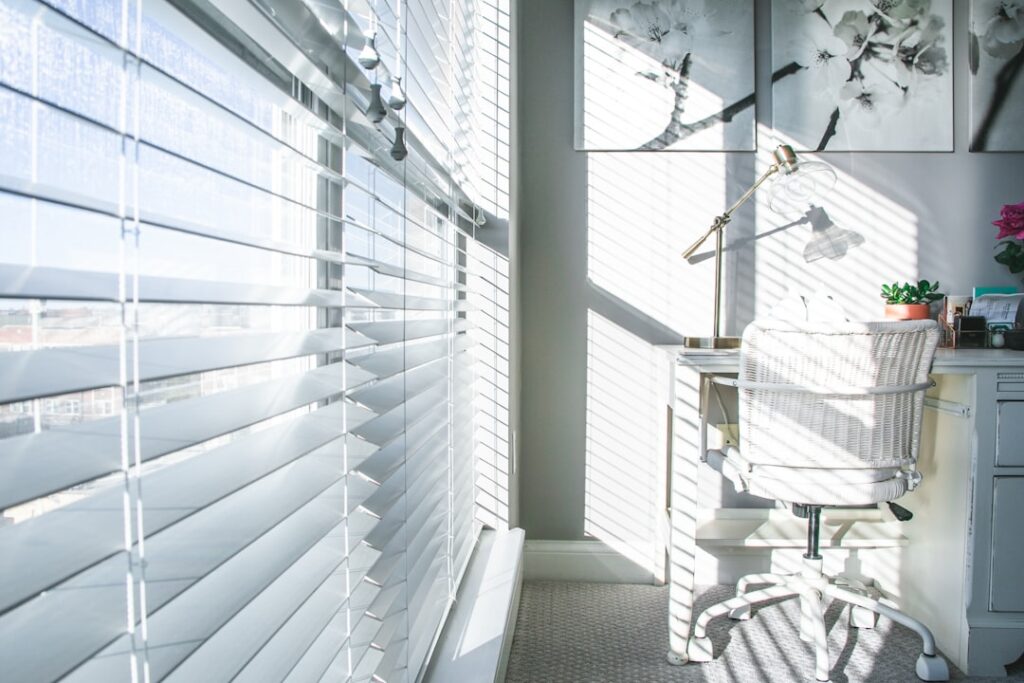
Walk into any blinds showroom and the choices blur together, but the types of window blinds actually fall into a handful of distinct categories, each built for a specific job. Some pivot to angle light, some stack to the side, and some are technically shades that get lumped in with blinds. Knowing which is which saves money and prevents ordering the wrong thing for a room.
- Venetian blinds (horizontal slats)
- Vertical blinds
- Wood and faux wood blinds
- Roller blinds (roller shades)
- Roman blinds (Roman shades)
- Cellular (honeycomb) shades
- Panel track blinds
- Pleated shades
- Smart and motorized versions
- Matching type to room
- Inside mount vs outside mount
- Cord safety and child-safe options
- Cost by type
- Choosing well
This guide lays out every major one of the types of window blinds, the slat sizes and materials that matter, and which style fits which window so you can match the covering to the room instead of guessing.
Venetian blinds (horizontal slats)
The classic. Horizontal slats connected by cords or a tilt wand rotate up to 180 degrees to control light and privacy, and the whole stack raises to the top. Slat widths run 1 inch (mini), 2 inch (standard), and 2.5 inch. Wider slats give a cleaner view when open and block more light when closed; narrow slats suit small windows. Available in aluminum, PVC, and faux wood, Venetian blinds are the versatile default for living rooms, offices, and kitchens.
Vertical blinds
Vertical slats (called vanes), 3.5 inches wide, hang from a top track and rotate to angle light, then slide to one side or split to the center to fully clear the opening. They are the go-to for sliding patio doors and wide picture windows because they draw sideways rather than stacking down. Vanes come in PVC, fabric, and faux wood. The downside is a slightly dated look and vanes that sway or clatter in a draft, though modern fabric versions read much softer.
Wood and faux wood blinds
These are Venetian blinds made specifically from real basswood or a PVC/composite that mimics wood grain. Real wood is light, warm, and premium but warps in humidity, so keep it out of bathrooms and over kitchen sinks. Faux wood resists moisture and heat, costs less, and is the right pick for bathrooms, kitchens, and sunrooms. Both come mainly in 2 inch and 2.5 inch slats and add architectural warmth that metal and plastic cannot match.
Roller blinds (roller shades)
A single panel of fabric winds around a tube at the top and unrolls to cover the window, with no slats at all. Simple, clean, and inexpensive, roller blinds come in light-filtering, room-darkening, blackout, and solar-screen fabrics. Solar rollers cut glare and UV while keeping the view; blackout versions suit bedrooms. Because they are a flat sheet, they suit modern interiors and pair well under drapery. Many are available motorized.
Roman blinds (Roman shades)
Roman shades are fabric that folds into soft horizontal pleats as they rise, giving the tailored, upholstered look of drapery with the tidy operation of a blind. They come in flat-fold, hobbled (cascading loops), and relaxed styles, and can be lined for blackout or insulation. Best in bedrooms, living rooms, and dining rooms where you want softness and warmth rather than a hard slatted look. They stack up several inches at the top even when fully raised.
Cellular (honeycomb) shades
Named for the honeycomb-shaped air pockets in their cross-section, cellular shades trap air to insulate the window, the most energy-efficient of the common types. Single-cell suits milder climates; double-cell adds insulation for cold or hot regions and can noticeably cut drafts and heating loss. They come in light-filtering and blackout, in pleat sizes from 3/8 inch to 3/4 inch, and in top-down/bottom-up configurations that let you lower the top for light while keeping the bottom closed for privacy. Ideal for bedrooms, nurseries, and any energy-conscious home.
Panel track blinds
Wide fabric panels glide across a track and stack behind one another, a modern alternative to vertical blinds for very wide openings and sliding doors. Each panel is 8 to 12 inches or wider, giving a clean, contemporary look and covering spans up to 16 feet. Good for room dividers and floor-to-ceiling glass where vertical vanes would look busy.
Pleated shades
Similar in appearance to cellular shades but a single layer of pleated fabric with no insulating air pocket. Cheaper than cellular and fine for light filtering and decorative use where energy efficiency is not the priority. A reasonable budget alternative when you like the accordion look but do not need the insulation.
Smart and motorized versions
Most of these types, roller, cellular, Roman, Venetian, and vertical, are now available with tubular motors for remote, app, or voice control and scheduling. Motorization costs $60 to several hundred dollars more per window but is worth it on hard-to-reach, tall, or numerous windows, and it removes the pull-cord hazard around young children.
Matching type to room
- Bedroom: blackout roller, blackout cellular, or lined Roman for darkness and, in cellular, insulation.
- Bathroom / kitchen: faux wood or PVC Venetian, or moisture-resistant roller, for humidity and easy wiping.
- Living room: wood Venetian, Roman, or roller under drapes for warmth and light control.
- Patio / sliding door: vertical blinds or panel track that draw to the side.
- Cold or hot climate: double-cell cellular shades to cut energy loss.
- Wide picture window: panel track or a wide-slat Venetian for a clean sweep.
Inside mount vs outside mount
Every type installs one of two ways, and it changes the look and the light control. An inside mount sits within the window frame for a clean, recessed appearance that shows off the trim, but it needs adequate frame depth, usually 2 to 3 inches, and leaves small light gaps at the edges. An outside mount attaches to the wall or trim above and around the opening, covering the whole window; it blocks more light, makes a small window look larger, and hides an out-of-square or shallow frame. For bedrooms where darkness matters, an outside mount with 2 to 3 inches of overlap on each side beats an inside mount for killing light leaks.
Cord safety and child-safe options
Corded blinds are a genuine strangulation hazard for young children and pets, and U.S. safety standards now push cordless designs for that reason. If you have kids, choose cordless blinds (a spring or push mechanism), cord-loop systems with a tensioner anchored to the wall, or motorized shades with no dangling cord at all. Retrofit cord cleats can wrap loose cords out of reach on existing blinds, but the safest path is buying cordless or motorized from the start. Cellular, roller, and Roman shades all come in cordless versions, so you rarely have to trade safety for style.
Cost by type
- Budget: aluminum and vinyl Venetian, basic rollers, and pleated shades, often $15 to $60 per window ready-made.
- Mid-range: faux wood Venetian, quality rollers, and single-cell cellular, roughly $50 to $150 per window.
- Premium: real wood blinds, custom Roman shades, double-cell cellular, and panel track, commonly $150 to $400-plus per window.
- Add-ons: motorization adds $60 to several hundred dollars per window; custom sizing and blackout linings add more.
Ready-made stock blinds cost far less but only fit standard windows; custom sizing costs more and is worth it for odd-sized or specialty-shaped openings.
Choosing well
One more factor worth weighing is upkeep. Slatted blinds like Venetian and vertical collect dust on every slat and take longer to wipe down; rollers, cellular, and pleated shades present a flat or folded surface that a quick vacuum-brush pass cleans in seconds. In kitchens and bathrooms, moisture-resistant faux wood and PVC wipe clean of grease and splashes, while fabric Romans and cellular can absorb odors and stains, so match the material to how messy the room gets. If low maintenance ranks high for you, lean toward roller or cellular shades over multi-slat blinds.
Start with the job the window needs done, darkness, insulation, a preserved view, moisture resistance, or a soft decorative look, and the right category narrows quickly. Among the many types of window blinds, most homes end up mixing two or three: cellular in bedrooms, faux wood in wet rooms, and rollers or Romans in living spaces. Measure each window, decide inside or outside mount, and buy the type built for that room’s demands rather than a single style stretched across the whole house.