A two-story vaulted ceiling creates drama, but it also leaves homeowners staring at a giant blank wall that swallows artwork and overwhelms furniture. A well-designed vaulted ceiling accent wall brings the eye down, anchors the space, and turns the architectural feature into a defining moment instead of a decorating headache. Materials range from a $200 weekend paint job to a $12,000 stone fireplace surround, and the choice depends on the wall’s role: focal point behind a fireplace, backdrop behind a sofa, or visual stop at the end of an open-plan room.
Why Vaulted Walls Need Special Treatment
Vaulted walls run 16 to 24 feet tall in most residential builds. A standard 8-foot painted accent wall has roughly 100 square feet to fill; a 20-foot vaulted version doubles to over 240 square feet. That extra square footage swallows undersized art, makes paint colors read flat, and demands materials that scale up visually without overwhelming.
The other complication is access. Anything above 12 feet requires either rolling scaffolding (Werner 12-foot scaffold rental at $90/day from Sunbelt), a multi-stage ladder, or hiring out the install entirely. Plan access logistics before falling in love with a finish that needs detailed work at 18 feet up.
Shiplap and Wood Paneling
Shiplap remains the most-requested vaulted accent wall material because horizontal lines visually shrink tall walls and add cottage or modern-farmhouse warmth. Run the boards horizontally for the most dramatic effect, or vertically to emphasize even more height in low-vaulted rooms under 16 feet.
Real shiplap from a lumberyard runs $3 to $7 per square foot in 1×8 pine. Faux shiplap panels from Home Depot’s Pure Bond ($35 per 4×8 sheet) or the UFP-Edge Charred Wood collection ($45 per 8-foot plank) install faster with construction adhesive and 18-gauge brad nails. For a 240-square-foot vaulted wall, materials run $800 to $2,000.
Stone and Stacked Stone Veneer
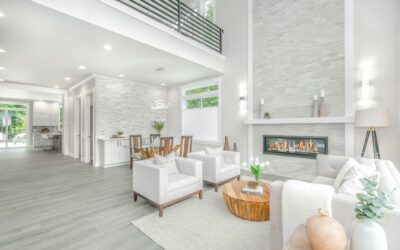
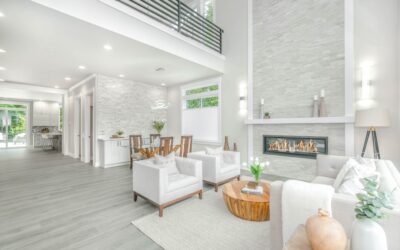
Stone surrounds make the strongest visual anchor on a vaulted wall, especially when paired with a fireplace. Cultured Stone, Eldorado Stone, and ClipStone offer mortarless dry-stack veneer systems that run $14 to $24 per square foot installed. For full bed-mortared natural stone, expect $28 to $55 per square foot installed depending on local labor rates.
Stone runs all the way to the ceiling peak for maximum drama, or stops at a horizontal line 8 to 10 feet up to create a “wainscot at scale.” Stopping the stone at a logical line (often where the cathedral ceiling pitch begins) reads more architectural than running stone to a vague stopping point mid-wall.
Painted Color Statements
For a low-cost transformation, deep-saturated paint is the workhorse. Benjamin Moore Hale Navy (HC-154), Sherwin-Williams Iron Ore (SW 7069), and Farrow & Ball Studio Green (No. 93) all read as architectural anchors on vaulted walls. Use Aura Matte Finish ($95 a gallon) for the deepest color depth — flat sheens swallow imperfections at high heights better than satin or eggshell.
Hire painters with scaffolding experience and OSHA fall-protection training. Standard interior painters charge $3 to $6 per square foot, but vaulted-wall painting adds $1.50 to $3 per square foot for scaffolding setup and risk premium. A 240-square-foot vaulted accent wall runs $1,000 to $2,200 painted by a pro versus $200 to $400 in DIY supplies if you can manage the scaffolding yourself.
Built-Ins and Wall-to-Ceiling Storage
One of the most striking vaulted accent walls is a floor-to-peak built-in: bookshelves, cabinets, or display niches climbing the full height of the vault. Customs run $4,500 to $14,000 depending on millwork detail. The visual payoff is enormous because the storage doubles as architecture.
For DIY-friendly versions, the IKEA Billy bookcase ($150) stacked two-high reaches 16 feet when paired with the extension unit. Anchor every bookcase to wall studs through the back panel with 2-1/2-inch GRK construction screws — vaulted-wall bookcases that aren’t anchored have a real tipping risk, and a 16-foot bookcase wall hits with force.
Wood Slat Walls
Vertical wood slat walls have exploded in 2024 and 2025 designs because they handle the tall vault gracefully. Run 1×2 strips of oak, walnut, or stained pine spaced 1 to 1-1/2 inches apart against a black-painted backer board. The vertical rhythm pulls the eye upward and frames the ceiling peak as architecture rather than empty space.
Pre-built slat panels from Wayfair ($85 to $200 per 4-foot section) skip the labor of cutting and spacing individual strips. The downside is matching grain across multiple panels — buy from a single dye lot and inspect each panel before installing. The Acupanel acoustic slat system ($120 per 4-foot panel) doubles as sound dampening, useful in vaulted great rooms where echoes get out of hand.
Lighting the Accent Wall
- Wall-washer downlights (Halo PD6 LED at $65 each) mounted in the ceiling slope, aimed straight down the wall face
- Picture lights (Restoration Hardware Aged Brass at $295) above hung artwork, hardwired to a switch
- Upward-throwing floor cans (Volt Lighting brass at $115) tucked behind sofas or fireplace surrounds for dramatic uplighting
- LED tape under shelving or behind stone returns — Govee Wi-Fi Pro at $40 lets you change color seasonally
- Statement chandelier in the room center — frequently more dramatic than wall-mounted sconces on a vaulted wall
Hiring Out vs DIY
Painting a vaulted accent wall is DIY-able if you’re comfortable on scaffolding. Anything else — shiplap, stone, slats, built-ins — is realistically a contractor job at heights above 12 feet because the time and risk add up fast. A trim carpenter charges $65 to $95 an hour for shiplap install on vaulted walls, with full projects landing $2,500 to $7,500 depending on material choice.
Whatever you build, paint or stain a sample on a 24-inch by 24-inch piece of drywall first, then hold it up against the wall at different heights and times of day. Light behaves differently at 4 feet than at 14 feet, and a color or texture that looks rich at eye level may go gray and lifeless near the peak. That single test board prevents most regret on a finish you’ll live with for the next 15 years.