
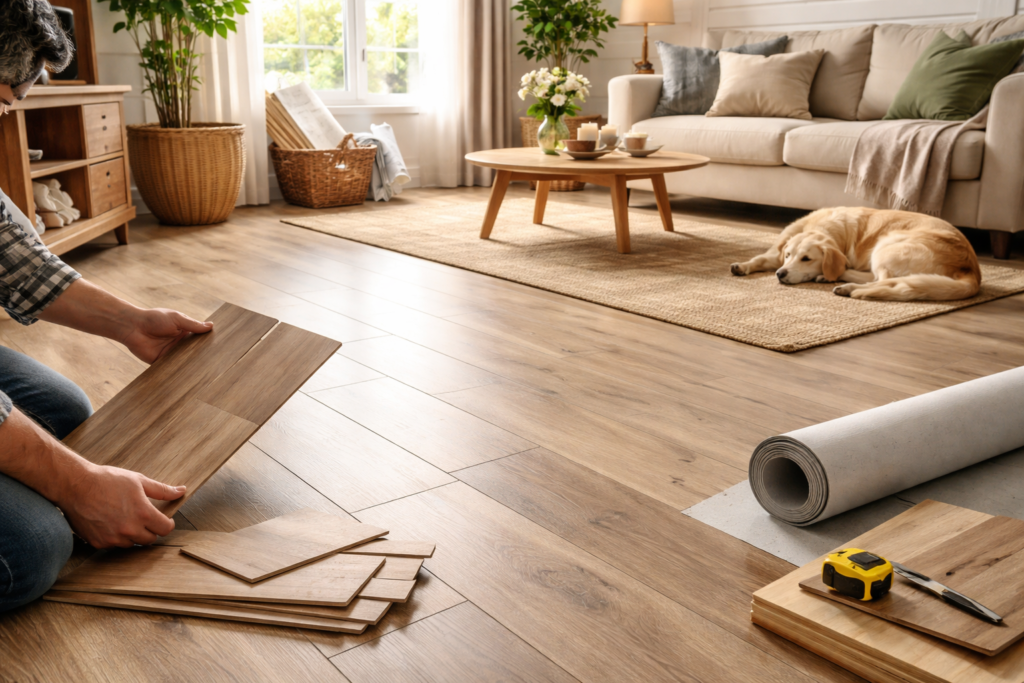
Vinyl has gone from the cheap option in builder spec homes to the dominant residential flooring category in the United States, with luxury vinyl plank alone capturing more than 25 percent of new floor installations as of last year. The vinyl flooring benefits driving that shift are real and measurable: a 100 percent waterproof core, click-lock installation that a homeowner can complete in a weekend, and a price-to-durability ratio that engineered hardwood cannot match in busy households. But the category covers everything from $1 per square foot sheet vinyl to $7 per square foot premium SPC, and the benefits scale with the product tier you choose.
Truly Waterproof Performance
Modern rigid-core vinyl planks, both stone plastic composite (SPC) and wood plastic composite (WPC), are constructed with PVC-bonded mineral cores that do not absorb water. Submerge a Lifeproof or COREtec plank in a bucket for 30 days and pull it out: no swelling, no warping, no edge curl. That makes vinyl the right choice for kitchens, mudrooms, finished basements, and full bathrooms where engineered hardwood and laminate fail.
This matters during real-life events. A washing machine hose blowing at 3 a.m. can dump 200 gallons of water onto a floor before anyone notices. Vinyl shrugs it off. Hardwood plank floors typically need to be pulled out and replaced after that kind of event.
Installation a Homeowner Can Actually Do
Rigid-core click-lock vinyl uses Unilin and Valinge angle-tap locking profiles that engage with hand pressure. A motivated DIYer with a tape measure, a utility knife, and a tapping block can install 600 to 800 square feet in a weekend. No glue, no nails, no specialty tools required. Compare that with site-finished hardwood, which demands a pneumatic flooring nailer, a moisture meter, and three to five days of professional labor.
Pad-attached vinyl simplifies the install further. The IXPE or cork backer eliminates the underlayment step and provides acoustic dampening that earns IIC ratings of 65 to 71 over standard subfloors with no additional pad.
Pricing That Spans Every Budget
Builder-grade sheet vinyl starts at $0.79 per square foot. Entry-level rigid core planks run $1.99 to $2.79. Mid-tier 20 mil products from Lifeproof, Pergo Extreme, and Mohawk SolidTech sit between $3.00 and $4.50. Premium SPC and engineered LVT from COREtec Premium, Mannington Adura Max Apex, and Karndean Korlok stretches to $5 to $7 per square foot.
Installed pricing typically adds $1.50 to $3.50 per square foot in labor, putting most whole-home vinyl projects between $4 and $9 per square foot total. That is roughly half the installed cost of a comparable engineered hardwood floor.
Durability Specs to Look For
The wear layer measured in mils is the most important durability number. A 6 mil wear layer is builder-grade and may show scratches within a year in a high-traffic hallway. A 12 mil wear layer handles standard residential traffic. A 20 mil layer survives dogs, kids, and rolling office chairs. A 22 to 28 mil layer is rated for light commercial use, which means rentals and vacation homes.
- Aluminum oxide ceramic-bead finish: top tier scratch resistance
- Embossed-in-register texture: visual realism that holds up over time
- UV-cured urethane top coat: prevents yellowing and fading
Comfort and Sound
Vinyl with attached underlayment is noticeably quieter than tile or laminate. The combination of a flexible PVC layer and IXPE pad absorbs impact, so footfall transmission to rooms below is reduced. SPC reads slightly harder underfoot than WPC because the limestone core is more dense, but both are softer than ceramic and porcelain.
Temperature comfort is a wash. Vinyl is cooler than carpet but warmer than tile in winter, and it works with electric radiant heat systems rated under 85 degrees Fahrenheit, which most major brands explicitly approve.
Low Maintenance and Easy Cleaning
The urethane wear layer on modern vinyl does not need wax or polish. Daily care is a dust mop or vacuum on hard-floor mode. Weekly cleaning is a damp mop with pH-neutral cleaner like Bona Hard-Surface Floor Cleaner or Bruce No-Wax Floor Cleaner. Avoid steam mops, which can lift edge bevels and void warranties.
Honest Cons You Should Know
Vinyl will not refinish. If a board takes severe damage, you replace it. Heavy point loads from refrigerator wheels or stiletto heels can dent lower-tier products. Sunlight exposure on south-facing rooms can fade lower-quality vinyl over five to seven years, so look for products with at least 8-hour QUV light-fastness ratings.
Indoor air quality concerns persist around PVC and phthalate plasticizers. Mitigate by choosing FloorScore certified or GreenGuard Gold certified products, which test below 0.5 mg per cubic meter total VOC after 14 days of off-gassing.
Brand Spotlight: COREtec Pro Plus
Shaw’s COREtec Pro Plus line is the most refined balance of price and performance in mid-tier vinyl. The 20 mil wear layer, embossed-in-register texture, and 5 mm SPC core sell for $3.99 to $4.79 per square foot. The U4 click-lock system engages firmly and disassembles cleanly if you need to lift a plank. The attached cork pad delivers an IIC sound rating of 71 and an R-value boost of 0.5, which is a small but real winter comfort improvement over bare SPC. Shaw backs the line with a lifetime residential and 20-year light commercial warranty handled directly through the manufacturer rather than the retailer.
Who Should Buy Vinyl Flooring
Vinyl flooring is the right call if you want a single waterproof product across kitchens, baths, and living areas, you have pets or children, you are working on a flip or rental, or you want to DIY a whole-house install. Choose a 20 mil or higher wear layer for any room with daily traffic, and pick mid-tier or premium brands if visual realism matters. If you want refinishable longevity, the warmth of natural wood underfoot, or the heirloom feel of solid wood floors, look at engineered or solid hardwood instead.
Prefer to explore on your own?
See how new flooring looks in your actual room in seconds — free, no signup.
Try the free Floor Studio →

