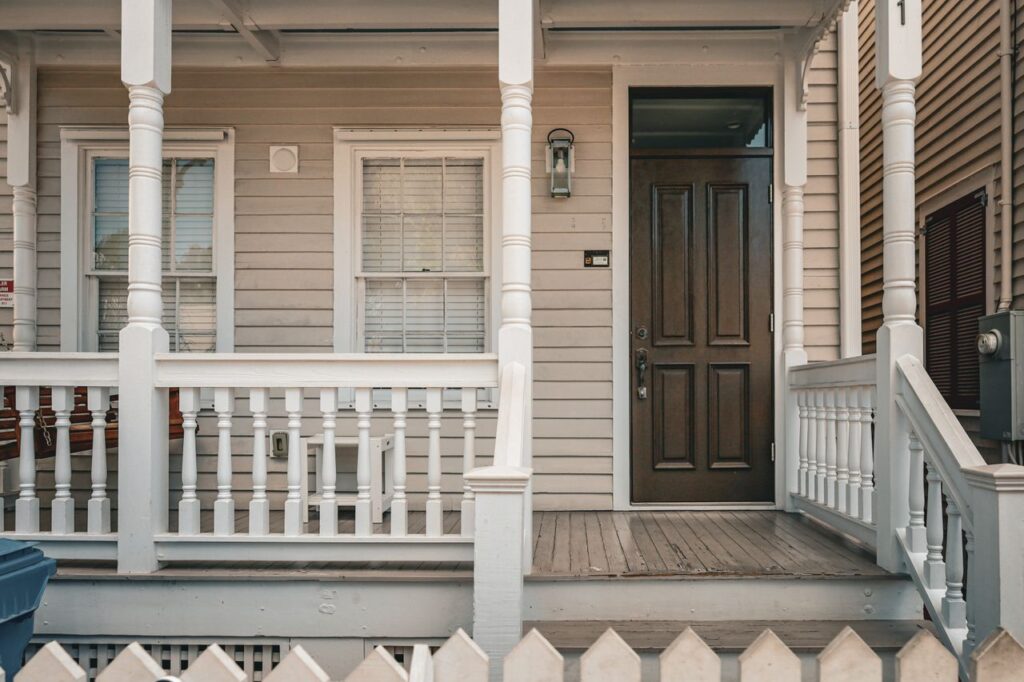
A porch floor takes a beating that no indoor floor ever sees: driving rain, baking sun, freeze-thaw cycles, and standing snow. Vinyl porch flooring handles all of it when it is the right product and installed with proper slope and drainage, which is exactly where most failures happen. Skip the slope or trap water under the wrong vinyl and you get rot, mold, and a buckled mess within a couple of seasons. This guide covers the two main outdoor vinyl systems, the waterproofing rules that actually matter, and what you should budget for a porch that lasts 20 years or more.
Indoor Vinyl Is Not Porch Vinyl
The first mistake homeowners make is buying interior luxury vinyl plank and laying it on an open porch. Standard indoor LVP and laminate are not rated for UV exposure or wide temperature swings. Direct sun fades them, and the daily expansion and contraction of an unconditioned space pops the click joints apart. Within a year you will see gaps, curling edges, and discoloration.
True outdoor vinyl porch flooring comes in two forms built for the weather. The first is rigid vinyl porch decking, sold in tongue-and-groove boards that interlock into a watertight surface, often branded as Wolf, Aeratis, or AZEK in PVC and composite lines. The second is roll-out vinyl sheet flooring rated for porches, a continuous waterproof membrane installed over a solid subfloor. Both shrug off rain, but they install very differently and suit different porch types.
With your porch floor looking fresh, it’s worth thinking about the finishing touches. A porch swing is a classic addition, and a retractable awning helps protect both the floor and your furniture from sun and rain.
We may earn a commission when you purchase through our links.
Vinyl Porch Decking: Boards That Interlock
Rigid PVC porch decking looks like traditional painted tongue-and-groove fir but never rots, splinters, or needs repainting. The boards lock side to side and shed water across the surface, so they work on open porches with no roof. Expect material costs of $4 to $9 per square foot, with installed prices reaching $12 to $20 per square foot once you add fasteners, framing adjustments, and labor.
The big advantages are longevity and low maintenance: a quality PVC porch deck carries 25-year-plus warranties and cleans with a hose. Hidden fasteners give a smooth, screw-free surface. The tradeoffs are cost and the fact that the boards need a properly framed, level joist system underneath at the right spacing, usually 16 inches on center or tighter. This is not a product you float over an old slab. It belongs on a built porch frame where the boards can be fastened and water can drain through the gaps or run off the pitch.
Vinyl Sheet Porch Flooring: Seamless Waterproofing
For a roofed porch over a solid plywood or concrete subfloor, porch-rated vinyl sheet flooring creates a single waterproof membrane with no seams for water to penetrate. Products marketed as porch and sunroom flooring, such as Tufdek or G-Floor roll vinyl, are designed to be glued down and, in some cases, heat-welded at the seams for a fully sealed surface.
Material runs roughly $3 to $8 per square foot, and the appeal is total water protection over the subfloor below, ideal for second-story porches and balconies that double as a roof for the space beneath. The catch is that the subfloor must be flawless. Any bump, gap, or fastener head telegraphs through, and any flaw in the seam or perimeter lets water under the membrane where it can rot the deck. Sheet vinyl also needs a covered or partially covered porch; full sun and pooling water shorten its life. Done right by an installer who welds the seams, it is the most reliable waterproofing for a covered porch deck.
Slope and Drainage: The Make-or-Break Detail
No vinyl porch floor survives standing water. Every porch must pitch away from the house so rain and meltwater run off. The standard is a slope of about 1/4 inch per foot, meaning a 10-foot-deep porch should drop roughly 2.5 inches from the house wall to the outer edge. On decking, this lets water run off and through the board gaps. On sheet vinyl, it carries water to a drip edge or scupper instead of pooling.
- Pitch away from the structure at 1/4 inch per foot minimum, never toward the house.
- Flash and seal the house wall where the porch meets siding so water cannot wick behind the floor.
- Install a drip edge or kick-out at the outer edge so runoff sheds clear instead of running back under the floor.
- Keep an air gap or ventilation under decking so the framing dries between rains and never traps moisture.
I have torn out more rotten porches caused by a flat floor than by any bad product. If your existing porch is dead level, the fix is to add tapered sleepers or re-pour with pitch before any vinyl goes down. It is unglamorous work, but it is the single thing that determines whether your new floor lasts two seasons or twenty years.
Subfloor and Underlayment Requirements
Decking needs sound, properly spaced joists, typically pressure-treated 2x framing at 16 inches on center, with a ledger lag-bolted and flashed to the house. Sheet vinyl needs a smooth, dry, dimensionally stable substrate, usually exterior-grade plywood or a clean concrete slab with no efflorescence. Sand down any ridges, set fastener heads below the surface, and fill seams so nothing prints through the vinyl.
Moisture testing matters on concrete. A slab that wicks groundwater will blister glued-down sheet vinyl from below. Tape a 2-foot square of plastic to the slab for 24 hours; condensation underneath means you need a moisture mitigation coating first. For wood substrates, confirm the framing is dry and treated, because vinyl seals moisture in as effectively as it keeps it out.
Pros and Cons of Vinyl Porch Flooring
On the plus side, vinyl porch flooring is fully waterproof, resists rot and insects, needs no annual staining or sealing, and cleans with soap and a hose. Quality PVC decking lasts decades and shrugs off splinters and warping that plague wood. Sheet vinyl gives seamless protection for covered porches and the rooms beneath them.
The downsides are real too. Cost runs higher than basic pressure-treated wood, dark vinyl gets hot underfoot in full sun, and both systems are unforgiving of installation shortcuts, especially slope and seam sealing. Get the framing, pitch, and drainage right and the product almost takes care of itself.
Final Recommendations
For an open, uncovered porch, choose rigid PVC tongue-and-groove decking over a properly pitched, well-ventilated frame. For a roofed porch or a deck that serves as a ceiling below, choose porch-rated sheet vinyl with welded seams over a flawless subfloor. In both cases, set the slope at 1/4 inch per foot, flash the house connection, and never let water pool. Budget $12 to $20 per square foot installed for decking and a bit less for glued sheet vinyl, and you will have a porch floor that outlasts the rest of the house.
Prefer to explore on your own?
See how new flooring looks in your actual room in seconds — free, no signup.
Try the free Floor Studio →