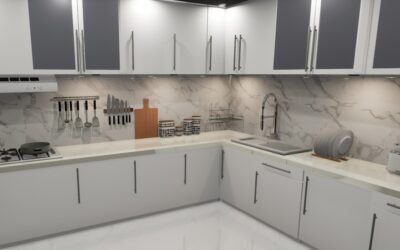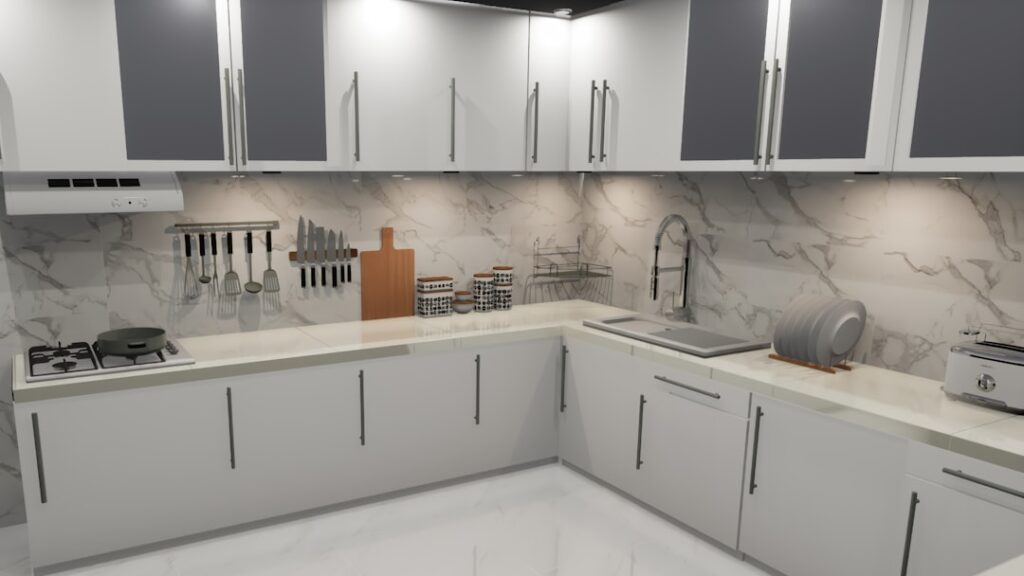
The all-white kitchen had its moment from 2010 to about 2022, and a lot of those kitchens now read as cold and dated. The fix isn’t a dramatic gut renovation — it’s a careful layering of warm beiges, taupes, and bones into the existing palette. A white and beige kitchen done well looks timeless instead of trendy, gives the room natural visual depth, and forgives daily wear in ways stark white never does. The trick is balancing undertones across cabinets, counters, flooring, and trim so nothing fights.
Part of our Kitchen Remodeling guide — explore the full guide →
- Pick Your Whites and Beiges Before Anything Else
- Cabinet Strategy: Two-Tone or Tonal Layering
- Countertops That Tie the Palette Together
- Flooring Choices for Visual Anchor
- Hardware, Faucets, and Metal Finish
- Lighting: Cool LEDs Will Kill the Look
- Tile, Backsplash, and Textile Accents
- Final Cost Check
Pick Your Whites and Beiges Before Anything Else
Whites and beiges both have temperature. White can lean cool (blue-based), warm (yellow-based), or neutral. Beige runs from cool greige to warm camel. The cardinal rule: keep undertones consistent across the palette. Pair a warm white like Benjamin Moore White Dove (OC-17) with a warm beige like Manchester Tan (HC-81). Pair Sherwin-Williams Alabaster (SW 7008) with Accessible Beige (SW 7036). Don’t mix a cool white with a warm beige — the kitchen reads jarring even if you can’t articulate why.
Test paint chips in the actual kitchen at 8 a.m., noon, and 8 p.m. North-facing kitchens push everything cooler and need a warmer palette to compensate. South-facing rooms can handle slightly cooler whites without going clinical.
Cabinet Strategy: Two-Tone or Tonal Layering
Two approaches work for white-and-beige cabinets. Two-tone splits the kitchen — typically white uppers and beige lowers, or beige perimeter with a white island (less common, often inverted). The Sherwin-Williams classics for this pairing are Pure White (SW 7005) uppers over Natural Linen (SW 9109) or Shoji White (SW 7042) bases.
Tonal layering keeps everything in a single tight range — say all cabinets in Benjamin Moore Swiss Coffee (OC-45) with the island in a slightly darker beige like Edgecomb Gray (HC-173). This approach reads more cohesive and is easier to live with long-term.
Cabinet costs scale with material and door style. Stock Shaker-style cabinets from Lowe’s Diamond Now or Home Depot Hampton Bay run $80-$150 per linear foot. Semi-custom from KraftMaid or Thomasville lands at $200-$400. Custom local-built cabinets push $400-$800 per linear foot, with painted finishes typically a $5-$15 per door upcharge over stained.
Countertops That Tie the Palette Together
Countertops carry the most visual weight in a kitchen, and the right choice ties whites and beiges together. Quartz dominates current installations for good reason — consistent color, durable, and engineered patterns that blend warm and cool tones intentionally.
- Cambria Brittanicca Warm: White base with warm beige and caramel veining. $75-$95 per sq ft installed
- Caesarstone Cloudburst Concrete: Warm white with subtle beige clouds. $65-$85 per sq ft
- Silestone Eternal Calacatta Gold: White with warm gold veining that reads beige in lower light. $80-$100 per sq ft
- Corian Cirrus White: Solid surface with subtle warm undertones, repairable scratches. $50-$75 per sq ft
Natural stone — particularly honed Calacatta and Crema Marfil marble — pulls the warmth deeper but demands sealing every 12-18 months and patina that some owners love and others hate. Plan on a $300-$500 annual maintenance budget if you go marble.
Flooring Choices for Visual Anchor
Flooring grounds a white and beige kitchen and determines whether the room reads light and airy or warm and lived-in. Wide-plank white oak in a natural finish is the most flexible choice — Mannington Maison Collection, Mirage Imagine, and Mohawk RevWood Plus all run $5-$9 per square foot for engineered planks. Oak’s natural tan tones complement both warm and cool beige cabinetry.
For a budget-friendly alternative, luxury vinyl plank like COREtec Pro Plus in oak visuals ($3-$5 per sq ft) delivers the look at half the price. Stay away from gray-toned LVP — it reads dated in 2026 and fights the warm palette.
Tile works too if you want something more European. A 12×24 porcelain tile in a soft warm white with subtle veining (Daltile Marble Attache or MSI Brickstone Ivory) holds up to spills better than wood and pairs perfectly with the cabinet palette. Budget $6-$12 per sq ft for the tile plus $5-$8 per sq ft for installation including thinset, grout, and labor.
Hardware, Faucets, and Metal Finish
One metal finish is plenty for a white and beige kitchen. Brushed brass and unlacquered brass have dominated since 2020 and still feel current — Delta Trinsic Champagne Bronze, Moen Brecklyn Brushed Gold, and Kohler Purist Vibrant Brushed Brass all read warm without going yellow. Expect $300-$700 for a quality kitchen faucet at Home Depot, Lowe’s, or Build.com.
Polished nickel works if you want something less trendy but still warm. Avoid chrome and matte black in this palette — both pull against the warm tones and create visual cold spots.
Cabinet hardware costs add up. Plan $4-$15 per pull or knob at retail. For a 25-cabinet kitchen with 50 doors and drawers, hardware budget runs $200-$750.
Lighting: Cool LEDs Will Kill the Look
This is the most common DIY mistake — installing 5000K daylight LED bulbs in a warm kitchen palette. The cool color temperature drains the warmth out of the cabinets and counters, and the room reads sterile. Use 2700K-3000K warm white LEDs throughout. Look for CRI (Color Rendering Index) of 90 or higher so the colors look true under the light.
Layer three light sources: ambient overhead (recessed cans or a central fixture), task lighting under the cabinets (LED strips or puck lights), and accent lighting from pendants over the island. Each layer should be on its own dimmer so you can adjust based on time of day.
Tile, Backsplash, and Textile Accents
The backsplash is where you can introduce subtle pattern without overpowering the palette. A 3×12 handmade-look ceramic in warm white (Fireclay Tile, Bedrosians Cloe, or Daltile Restore Bright White) installed in a herringbone or straight stack adds texture. Carrara marble subway tile reads cleaner; zellige tile reads more artisanal — both work.
Window treatments and rugs in natural fiber — jute runners, linen Roman shades, cotton seat cushions — reinforce the warmth without adding any color. A 2×8 jute runner in front of the sink runs $80-$160 and softens hard surfaces underfoot.
Final Cost Check
A full white-and-beige kitchen renovation on a 200-square-foot footprint runs $35,000-$75,000 for mid-range finishes, $75,000-$150,000 for high-end. Cabinet refacing or repainting plus new hardware and a backsplash refresh hits the same look for $8,000-$18,000 if the existing layout works. For most homeowners, the second approach delivers 80% of the impact at 20% of the cost — and a thoughtful white and beige kitchen palette ages far better than another all-white build-out.