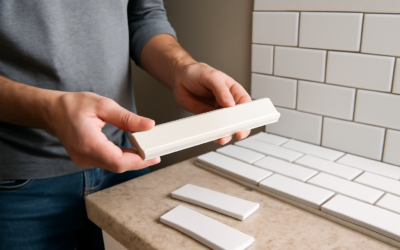
Few details separate a professional tile job from a rushed one as clearly as the edges. White bullnose tile solves the single most common finishing problem in any tiled wall or backsplash: what to do where the tile stops and the drywall, counter, or open air begins. A bullnose is a trim piece with one or more rounded, glazed edges, and the white version pairs with the enormous range of white field tiles that dominate kitchens and bathrooms today. Understanding how these pieces work will save you money, prevent a common installation headache, and give your project the crisp, retail-showroom finish that homeowners consistently want but rarely know how to specify.
Part of our Tile & Grout guide — explore the full guide →
What Bullnose Tile Actually Is
A bullnose is a specialty trim tile with a smooth, convex rounded edge that has been glazed over so no raw, sharp ceramic bisque is exposed. Standard field tiles are glazed only on the flat face; their four cut sides show the unfinished clay body. That raw edge is fine when it butts against another tile, but it looks unfinished and feels rough when it terminates a run. A bullnose caps that termination with a rounded, finished profile.
You will encounter two main formats. A single bullnose has one rounded edge and is used along a straight run, such as the top of a backsplash. A double bullnose, sometimes called a corner or down-angle piece, has two adjoining rounded edges and is used at outside corners where two exposed edges meet. There are also bullnose corner pieces molded specifically for turning a 90-degree external corner cleanly.
Common Sizes and Formats
White bullnose is manufactured to match popular field-tile dimensions so the trim reads as part of the same family. The most common sizes include:
- 2 by 6 inches, the classic subway-tile bullnose for backsplash tops and edges
- 3 by 6 inches, the larger subway proportion
- 3 by 12 and 4 by 12 inches, for modern elongated subway looks
- 2 by 2 and 4 by 4 inches, useful for shorter runs and older tile matching
- Pencil-liner bullnose, a slim 1/2- to 5/8-inch rounded strip used as a delicate cap
Bullnose pieces are sold individually or by the linear foot rather than by the square foot, since you only need them along exposed perimeters. Measure the total length of every edge that will be exposed, then divide by the piece length to find your count. Always add roughly 10 to 15 percent extra for cuts, breakage, and matching future repairs.
Where White Bullnose Tile Belongs
The rounded profile earns its keep anywhere a tile field ends without meeting a wall, cabinet, or another surface. In kitchens, the top course of a backsplash that stops below the upper cabinets is the textbook application, giving a soft, finished lip instead of a raw cut line. In bathrooms, bullnose finishes the sides and top of a tub surround, the exposed vertical edges of a shower niche, and the outer edge of a wainscot band. It also caps the front lip of a tiled windowsill or a shower curb.
White bullnose is especially valuable because white field tile is everywhere, and matching the exact white and sheen matters. Buy your bullnose from the same manufacturer and dye lot as your field tile whenever possible. A slightly warmer or cooler white on the trim will stand out against a wall of otherwise uniform tile, so hold samples side by side under the actual room lighting before committing.
Materials and Price Ranges
Most white bullnose is glazed ceramic, which is affordable and easy to cut, but you will also find porcelain and even natural-stone versions for higher-end jobs. Ceramic bullnose typically runs about $1.50 to $4 per linear foot for standard subway sizes, while porcelain and specialty pencil liners can reach $5 to $10 or more per linear foot. Designer and handmade lines climb higher still.
Budget for the trim as a separate line item. Homeowners often price out an entire backsplash by the square foot and forget the perimeter trim entirely, then discover at the checkout that bullnose adds $40 to $150 to a modest kitchen job. It is money well spent, because the alternative finishing methods each have trade-offs.
Bullnose Versus Modern Edge Alternatives
Bullnose is the traditional solution, but it is no longer the only one. Metal or PVC edge trim, sold under names like Schluter, is a slim L-shaped or rounded profile that tucks under the last row of tile and covers the raw edge with an aluminum, brass, or plastic strip. Many contemporary designs favor this crisp, linear look, and it works well when a matching bullnose is not manufactured for a large-format or mosaic tile.
A third option is a mitered edge, where two tiles are cut at 45 degrees and joined to hide the raw bisque. This produces a seamless, trimless look prized in high-end design but demands precise cutting and is easy to chip. White bullnose remains the most forgiving and traditional choice, softening the edge, resisting chips better than a mitered corner, and requiring no special tools beyond what you already need to set the field tile.
Installation Tips That Prevent Regret
Set bullnose pieces after or alongside the field tile, keeping grout joints continuous so the trim lines up with the courses below. Plan your layout so a full bullnose lands at the most visible corner rather than a sliver of a cut piece. A few practical pointers:
- Dry-lay the top row first to confirm the bullnose sits flush and the grout lines align with the field.
- Back-butter each piece with thin-set for full adhesion, since trim edges are prone to popping loose.
- Keep the rounded edge slightly proud of or flush with the wall surface, never recessed, so the profile reads as intended.
- Use spacers to hold a consistent grout joint between the bullnose and the field tile.
- Wipe glaze clean before the thin-set skins over; cured thin-set on a glossy white face is hard to remove without scratching.
Estimating How Much You Need
Ordering the right quantity of bullnose is a common stumbling block because it is sold differently from field tile. Walk the project and measure every edge that will be exposed to open air, a countertop, or a different material. Add each of those measurements together to get your total linear footage. Then divide by the length of your chosen bullnose piece, remembering that a 6-inch-long piece yields two per foot. Round up, then add 10 to 15 percent for cuts and breakage.
Do not forget outside corners, which need special double-bullnose or corner pieces rather than two single pieces butted together. A mitered pair of singles leaves a visible seam and two vulnerable edges, whereas a molded corner wraps the turn cleanly. Count your outside corners separately and order the matching corner trim, since these pieces are frequently overlooked until installation day, when a missing corner can stall the whole job.
Grout, Caulk, and Long-Term Care
Match your grout color to the look you want. A bright white grout with white bullnose creates a seamless, monolithic surface, while a light gray grout subtly defines each piece. Wherever the tile meets a different plane, such as where a backsplash top curves away from the wall or where the surround meets the tub, use a color-matched flexible caulk rather than rigid grout. Caulk absorbs the tiny seasonal movement between materials that would otherwise crack a grout line.
Glazed white bullnose is nonporous and easy to maintain. Wipe it with a damp cloth and mild cleaner, and avoid abrasive pads that can dull the glossy surface over years. Reseal only the grout, not the glaze. With sound installation, quality trim, and matched grout, white bullnose delivers a clean, durable, professional edge that quietly elevates the entire installation for decades.
Prefer to explore on your own?
See how new flooring looks in your actual room in seconds — free, no signup.
Try the free Floor Studio →