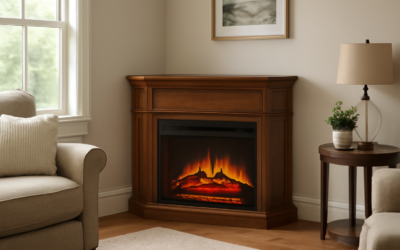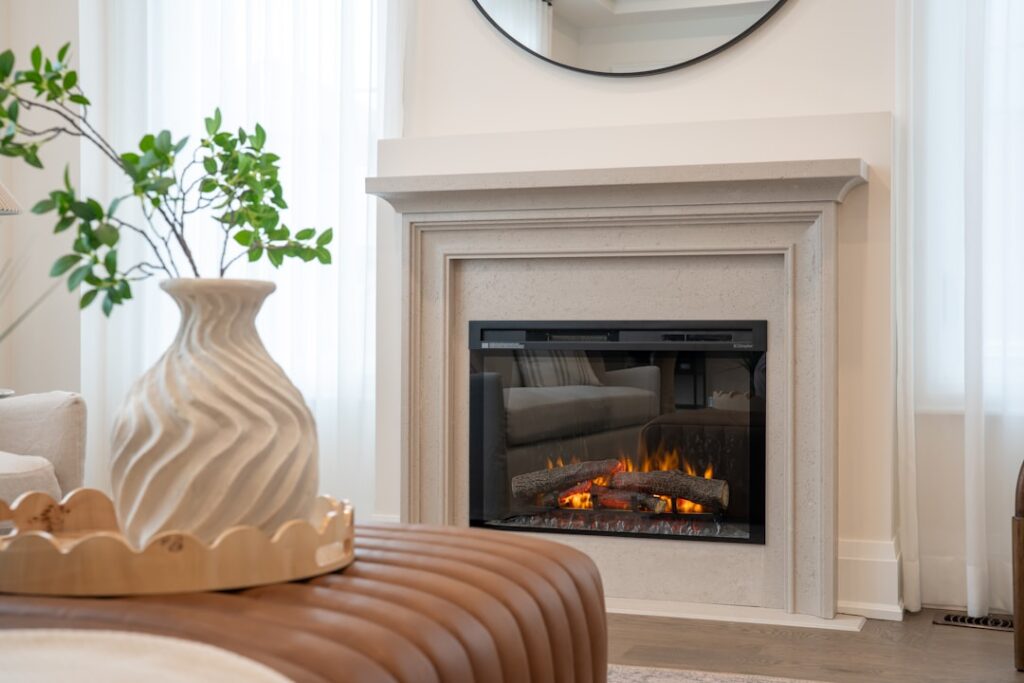
A white electric fireplace gives you the anchor of a hearth without a mason, a chimney, or a gas line. Plug it into a standard outlet and you get an LED flame effect plus roughly 5,000 BTU of supplemental heat. I’ve installed dozens of these in rooms where a real fireplace was never in the cards, and the white finish is the one people ask for most because it disappears into trim and reads clean against almost any wall color.
The trick is matching the format to your room and not overpaying for wattage you can’t use on a 15-amp circuit. Below is exactly what I check before I recommend a unit.
Why White Sells Better Than You’d Think
White painted MDF and hardwood veneers match standard trim packages, so the unit looks built-in rather than dropped-in. That matters in rentals and new builds where you don’t want a dark furniture block interrupting a light wall. A white mantel also bounces the room’s light instead of absorbing it, which keeps a small living room from feeling crowded.
Two cautions from the field. Cheap glossy white plastic yellows near a south-facing window inside a couple of years, so look for a matte or satin painted finish. And white shows dust on the top shelf faster than espresso does, so plan on a quick wipe every week if the mantel sits at eye level.
One more thing worth knowing before you shop: “white” isn’t one color. Manufacturers ship bright whites, antique or cream whites, and warm off-whites, and they photograph nearly identical online while looking very different next to your trim. If your baseboards and casings are a warm builder white, a stark bright-white mantel will read cold and slightly off against them. Order the finish closest to the trim you already have, or hold a sample chip against the wall before you commit.
The Four Formats You’ll Choose Between
- Mantel packages — a firebox set into a furniture surround with a shelf on top. Widths run 44 to 68 inches. Best for a blank wall you want to make the focal point. Expect $300 to $900.
- TV-stand / media consoles — the firebox lives under a shelf rated for a 55- to 70-inch TV. Great for one-piece living-room setups. Usually $250 to $700.
- Wall-mounted linear units — a slim glass-front box that hangs like a flat-screen, 36 to 72 inches wide, 4 to 6 inches deep. Modern look, $200 to $800.
- Insert-only fireboxes — the heater and flame engine with no surround, meant to drop into your own built-in millwork. $150 to $450.
If you’re new to these, start with a mantel package. It’s the most forgiving, it ships as one unit, and the white surround hides the seams that a bare insert leaves exposed.
Heat: What 1,500 Watts Actually Does
Nearly every plug-in white electric fireplace tops out at 1,500 watts on a 120-volt outlet, pulling about 12.5 amps. That converts to roughly 4,600 to 5,100 BTU, enough to take the chill off a room up to about 400 square feet. It’s supplemental heat, not a furnace replacement. In a drafty 600-square-foot great room it’ll feel pleasant near the unit but won’t hold the whole space at 72 degrees on a cold night.
Most units run a fan-forced ceramic or coil heater. You get two heat settings on the cheaper models (750W and 1,500W) and a thermostat on the better ones so the heater cycles to hold a target temperature. The flame effect runs independently, so you can enjoy the fire in July with the heat switched off and only sip a few watts for the LEDs.
The Circuit Rule Nobody Reads
A 1,500-watt heater is the single biggest draw most people plug into a bedroom or living-room outlet. On a standard 15-amp circuit, that heater alone uses 80 percent of the safe continuous load. Follow these rules and you won’t trip a breaker or cook an outlet:
- Plug directly into a wall outlet, never a power strip or a light-duty extension cord. The cord will overheat.
- Don’t share the circuit with a space heater, a hair dryer, a microwave, or a window AC. Two 1,500W loads on one 15-amp circuit will trip the breaker every time.
- If the outlet or plug feels hot to the touch, stop and have an electrician check it. Warm is normal; hot is not.
- Larger 5,000-watt units exist, but those are hardwired to a dedicated 240-volt circuit and need an electrician. That’s a different project and a different budget.
What the Flame Effect Really Looks Like
The days of the orange rotating cylinder are mostly gone. Today’s flame effect uses LEDs projected onto a moving screen or reflected off a rotating rod, and the good ones look convincingly like fire from six feet away. Features that separate a $500 unit from a $200 one:
- Adjustable flame brightness and speed so you can dial it down for evening ambiance.
- Color options — orange, blue, violet, or a mix. Skip the neon settings; the natural amber is the one you’ll actually use.
- Ember bed material — acrylic “crystals,” faux logs, or river rock. Logs read most traditional in a white mantel; crystals suit a modern wall unit.
- Depth — units with a rear reflector and a few inches of internal depth throw a more three-dimensional flame than the flat, painted-on look of the cheapest inserts.
My honest take: spend the extra $100 for adjustable brightness. A flame that only runs at full blast looks like a TV screensaver at night.
Sizing and Placement
Measure the wall and the firebox opening, not just the outside width. A 60-inch mantel needs about 62 inches of clear wall plus room to open the top shelf. Keep the top and side vents clear by at least the distance the manual specifies — usually a few inches — because that’s how the heater sheds air. Never set the unit inside a tight alcove that chokes the vents; trapped heat shuts the unit down or, worse, scorches surrounding material.
For a media console, confirm the shelf’s weight rating against your TV. A 65-inch TV runs 50 to 70 pounds, and most consoles handle it, but the cheap ones bow. Center the firebox at seated eye level, roughly 40 to 42 inches off the floor for a mantel, so the flame sits where you’ll actually look at it.
Installation Timeline and Tools
A mantel package is a two-person, one- to two-hour assembly straight out of the box — think flat-pack furniture with a firebox already installed. A wall-mounted unit takes about the same time but needs a stud finder, a level, and lag screws or heavy-duty anchors into at least two studs. Don’t hang a 40-pound glass box on drywall anchors alone.
If you want the fully recessed, flush-mount look, you’re framing an opening and running the wiring inside the wall, which pushes it into a half-day job and possibly a permit. For most people, the surface-mount route delivers 90 percent of the look with none of the drywall repair.
What to Budget and Where to Save
A solid white electric fireplace mantel in the 47- to 60-inch range runs $350 to $700 and will last a decade with normal use. Spend on the finish quality, the flame adjustability, and a real thermostat. Save by skipping app control and Alexa integration you’ll use twice, and by buying an insert-only firebox if you already have millwork to drop it into.
Watch the running cost too. At 1,500 watts and around 16 cents per kilowatt-hour, full-heat operation costs roughly a quarter per hour. Flame-only ambiance costs a few cents an hour. That’s cheaper than running the furnace to warm one room you’re actually sitting in.
Bottom Line
Buy the format that fits your wall, insist on a matte painted finish, confirm you have a dedicated 15-amp outlet, and pay a little extra for an adjustable flame and a thermostat. Do that and a white electric fireplace gives you a clean, bright focal point plus real supplemental heat for a fraction of the cost and mess of the real thing.