
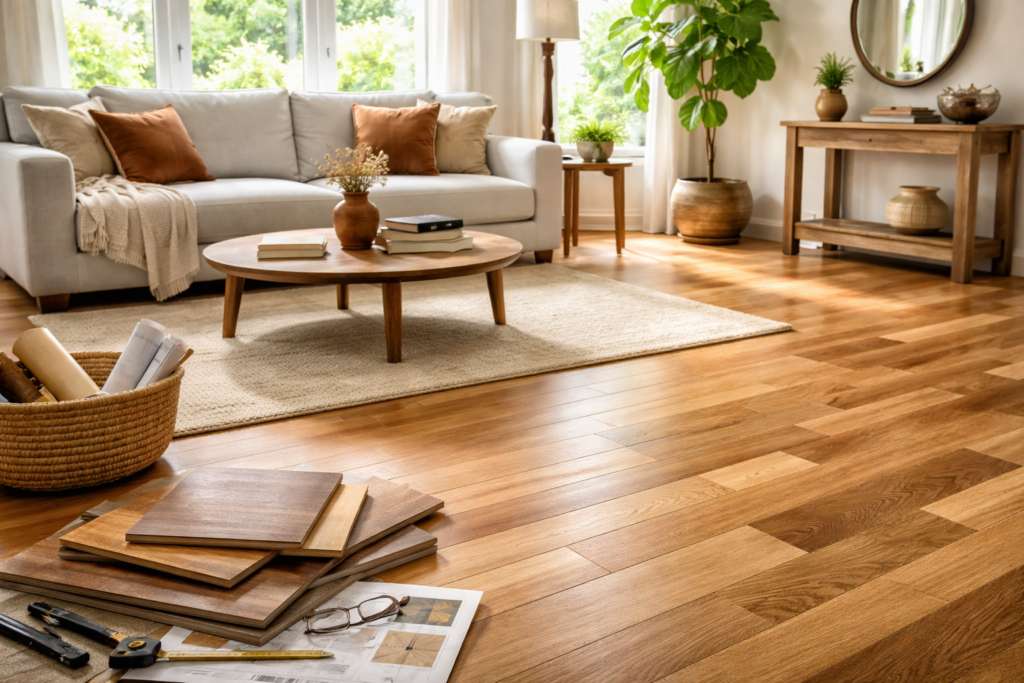
Ask a real estate appraiser which floor adds the most value at resale and the answer never changes. The advantages of hardwood flooring show up on inspection reports, in National Association of Realtors surveys, and in the wallets of homeowners who refinish a 30-year-old floor instead of ripping out 8-year-old laminate. Hardwood is not the cheapest material, but it is the only residential floor that gets more valuable with age when it is cared for properly.
- Lifespan That Outlasts Every Competitor
- Refinish Capability Sets It Apart
- Resale Value Premium
- Species Options for Every Budget and Use Case
- Indoor Air Quality Advantage
- Design Flexibility and Plank Format Options
- Repair-and-Replace Flexibility
- Honest Trade-offs to Know
- Engineered Versus Solid Hardwood Trade-offs
- What to Buy and Where
Lifespan That Outlasts Every Competitor
Solid 3/4 in white oak, hickory, or maple installed over a plywood subfloor will run 80 to 100 years with three or four refinishes along the way. Engineered hardwood with a 4 to 6 mm wear layer, like Mirage Engineered or Mannington Maison, supports two refinishes and lasts 40 to 60 years. Compare that to laminate at 15 to 25 years, LVP at 15 to 20 years, and carpet at 7 to 12 years. Over a 50-year ownership horizon you replace LVP three times and hardwood zero times.
Refinish Capability Sets It Apart
This is the single biggest functional advantage. A 100-grit drum sand, edger pass, and three coats of Bona Traffic HD waterborne finish restores a beat-up oak floor for $3 to $5 per sq ft, far less than the $8 to $14 per sq ft of new installation. NWFA installation guidelines allow most 3/4 in solid floors to be sanded 6 to 10 times across their life. Engineered floors with a 2 mm wear layer get one light screen-and-recoat; a 4 mm wear layer earns a full sanding.
Resale Value Premium
The National Association of Realtors 2024 Remodeling Impact Report pegged hardwood refinishing at a 147 percent cost recovery and new wood floor installation at 118 percent. Appraisers typically add $3 to $5 per sq ft to home value for hardwood versus carpet. In move-up markets like Denver, Charlotte, and Nashville, the swing widens to $8 per sq ft. Listings that mention solid oak or hickory close 4 to 6 days faster than equivalent homes with vinyl or laminate.
Species Options for Every Budget and Use Case
- Red Oak (Janka 1290) — $4 to $7 per sq ft material, the value benchmark
- White Oak (Janka 1360) — $5 to $9 per sq ft, current designer favorite, takes stain evenly
- Maple (Janka 1450) — $6 to $10 per sq ft, light and uniform, great for modern interiors
- Hickory (Janka 1820) — $5 to $9 per sq ft, hardest domestic option, hides dents
- Brazilian Cherry (Janka 2350) — $7 to $12 per sq ft, ultra-hard but darkens with UV exposure
Indoor Air Quality Advantage
Hardwood does not off-gas formaldehyde the way budget laminate cores can if they fail CARB Phase 2 or TSCA Title VI compliance. Pre-finished factory floors from Bruce, Shaw Epic Plus, or Mirage carry FloorScore certification. Site-finished floors using a waterborne finish like Bona Traffic HD or Loba Easy Finish drop VOCs below 100 g/L. For asthma and allergy households, hardwood does not trap dander and dust mites the way looped or plush carpet does.
Design Flexibility and Plank Format Options
You can buy anything from 2 1/4 in red oak strip at $3.50 per sq ft to wide-plank 9 in white oak from Stuga or Carlisle at $14 to $22 per sq ft. Stain options run from natural through dark walnut and reactive iron finishes. Wire-brushed, hand-scraped, smooth, and live-sawn textures all read differently. No other floor offers this much design range; LVP and laminate are stuck with whatever the manufacturer prints that year.
Repair-and-Replace Flexibility
Damage a single board or a 4 ft section of hardwood and the repair path is well established. Pull the damaged plank with a circular saw and chisel, install a replacement board cut to length, sand and refinish locally if pre-finished or blend into the field if site-finished. A skilled contractor handles a 6-board replacement in a full day for $400 to $800 total. The same damage on laminate or LVP often requires lifting half the floor to remove planks from the click sequence, then trying to match a discontinued SKU. Hardwood ages forgivingly because individual elements remain repairable across decades.
Honest Trade-offs to Know
Hardwood is not waterproof. Standing water from a dishwasher leak will cup and crown the boards within 48 hours. It dents under a dropped cast iron pan or a stiletto heel, especially the softer 870 Janka pine or 1010 walnut. Installation requires a flat subfloor (±3/16 in over 10 ft), a 6-mil poly vapor barrier in below-grade or slab applications, and 14 to 21 days of acclimation in the conditioned space. Pets with untrimmed nails will scratch satin finishes within months unless you use a Bona Pro Series finish or Rubio Monocoat hardwax oil.
Engineered Versus Solid Hardwood Trade-offs
Solid 3/4 in hardwood demands a plywood or OSB subfloor, nail-down installation with cleat or staple guns, and a 14 to 21 day acclimation window. It cannot be installed on concrete slabs below grade. Engineered hardwood with 3 to 6 layers of cross-laminated core handles slab installs (floating, glue-down, or nail-down depending on thickness), tolerates radiant heat up to 81 degrees Fahrenheit, and accepts wider plank widths (7 in, 9 in, even 11 in) that would cup in solid format. Engineered products from Mirage, Mannington Maison, and Shaw Epic Plus with 4 mm wear layers refinish almost as many times as solid 3/4 in, making the price premium of $1 to $3 per sq ft worthwhile in slab-heavy markets like Texas and Florida.
What to Buy and Where
For a 1,000 sq ft project with a $10,000 to $14,000 budget, Bruce Classics 3 1/4 in red oak at LL Flooring, Mohawk Brentmore at Home Depot, or Shaw Floorte hardwood at a local independent dealer cover most needs. Higher budgets unlock Mirage, Mercier, or Carlisle wide-plank lines. Always pull from three or four boxes during install to randomize grain and color. The advantages of hardwood flooring compound year after year; the investment pays back every time you list, refinish, or simply walk across a 30-year-old plank that still looks brand new.
Prefer to explore on your own?
See how new flooring looks in your actual room in seconds — free, no signup.
Try the free Floor Studio →

