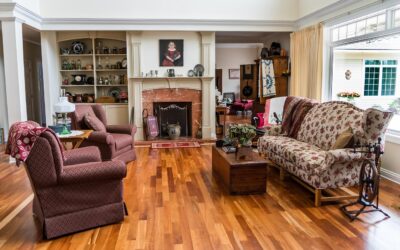
Tour a restored 1820s saltbox in New England or a converted Carolina tobacco barn and the floor underfoot is almost always the same material — heart pine or eastern white pine pulled from buildings that were standing before refrigeration existed. Antique pine flooring is reclaimed softwood milled from beams, joists, and original floorboards of pre-1940 structures, prized for tight growth rings, nail holes, weathered patina, and widths up to 20 inches that no new-growth pine can match. Material runs $7 to $22 per square foot depending on grade and provenance.
What Antique Pine Actually Is
Two species dominate the reclaimed market. Longleaf heart pine (Pinus palustris) was the dominant Southern lumber from 1780 to 1920, growing in old-growth stands with 25 to 40 growth rings per inch — roughly five times the density of modern plantation pine. Eastern white pine (Pinus strobus) supplied Northeast colonial buildings with wider, softer boards milled from trees up to 200 feet tall before logging depleted the original forests.
Both species come milled as either tongue-and-groove flooring blanks or in original face-nailed condition with the historic nail holes preserved. Widths typically run 5 to 16 inches with 12 inch being the common compromise. Thicknesses range from 5/8 inch resawn to full 1 inch original-thickness boards that can be sanded multiple times over a century of service.
Where It Performs Best
Historic home restorations are the natural application. Federal-style, Greek Revival, Victorian, and Craftsman houses originally built with pine floors look correct only when refloored with material from the same era. Wide-board heart pine also dominates the high-end farmhouse market — Connecticut weekend houses and Hudson Valley conversions specify 12 to 16 inch reclaimed planks at $14 to $22 per square foot for the visual statement.
Modern lofts and contemporary builds use reclaimed pine as a counterpoint to industrial finishes. A reclaimed heart pine floor against polished concrete, blackened steel, and white walls reads as deliberate sourcing rather than period costume. Avoid antique pine in kitchens with island traffic, mudrooms, and high-pet households — the Janka rating of 870 for heart pine and 380 for white pine cannot match oak under sustained abuse.
Pros That Justify the Reclaimed Premium
- Tight old-growth grain at 25 to 40 rings per inch in heart pine, impossible to source new
- Wide plank widths up to 20 inches from beams that no living tree can supply today
- Natural patina from 100 to 200 years of oxidation, oil finishes, and gentle wear
- Historic character with nail holes, mortise pockets, and saw kerf marks preserved
- Carbon-stored material with no new logging required and net-negative embodied carbon
Drawbacks That Cost Real Money
Hidden metal is the recurring nightmare. Reclaimed boards routinely contain forgotten cut nails, square nails, screws, and embedded staples that dull or destroy sander belts and chip jointer knives. Quality reclaimers metal-detect every board before milling, but budget suppliers do not, and an undetected nail in a custom blade costs $80 to $250 in replacement plus an hour of downtime.
Width and length consistency varies. Unlike new prefinished hardwood that arrives in tight tolerances, reclaimed boards can vary 1/16 inch in width and 1/32 inch in thickness across a single bundle. Plan to face-screw and plug or to scribe trim boards to match. Budget an extra 10 to 15% waste factor for unusable lengths and short cutoffs that cannot be tucked under closets.
Cost Breakdown Per Square Foot
- Reclaimed heart pine, 6 to 10 inch standard widths: $9 to $14 per square foot
- Reclaimed heart pine, 12 to 20 inch wide planks: $14 to $22 per square foot
- Reclaimed eastern white pine: $7 to $12 per square foot
- Installation labor (face-nailed or T&G): $4 to $7 per square foot
- Sanding and three coats of finish onsite: $3 to $5 per square foot
A 500 square foot living room and dining room install in 10 inch reclaimed heart pine therefore lands between $7,500 and $11,500 turnkey. The same room in standard new oak runs $4,500 to $7,500, putting the antique premium at roughly 50 to 60% — paid for entirely by the character of the material.
Sourcing and Provenance Verification
The reclaimed wood industry has both honest brokers and outright misrepresenters. Reputable suppliers like Carlisle, Mountain Lumber, Aged Woods, and TerraMai document provenance with photographs of the original building, removal dates, and chain-of-custody records. Ask for these documents before paying a deposit. Anyone unwilling to share them is selling new-growth pine stained brown and called antique.
Kiln drying is non-negotiable. Insist on documentation that the boards were dried to 6 to 8% moisture content and held at that level until shipment. Wet reclaimed boards cup and twist after installation, ruining the install regardless of how careful the carpentry was.
Installation Specifics That Matter
Acclimate the boards 7 to 14 days in the install room at 35 to 50% relative humidity. Plywood subfloors need 3/4 inch CDX or better with screws into the joists every 6 to 8 inches. Wide planks above 8 inches benefit from face-screwing with hand-forged or cut nail style screws at 16 inch spacing along the edges, plus standard T&G blind nailing in the field. Skip the face-screwing on wide reclaimed planks and they will cup within two seasonal humidity cycles.
For original-condition face-nailed boards, use cut nails from Tremont Nail Company at 7d or 8d for visual authenticity. Pre-drill every nail location to prevent splitting along the grain — heart pine is brittle when nail-driven without pre-drilling.
Finish Choices and Maintenance
Pure tung oil, hardwax oil from Rubio Monocoat, and OSMO Polyx-Oil preserve the patina better than polyurethane. These penetrating finishes recoat in worn areas without sanding the entire floor — a maintenance feature that matters on $14 per square foot material. For high-traffic rooms, two coats of Bona Traffic HD water-based polyurethane in matte produce a more durable surface at the cost of some warmth in the look. Antique pine flooring rewards buyers who accept the soft, character-rich, slightly imperfect nature of the material and who budget for the lifetime maintenance cycle that softwood floors demand.
Prefer to explore on your own?
See how new flooring looks in your actual room in seconds — free, no signup.
Try the free Floor Studio →