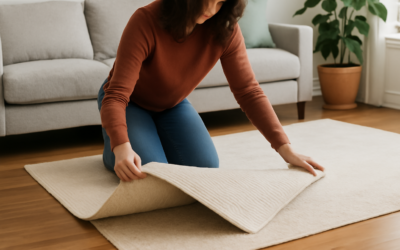
Most people buy a rug pad as an afterthought, then discover their beautiful oak floors have hazy discoloration or fine scratches right where the rug sat. Choosing the right area rug pad for hardwood floor protection is not optional, it is what stands between your finish and years of grit, sliding, and chemical reactions. The wrong pad, especially cheap solid rubber or PVC, can actually bond to and discolor your floor’s finish. The right one grips, cushions, and breathes. This guide explains which type to choose and why.
- Why Hardwood Needs the Right Pad
- The Main Pad Types
- The Felt-and-Rubber Combo Is Best
- Choosing the Right Thickness
- What a Good Pad Costs
- Pros and Cons at a Glance
- Matching the Pad to Your Rug and Traffic
- Common Mistakes to Avoid
- How to Measure and Cut a Pad
- Do You Always Need a Pad?
- Care and Maintenance Tips
Why Hardwood Needs the Right Pad
Hardwood finishes, whether polyurethane, oil, or aluminum-oxide factory coatings, can react chemically with certain plastics and adhesives. A bargain pad made of cheap PVC or coated with sticky latex can leave a yellow or cloudy haze on the finish, sometimes permanently. On top of that, a rug without a pad slides, trapping abrasive grit underneath that sands tiny scratches into the surface every time someone walks across it.
A proper pad solves three problems at once: it stops the rug from slipping, it cushions and protects the finish, and it lets air circulate so moisture does not get trapped against the wood.
The Main Pad Types
You will encounter four common constructions:
- Felt: Dense recycled-fiber padding. Adds cushion and protects the finish but offers little grip. Best under heavy furniture-anchored rugs.
- Natural rubber: A waffle or grid of natural (not synthetic) rubber. Excellent grip, hardwood-safe when it is genuine natural rubber.
- Felt-and-rubber combo: Felt top for cushion, natural rubber bottom for grip. The gold standard for hardwood.
- PVC/foam: The cheap option. Avoid on hardwood; it can degrade and discolor the finish.
The Felt-and-Rubber Combo Is Best
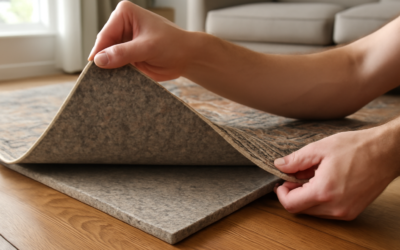
For nearly every hardwood situation, a felt-and-natural-rubber pad wins. The felt layer, usually 1/4 inch to 3/8 inch thick, adds plush cushion and a protective barrier, while the natural rubber bottom grips the floor without adhesives. Crucially, real natural rubber will not off-gas plasticizers that attack a wood finish the way cheap synthetic rubber and PVC can. Look explicitly for “natural rubber” and “hardwood safe” on the label.
Choosing the Right Thickness
Thickness is a comfort-versus-stability tradeoff:
- 1/4 inch: The sweet spot for most living rooms, balancing cushion and a stable feel.
- 3/8 inch: Extra plushness for bedrooms or where you want a luxurious step.
- 1/8 inch (low profile): Best under doors that swing over the rug or in high-traffic halls where a thick pad would be a trip hazard.
Buy the pad about an inch smaller than the rug on all sides so it stays hidden and the rug edges can taper to the floor.
What a Good Pad Costs
Quality hardwood-safe pads run roughly $0.50 to $1.50 per square foot. A felt-and-rubber pad for a standard 8×10-foot rug typically costs $40 to $90. It is a small investment against refinishing a damaged floor, which can run several dollars per square foot for the whole room.
Pros and Cons at a Glance
The tradeoffs of using a quality pad:
- Pro: Prevents slipping and the scratches that grit causes.
- Pro: Protects the finish from chemical haze and discoloration.
- Pro: Adds cushion and extends the rug’s life by reducing fiber crushing.
- Pro: Allows airflow to prevent trapped moisture.
- Con: Quality natural-rubber pads cost more than bargain PVC.
- Con: Using the wrong cheap pad can do more harm than no pad at all.
Matching the Pad to Your Rug and Traffic
The right pad depends partly on the rug sitting on it. A heavy wool or jute rug anchored by furniture needs grip less than cushion, so a thicker felt or felt-and-rubber pad serves it well. A lightweight cotton or flatweave rug in a hallway slides easily and demands a grippier natural-rubber surface to stay put and prevent a tripping hazard. In high-traffic zones like entryways and kitchens, prioritize a low-profile, grippy pad so the rug edges lie flat and no one catches a toe. Under a dining table, a thin, firm pad is better than a plush one, because thick cushion makes chairs tip and wobble when people sit and slide.
Common Mistakes to Avoid
A few errors do real damage to hardwood. The biggest is using a cheap PVC or coated-foam anti-slip pad, the kind sold in big rolls, which can chemically react with the floor finish and leave a sticky or discolored residue that is difficult to remove. Another is sizing the pad to match the rug exactly; it should be about an inch smaller on every side so it stays hidden and the rug can taper to the floor. People also forget to lift and air the rug periodically, allowing moisture and grit to sit trapped against the wood. Finally, never assume an expensive rug came with a hardwood-safe pad; check the label yourself for the words “natural rubber” and “hardwood safe.”
How to Measure and Cut a Pad
Buying the right size is half the job. Measure your rug’s actual dimensions, then plan for a pad that is one inch smaller on every side, so a 5-by-8-foot rug pairs with a pad cut to roughly 4 feet 10 inches by 7 feet 10 inches. Most quality felt-and-rubber pads cut easily with sharp household scissors or a utility knife and a straightedge, and the felt side usually shows a grid that makes straight cuts simple. Cut from the felt side, take your time around corners, and dry-fit before trimming the final inch. If your rug is an irregular shape, trace it onto the pad with the rug flipped over, then cut just inside the line so the pad stays hidden under the finished edge.
Do You Always Need a Pad?
Some homeowners wonder whether a pad is truly necessary, and the honest answer is almost always yes on hardwood. Even a heavy rug anchored by furniture benefits from the cushion and the protective barrier against grit and finish discoloration. The rare exception is a very thick, dense rug in a low-traffic room where slipping is not a concern, but even then a thin felt pad extends the rug’s life by reducing fiber crushing. The one situation to avoid entirely is going without a pad and letting a thin rug slide freely, which traps abrasive grit and sands fine scratches into the finish with every step. When in doubt, a hardwood-safe pad is cheap insurance for an expensive floor.
Care and Maintenance Tips
Lift the rug and pad a couple of times a year to vacuum underneath and let the floor breathe. If you notice any tackiness on the floor, switch pads immediately. Avoid any pad with an adhesive coating, and never use a basic anti-slip foam runner liner on a finished hardwood floor. With a genuine natural-rubber-and-felt pad sized correctly, your area rug stays put, your floor stays scratch-free, and the finish keeps its clarity for years.
Prefer to explore on your own?
See how new flooring looks in your actual room in seconds — free, no signup.
Try the free Floor Studio →