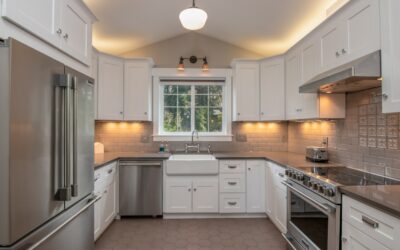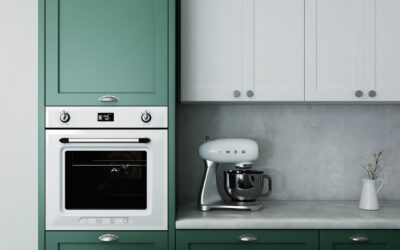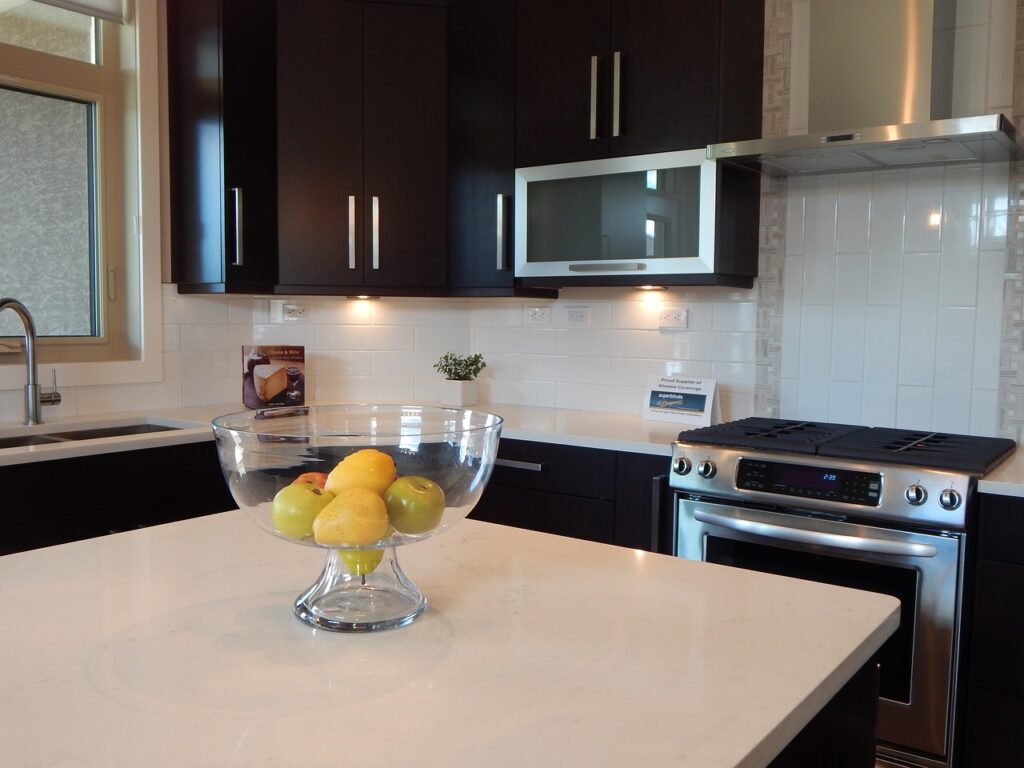
White cabinets give you the widest range of backsplash options in kitchen design, which is exactly why so many homeowners freeze when it is time to choose. Everything technically “works” with white, but some combinations genuinely transform a kitchen while others fall flat. These backsplash ideas for white cabinets cover the materials, colors, and patterns that designers and contractors recommend most often, organized by the look you are trying to achieve.
Part of our Kitchen Remodeling guide — explore the full guide →
Bold Contrast: Dark and Dramatic Backsplashes
White cabinets paired with a dark backsplash create immediate visual tension that makes the kitchen feel curated rather than builder-grade. This approach works best in kitchens with ample natural light, where the dark surface adds depth without making the room feel smaller.
- Black subway tile with white grout: The grout lines create a grid pattern that reads as intentionally graphic. Use 3 x 6 or 4 x 8 inch tiles in a running bond or stacked layout. Cost: $4 to $10 per square foot for ceramic.
- Dark green zellige: Hunter green or emerald handmade tiles bring organic warmth and visual texture. The slight color variation across each tile keeps the surface from feeling flat. Cost: $15 to $35 per square foot.
- Charcoal natural stone: Soapstone or dark slate in a honed finish pairs beautifully with white Shaker cabinets. The matte surface absorbs light rather than reflecting it, creating a quiet sophistication.
- Navy blue glass mosaic: Small-format glass tiles in deep navy produce a rich, reflective surface that changes character throughout the day as light shifts.
Warm and Earthy: Adding Depth Without Drama
White kitchens can feel clinical. Warm-toned backsplashes counteract that sterile quality by introducing organic color and texture that makes the space feel lived in.
Terracotta-toned tiles in square or hexagonal formats bring Southwestern and Mediterranean warmth. Pair them with brass or unlacquered copper hardware on the white cabinets for a cohesive palette. Cream and beige marble, particularly Crema Marfil, adds subtle veining and a warm undertone that softens the white without competing with it.
Wood-look porcelain tile is another option worth considering. Planks set horizontally in a running bond pattern add the warmth of natural wood with the water resistance of porcelain. Choose a light oak or walnut tone to contrast gently against white cabinetry.
Classic and Clean: White-on-White Approaches
A white backsplash with white cabinets is not boring when you add texture and dimension. The key is choosing a material or pattern that creates visual interest through shape and surface rather than color.
- White arabesque tile: The lantern shape creates scalloped curves that add movement to an all-white palette. Cost: $8 to $18 per square foot.
- White herringbone: Rectangular tiles set at 45-degree angles produce a zigzag pattern that catches light differently across each tile.
- Beveled white subway tile: The angled edge on each tile creates shadow lines that define the grid without adding color contrast.
- White Carrara marble slab: A single marble slab with gray veining provides a clean, seamless look. The natural stone veining prevents the all-white scheme from feeling flat. Installed cost: $75 to $150 per square foot.
Modern and Geometric: Pattern-Forward Options
Geometric tile shapes let you add personality to a white kitchen without relying on bold color. These patterns work particularly well in contemporary and transitional kitchens.
Hexagonal tiles in 2-inch or 4-inch formats create a honeycomb pattern that pairs well with clean-lined white Shaker or flat-panel cabinets. Picket tiles, shaped like elongated hexagons, installed vertically produce a sophisticated texture that feels fresh without being trendy. Fan-shaped or fish scale tiles make a strong statement behind a range or as an accent panel flanked by simpler tile on the sides.
For the most impact, pick one geometric shape and keep the color simple. A single unusual shape in a neutral tone reads as intentional design. Multiple shapes or colors in one backsplash can quickly look chaotic against the clean lines of white cabinets.
Material Guide for White Cabinet Pairings
Each backsplash material brings different characteristics to the combination with white cabinetry.
- Ceramic tile: Most affordable at $2 to $10 per square foot. Widest color and shape selection. Easy to cut and install. Works for every style from farmhouse to contemporary.
- Porcelain tile: Denser and more water-resistant than ceramic at $4 to $15 per square foot. Better for behind-sink and stove areas.
- Natural marble: Elevated look at $10 to $30 per square foot for tile, $75 to $150 for full slabs. Requires sealing and careful maintenance.
- Glass tile: Reflective surface brightens kitchens at $8 to $25 per square foot. Shows adhesive through translucent tiles, requiring white thinset.
- Cement tile: Handmade with bold patterns at $8 to $20 per square foot. Porous and requires sealing. Adds artisan character.
Colors That Work Best With White Cabinets
Some color families pair better with white cabinetry than others based on the cabinet undertone. True white cabinets (no yellow or gray tint) work with cool blues, greens, and grays. Warm white or cream cabinets pair better with terracotta, sage green, warm gray, and gold tones.
Colors to approach with caution include bright red, orange, and purple, which can overwhelm a kitchen quickly. If you want a bold color, limit the backsplash area and keep it behind the range as an accent rather than wrapping the entire kitchen. Greige, sage, and dusty blue are the safest options for homeowners who want color without risk.
Choosing Based on Kitchen Style
Match the backsplash to your overall kitchen design for a cohesive result.
- Farmhouse: White subway tile in a running bond with light gray grout. Add a pot filler behind the range for an authentic touch.
- Modern: Large-format porcelain slab in a marble print. No grout lines, minimal visual interruption.
- Transitional: Marble herringbone or stacked white subway tile with brass accents.
- Coastal: Blue or green glass tile in a brick pattern. Pair with white cabinets and light wood countertops.
- Industrial: Exposed brick veneer or matte black tile with thick white grout lines.
The backsplash is one of the most visible surfaces in any kitchen. With white cabinets as your backdrop, nearly any direction can work. Narrow your options by style first, then material, then color. That sequence prevents decision paralysis and leads to a result that feels considered rather than random.