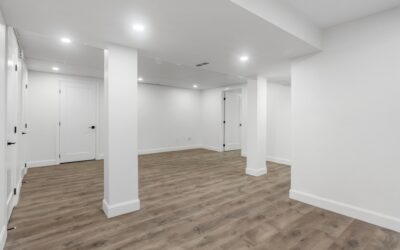
Finished basements return roughly 70 percent of project cost at resale, more if you add a bedroom or full bath. A proper basement makeover runs $30,000 to $75,000 in most US markets — but only if the moisture, insulation, and code work get done correctly. Here are the shortcuts that come back to haunt homeowners and the decisions that actually pay off long term.
Solve Moisture Before Anything Else
Every basement leaks somewhere, even if you have never seen water. Concrete walls and floors are vapor-permeable, meaning humid air constantly moves through them. Frame a basement wall with insulation and drywall over moisture, and you have a perfect mold incubator within 18 months.
Run a hygrometer in the basement for two weeks before starting any work. Indoor humidity should sit between 30 and 50 percent year-round. If yours runs higher, install a dedicated dehumidifier like the Aprilaire E080 ($800 to $1,200) or address the source — gutters, grading, or a perimeter drain. Skip this step and the makeover will fail.
Frame It Right
Basement walls should never touch the concrete directly. Use a 2-inch gap of rigid foam insulation between the framing and the foundation. Owens Corning XPS Foamular 250 ($45 per 4×8 sheet) acts as both vapor barrier and thermal break. Frame the 2×4 wall just inside the foam, attaching only at the bottom plate and ceiling.
Treat the bottom plate. Code requires pressure-treated lumber wherever framing contacts concrete. A standard SPF 2×4 will rot from the bottom up within five years if the concrete sweats moisture. Pay the extra two dollars per board for treated lumber along all base plates.
Choose the Right Flooring
Carpet in basements is a recipe for mold and stink, even with the best moisture control. Hard-surface flooring tolerates the occasional spill, leaky water heater, or window-well overflow that every basement experiences eventually. Best choices in order:
- Luxury vinyl plank (LVP) — 100 percent waterproof, $3 to $7 per sq ft installed, the default for basements
- Engineered hardwood with click-lock — limited risk of swelling, $6 to $12 per sq ft
- Porcelain tile — most durable, $8 to $15 per sq ft installed
- Polished concrete — embrace the existing slab, $4 to $10 per sq ft for grind and seal
- Cork plank — warmer underfoot, $5 to $10 per sq ft, needs good moisture control
Skip solid hardwood, laminate without a waterproof core, and traditional broadloom carpet. Even pet-friendly carpet pads designed for spills cannot survive a basement flood event. LVP from brands like Coretec, Shaw, or Mohawk has become the basement default for good reason.
Ceiling Height Hacks
Most basements have 7 to 8 feet of ceiling height — enough to feel comfortable when finished correctly. Drop ceilings eat 4 to 6 inches and feel oppressive. Drywall ceilings save that space but require relocating any plumbing or electrical that runs across the joists.
A middle-ground option is the “exposed industrial” look — paint the joists, ductwork, and electrical lines all the same matte black, and add track lighting between them. This preserves full ceiling height and runs about $1,500 for a 1,000 sq ft basement in paint and labor versus $4,000 for drywall plus rerouted utilities.
Lighting Is Critical
Basements lack natural light, so artificial lighting must do everything. Plan for 25 to 35 lumens per square foot of ambient light plus dedicated task lighting in any work areas. For a 1,000 sq ft basement that means 25,000 to 35,000 total lumens — usually 16 to 24 recessed LED fixtures.
Use 4-inch IC-rated cans like the Halo HLA4 ($25 each) on dimmer switches. Avoid the temptation to install a few overpowered fixtures; spread the light evenly across the ceiling at 6 to 8 foot spacing. Cool 4000K bulbs feel commercial; warmer 2700K to 3000K reads as living space.
Adding a Bedroom or Bath
A basement bedroom requires an egress window — by IRC code, a minimum 5.7 square feet of clear opening with no dimension less than 24 inches. Cutting an egress window through a poured foundation runs $3,500 to $7,000 including the window-well, lid, and waterproofing. This is the single biggest variable in the bedroom budget.
A basement bath adds $7,000 to $15,000 depending on plumbing access. If the existing drain stack runs through the basement, tying in is straightforward. If not, you need a sewage ejector pit and pump system — Liberty Pumps LE51 or Saniflo Saniaccess — which adds $1,500 to $3,000 plus the install labor.
Electrical and HVAC
Basements often need a sub-panel if you add significant load. A new bedroom, bath, and entertainment area can require 60 to 80 amps of capacity. Adding a 100-amp sub-panel runs $1,500 to $3,000 by a licensed electrician.
HVAC is the other often-overlooked piece. Most basements share the main floor’s furnace, but the ducting may be undersized for a finished space. Verify supply and return capacity, and add dedicated returns to prevent basements from running cold in winter and damp in summer. A mini-split heat pump like the Mr Cool DIY 24K ($1,800) handles a basement zone independently for moderate cost.
Permits and Inspections
Most jurisdictions require permits for any basement makeover that involves framing, electrical, plumbing, or HVAC work. Skipping permits saves $300 to $1,000 upfront but creates real problems at resale — inspectors flag unpermitted finished basements, and buyers ask for either remediation or a price reduction.
Pull the permits. The inspector catches mistakes you cannot see, especially around moisture barriers, framing fastener spacing, and outlet height. The peace of mind alone is worth it, and the appraisal value of a permitted finished basement runs 15 to 25 percent higher than an unpermitted one.
Budget Reality Check
A full 1,000 sq ft basement makeover with one bedroom, one bath, an open living area, and a small wet bar typically runs $45,000 to $70,000 in 2026 dollars. DIYers who handle framing, flooring, and finish work themselves can shave $15,000 to $25,000 by hiring out only the electrical, plumbing, HVAC, and drywall.
Build in a 15 to 20 percent contingency. Hidden surprises — radon levels, a cracked drain tile, asbestos in the joist bays of older homes — show up in a large share of basement projects. Have the budget to address them properly rather than burying the problem behind new drywall.