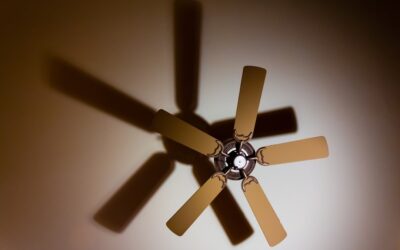
Not every spot that needs a breeze has an electrical box in the ceiling, and running new wiring to a gazebo, tent, or off-grid cabin is often impractical or impossible. That is where a battery powered ceiling fan comes in, delivering overhead airflow without a hardwired connection or a licensed electrician. These cordless units have improved sharply in recent years, and understanding what they can and cannot do helps you decide whether one fits your space.
How Battery-Powered Fans Work
Instead of drawing from household current, these fans run on a rechargeable battery pack, either built into the fan or removable like a power-tool battery. You charge the pack, mount the fan wherever you need it, and it runs until the charge drops.
Most use energy-efficient DC motors, which sip power and stretch runtime far longer than an old AC motor could on the same battery. Many models also include a small solar panel option or a USB charging port, so you can top them up off-grid without ever plugging into the wall.
Common Types Available
Battery fans come in a few distinct forms, and the right one depends on where you plan to use it. Know the categories before you shop.
- Rechargeable hanging fans: Hook or mount to a beam, popular for tents and gazebos.
- Solar-powered fans: Pair a panel with a battery for daytime running and stored charge.
- Portable clip and stand hybrids: Some hang overhead but also clamp to a rail or post.
- Emergency backup fans: Kept charged for power outages and storm season.
For a permanent-looking installation, the hanging rechargeable style comes closest to a traditional ceiling fan, while solar models suit sheds and outbuildings with sun exposure.
Runtime and Battery Life
The single biggest question is how long it runs on a charge, and the honest answer is that it varies widely with speed and battery size. On low, many units run 8 to 20 hours, but on high that can drop to just 3 to 6 hours.
Battery capacity, measured in milliamp-hours, tells the story. A fan with a 10,000 mAh pack runs far longer than one with 4,000 mAh. If you need all-night airflow in a tent, look for a large-capacity battery or a model that accepts swappable packs so you can rotate a charged one in. Recharge times typically run 4 to 8 hours from a wall adapter and longer from solar alone.
Airflow Expectations
Set your expectations realistically. A battery fan cannot match the airflow of a hardwired 52-inch fan pulling continuous household power, because it has to balance breeze against battery drain.
Blade spans on these units usually run smaller, often 12 to 20 inches, and they move enough air to cool a person nearby or a small enclosed space like a tent or camper. Think of them as personal or zone cooling rather than whole-room climate control. For a bedroom or living room, a hardwired fan remains the better performer.
Best Uses for a Cordless Fan
These fans earn their keep wherever wiring is absent or temporary. A few scenarios come up again and again.
- Camping and RVs: Overhead airflow in a tent or camper without hookups.
- Gazebos and pergolas: A breeze in an outdoor structure with no electrical run.
- Power outages: Emergency cooling when the grid goes down.
- Sheds and workshops: Ventilation in an outbuilding, especially with solar.
- Nurseries and cribs: Gentle, placeable air movement without a wiring project.
What to Look For When Buying
A few specs separate a fan you will love from one that disappoints. Prioritize battery capacity and runtime first, since a weak battery undermines everything else.
Check the mounting method to be sure it fits your space, whether a ceiling hook, a beam bracket, or a hanging loop. Look for multiple speed settings and, ideally, a remote or timer for convenience. If you plan to use it outdoors, confirm the unit is rated for damp or outdoor use so moisture does not ruin the electronics. A built-in LED light is a common bonus that adds real value for camping and outages.
Caring for the Battery
The battery is the heart of one of these fans, and how you treat it decides how long the fan stays useful. Most units use lithium-ion packs, which last longest when you avoid running them dead flat every time and store them at a partial charge rather than fully drained.
Heat is the enemy of lithium batteries, so keep the fan out of a hot car trunk or a sun-baked shed shelf between uses, since prolonged high temperatures shorten the pack’s life. If you store the fan over winter, top the battery to roughly half charge and check it every couple of months so it does not sit at zero, which can permanently damage a cell. Solar-equipped models benefit from placing the panel where it catches steady daylight rather than dappled shade. Treated well, a quality lithium pack holds strong capacity for several years before it needs replacing, and many fans use swappable packs so a fresh battery is a cheap fix rather than a new fan.
The Bottom Line
A battery powered ceiling fan will not replace a hardwired fan for cooling a whole living room, but for the many places that lack wiring, it is a genuinely useful solution. It brings overhead airflow to tents, gazebos, sheds, and off-grid spaces, and doubles as a dependable backup when the power fails.
Match the battery capacity to how long you need it running, pick a mounting style that fits your spot, and choose an outdoor-rated model if it will face the elements. With the right unit, you get a cool breeze exactly where a traditional fan could never reach.