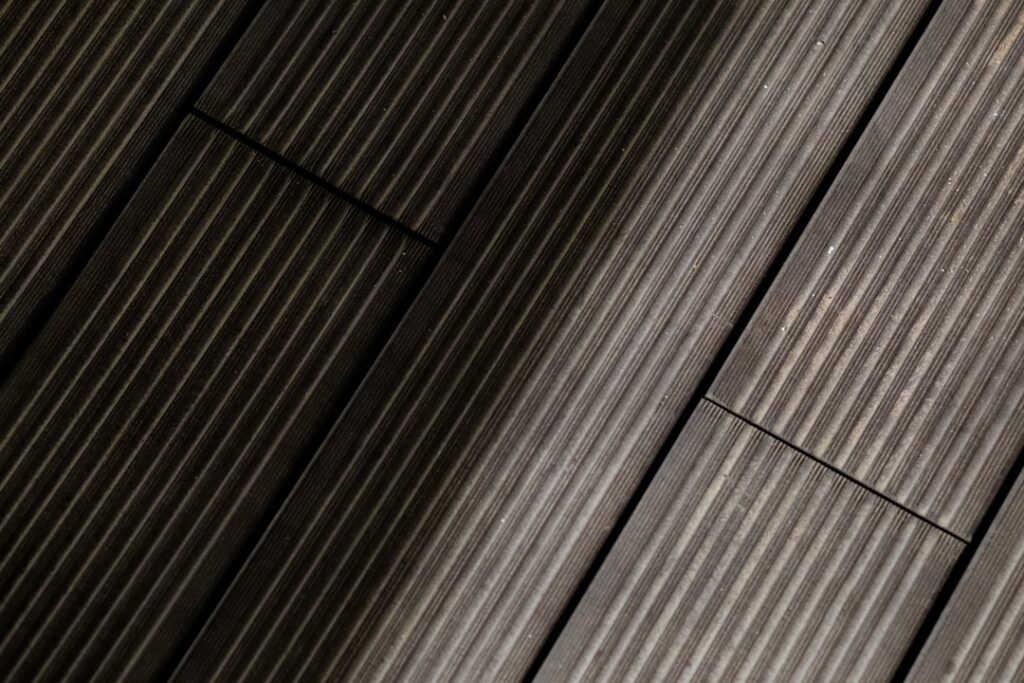
Black composite decking is the boldest look in outdoor living right now — a charcoal or near-black deck against light siding photographs like architecture, hides grill drippings, and pairs perfectly with the black window frames dominating new builds. Every major brand now offers a dark line. But black boards in July sun get hot enough to matter, and “black” on a sample chip ranges from true ebony to warm dark walnut. This guide names the genuinely black lines, gives you the honest heat numbers, and covers fade, styling, and the compromises that make a dark deck livable.
Part of our Decks & Outdoor guide — explore the full guide →
The Heat Reality, With Numbers
Physics first: surface temperature tracks solar absorption, and dark surfaces absorb 85-95% of incoming solar energy versus 30-50% for light ones. Composite compounds the issue because plastic conducts heat poorly — the surface layer holds its heat instead of sinking it away like thick lumber does.
Real-world midsummer readings on a 90-95°F sunny day:
| Surface | Typical peak surface temp |
|---|---|
| Light gray composite | 120-135°F |
| Mid-brown composite | 130-145°F |
| Black/charcoal composite | 145-165°F |
| Cedar (natural) | 110-125°F |
| Broom-finished concrete (light) | 115-130°F |
Skin discomfort starts around 120°F; brief-contact burns become possible above roughly 140°F. Translation: a black composite deck in full afternoon sun is a shoes-on surface for adults and a genuine hazard for toddlers’ feet and dogs’ paws. In shade or by evening it’s a non-issue — the boards shed heat quickly once the sun drops.
Some manufacturers engineer around this. MoistureShield’s CoolDeck technology claims up to 35% less heat absorption in its treated colors; Deckorators’ mineral-based Voyage line runs somewhat cooler than wood-flour composite; TimberTech promotes lighter-cap “cool” colorways. These help but don’t repeal physics — a black CoolDeck board is still hotter than a light gray anything.
Brands and Lines With True Dark Boards
- TimberTech — the deepest bench of dark options: Reserve “Dark Roast,” Landmark “Castle Gate” (dark gray-brown), and AZEK PVC lines with “Dark Hickory.” The PVC versions carry more UV stabilizer headroom and TimberTech’s strongest fade warranty; our TimberTech review covers the tier differences.
- Trex — “Winchester Grey” and “Clam Shell” are mid-grays; the truly dark plays are Transcend “Spiced Rum”-adjacent darks and the Signature/Lineage darker tones. Trex’s darkest boards read charcoal-brown rather than jet black.
- Fiberon — Concordia “Bordeaux” and “Graphite Cliffs”-style dark grays; Promenade PVC offers dark slate tones. Strong multi-tonal streaking keeps big dark decks from looking like a parking lot.
- Deckorators — Voyage “Tundra” and “Dark Slate” in mineral-based composite: the stiffness and low thermal expansion of MBC suit dark colors, which move more with heat on conventional boards.
- MoistureShield — Vision “Smokey Gray” and darker Meridian tones with CoolDeck — the pick if you insist on dark boards in a full-sun southern exposure.
Note the pattern: almost nothing is pure #000000 black. Manufacturers deliberately formulate “black” as deep charcoal or espresso, partly for heat, partly because true black shows every pollen grain and water spot.
Fade: Better Than Its Reputation
Early uncapped composites faded chalky within a few seasons and made owners gun-shy about dark colors. Modern capped boards are a different product: the polymer cap carries the pigment plus UV inhibitors, and the big brands warranty color against fade beyond a specified Delta E (typically 5 units) for 25-50 years. Expect a slight, even mellowing in the first 3-6 months as manufacturing tension in the cap relaxes — order 10% extra from the same lot so future repairs match — and then stability. Dark boards show dust, pollen, and hard-water spotting far more than they fade; plan on rinsing a black deck more often than you would a gray one.
Styling a Black Deck
- Railings: black boards + black aluminum balusters can read heavy. The classic move is contrast — white or bronze rails, or black posts with clear glass or cable infill to keep the view. Matte black hardware everywhere else.
- Picture-frame borders: a light gray or brown border around a black field defines the edge and hides end cuts — high-impact, costs only a few boards.
- Mixed-width and two-tone decks: alternating black and driftwood-gray boards is the current builder-show look and drops average surface temp meaningfully.
- Against the house: black decking sings against white, cream, and light-gray siding; against dark siding it can flatten. Bring a full board sample home — chips lie.
- Underfoot comfort: outdoor rugs at seating zones and a shade sail or pergola over the lounge area solve most of the heat complaint where feet actually go.
Live-With-It Checklist Before You Commit
- Map your sun. A north- or east-facing deck, or one shaded by 3 p.m., wears black beautifully. A shadeless west/south exposure in Texas or Arizona is where black-deck regret lives.
- Test a sample in July. Lay sample boards in the actual location on a hot afternoon and put your palm on them at 4 p.m. This one test settles the debate better than any article.
- Budget for shade if needed. A pergola or fixed cover changes the equation entirely — a covered patio in black composite stays perfectly comfortable.
- Plan the wash routine. Soap, water, soft brush twice a season minimum on black; skip this and pollen film turns the deck gray-green.
- Check expansion gapping. Dark boards run hotter and move more; follow the brand’s high-temperature gapping chart exactly, especially on PVC.
Smarter Alternatives If Heat Kills the Plan
- Dark gray instead of black: colors like slate and graphite deliver 80% of the drama at 10-20°F less surface heat.
- Dark border, light field: black picture-frame around a sand or gray field gives the black-accent look with a walkable center.
- Dark PVC: cellular PVC runs marginally cooler than wood-filled composite in some colorways and dries faster — details in our PVC decking guide.
- Black railing on any deck color: honestly, most of the “black deck” Pinterest effect comes from the railing and furniture, not the boards.
Keeping a Black Deck Looking Black
Dark boards don’t demand more protection — they demand more washing. The maintenance calendar that keeps the color crisp: rinse monthly during pollen season (yellow film is glaring on charcoal), do a soap-and-soft-brush wash in late spring and early fall, and squeegee or sweep standing water after storms if your water is hard — mineral spotting is the number-one cosmetic complaint on black composite, and it’s purely aesthetic but very visible. Keep grill mats under cookers; grease sheen shows on black like nothing else. For furniture, felt or rubber glides only, and lift rather than drag planters. Snow country: plastic shovel, and let sun do the rest — black boards clear themselves faster than any other color, one genuine advantage of all that absorption. None of this is hard; it’s just honest to say a black deck washed twice a year looks worse than a gray one washed never.
FAQ
How much hotter is black composite than gray?
Side-by-side in identical sun, expect black to run 15-30°F hotter than a light gray board from the same line. That’s the difference between “warm” and “can’t stand here.”
Does black composite decking fade to gray?
Capped boards from major brands hold color within warranty limits for decades. You’ll see minor initial mellowing, then stability. Uncapped bargain boards are the ones that go chalky — don’t buy them in any color, especially black.
Is black composite more expensive?
Usually no premium for the color itself; dark tones simply cluster in the premium lines, so you’re paying tier pricing — $6.50-$10/sq ft material against $2.50-$4.50 for entry lines. See our WPC decking guide for the full tier breakdown.
Do black decks show scratches more?
Yes — a scratch through a dark cap exposes lighter core and stands out. Furniture glides and a no-drag grill rule matter more on black than on variegated browns.
Verdict
Black composite decking is a legitimate design win with one honest tax: heat. If your deck gets afternoon shade — or you’re willing to buy it with a pergola — pick a dark line from TimberTech, Deckorators, or MoistureShield and enjoy the drama. If it bakes unshaded all afternoon, step down to dark gray or use black as a border. Sample boards in real sun before ordering; your bare feet in July are the only reviewer that counts.