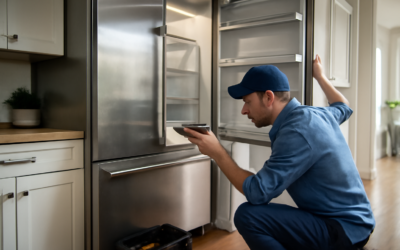
Most Bosch refrigerator repair calls I run into fall into a handful of predictable failures — a warm compartment, a noisy fan, water on the floor, or a flashing panel. The good news is that a fair number of them are user-serviceable if you’re methodical. This Bosch refrigerator repair guide walks the safe DIY fixes and, just as important, tells you where to stop and hand it to a certified tech.
- Before You Touch Anything: Safety
- Fridge Not Cooling but Running
- Reading Bosch Error Codes
- Water on the Floor
- Noises and What They Mean
- Routine Maintenance That Prevents Repairs
- Defrost System Troubleshooting
- Safe DIY Parts and Rough Costs
- Ice Maker and Dispenser Faults
- Fridge Runs Constantly
- When to Call a Pro
Before You Touch Anything: Safety
Cut power at the breaker or unplug the unit before any repair beyond swapping a filter. A refrigerator’s compressor circuit runs on 120V and the start relay can hold a charge. And read this clearly: the sealed refrigerant system — compressor, evaporator, condenser, and capillary tube — is off-limits to DIY. Federal law requires EPA-608 certification to open a refrigerant circuit or handle refrigerant. If your problem traces to any of those components, this is a call-a-pro job, full stop. Everything in the DIY sections below is on the safe side of that line.
Fridge Not Cooling but Running
When the compressor hums but the box stays warm, work through the accessible causes before assuming the worst.
- Condenser coils: Bosch bottom-freezer and French-door models have coils behind the lower rear panel. Dust-caked coils can’t reject heat, so the fridge runs constantly and still drifts to 45°F or warmer. Vacuum them every 6 to 12 months. This alone fixes a surprising share of “not cooling” calls.
- Evaporator fan: If the freezer is cold but the fridge is warm, the evaporator fan behind the freezer’s rear panel may have failed. Listen for it. A dead or ice-blocked fan means cold air never reaches the fridge compartment.
- Air vents: Packed shelves blocking the interior vents starve the fridge of cold air. Leave a couple inches of clearance.
Target temperatures are 37°F for the fridge and 0°F for the freezer. If coils are clean, the fan spins, and vents are clear but it still won’t hold temperature, you’re likely looking at a sealed-system fault — pro territory.
Reading Bosch Error Codes
Bosch panels show alphanumeric codes that narrow the diagnosis fast. A few common ones:
- E1 / E2: temperature sensor (thermistor) fault in the fridge or freezer circuit. The thermistor is a user-replaceable part, roughly $15 to $40.
- Flashing temperature display or alarm tone: usually a door left ajar or a warm-up event. Confirm the door seals before chasing electronics.
- “SuperFreezing” stuck on: often a stuck button or a control-board glitch; try a power-cycle first.
Power-cycle before replacing anything: unplug for 5 minutes, plug back in. That clears a lot of one-off board hiccups. If the code returns immediately, the flagged component is genuinely at fault.
Water on the Floor
Leaks almost always come from one of two places, and neither is a sealed-system issue.
- Clogged defrost drain: The most common cause. Ice or gunk blocks the drain at the back of the freezer floor, meltwater backs up, and it eventually spills. Thaw the drain with warm water flushed through a turkey baster, and clear the tube.
- Water line or inlet valve: Models with ice/water dispensers can leak at the fill line fitting or a cracked valve. Shut the house water supply, dry everything, and watch for the source. The inlet valve is a replaceable part, typically $30 to $80.
Noises and What They Mean
Bosch fridges are quiet by design, so new noise usually signals something specific.
- Loud humming or buzzing: often the condenser fan hitting debris, or the water inlet valve during a fill.
- Grinding or clicking from the freezer: the evaporator fan blade striking ice buildup — points to a defrost problem.
- Rapid clicking from the base: the compressor start relay trying and failing to start the compressor. That’s a warning sign of a sealed-system or relay fault; get a pro on it.
Routine Maintenance That Prevents Repairs
Most service calls I run trace back to a maintenance step that got skipped. A short seasonal routine keeps the expensive parts alive:
- Vacuum the condenser coils every 6 months. On bottom-freezer and French-door Bosch models the coils sit behind the lower rear panel; a caked coil makes the compressor run 20 to 30% longer and shortens its life.
- Replace the water filter on schedule. Bosch specifies a 6-month interval, or roughly every 200 gallons. An overdue filter slows dispenser flow and can freeze the fill tube.
- Clean the door gaskets. Wipe them with warm soapy water quarterly and check for tears. A grimy or torn seal leaks cold air, driving up runtime and inviting condensation.
- Level the unit. A fridge tilted forward stresses the doors and can throw off the defrost drain’s slope, causing slow leaks.
- Set temperatures correctly. 37°F fridge, 0°F freezer. Colder settings waste energy and load the compressor for no benefit.
Fifteen minutes twice a year on this list heads off the majority of the faults covered above.
Defrost System Troubleshooting
Frost building on the freezer’s back wall, or a fridge that slowly warms over a day or two, usually points to the defrost system. The auto-defrost cycle has three parts: the defrost heater, the defrost thermostat, and the timer or control board. The thermostat and heater are accessible behind the freezer’s rear inner panel and are user-serviceable with basic tools and a multimeter. A defrost thermostat runs $10 to $30; a heater element $30 to $70. Test for continuity with the power off. If you’re not comfortable with a multimeter, this is a reasonable point to call a tech.
Safe DIY Parts and Rough Costs
- Water filter: $30 to $50, twist-out, 6-month interval.
- Door gasket/seal: $50 to $120; replace when the dollar-bill test slips out easily.
- Thermistor/temperature sensor: $15 to $40.
- Evaporator or condenser fan motor: $40 to $120.
- Defrost thermostat: $10 to $30.
- Water inlet valve: $30 to $80.
These are the components a handy owner can tackle. Order parts by your exact model number — it’s on the tag inside the fridge compartment, usually on a side wall near the crisper. Buy Bosch-specified parts rather than generic substitutes; the sensors and control boards are model-matched, and a near-miss part can throw a fresh error code or fail early. Keep a photo of the rating tag on your phone so you’re not crawling behind the unit every time you order.
Ice Maker and Dispenser Faults
On Bosch models with an ice maker, “no ice” complaints usually trace to something accessible, not the sealed system. Start with the water: a partially frozen fill tube or a clogged water filter throttles supply, so the mold never fills. Swap a filter that’s past its 6-month mark before anything else. Next check the water inlet valve — if it’s electrically dead or the screen is clogged, no water reaches the mold. Confirm the freezer is holding 0°F to 5°F, because a warm freezer won’t cycle the ice maker at all. If water flows, the freezer is cold, and the mold still won’t eject, the ice maker module itself may have failed; it’s a bolt-in, plug-in part in the $80 to $200 range that a handy owner can replace.
Fridge Runs Constantly
A Bosch that never shuts off is trying to shed heat it can’t get rid of. Walk the accessible causes in order: dirty condenser coils (vacuum them), a condenser fan choked with debris, a door seal leaking warm air in, or a fridge stuffed so full that airflow can’t circulate. Also check that neither the SuperCooling nor SuperFreezing mode is stuck on — those force the compressor to run hard and are easy to leave engaged by accident. If the coils are clean, the fans spin, the seals pass the dollar-bill test, and it still won’t cycle off while the box drifts warm, suspect a refrigerant undercharge or a failing compressor. That’s a sealed-system diagnosis and belongs to a certified tech.
When to Call a Pro
Hand it off the moment the diagnosis points to the sealed system: a compressor that won’t start or overheats, a refrigerant leak (fridge runs nonstop but never cools, oily residue near coils), or a failed evaporator/condenser inside the refrigerant loop. Those repairs require EPA-608 certification, recovery equipment, and vacuum/recharge tools — not DIY, not optional. A professional Bosch refrigerator repair service call typically runs $75 to $150 for diagnosis, and a sealed-system compressor job can reach $500 to $1,000 in parts and labor.
Weigh that against the unit’s age. On a Bosch under five years old, a control board or fan swap is worth it. Past ten years, a major sealed-system Bosch refrigerator repair often costs more than half the price of a replacement — at which point replacing makes more sense. When in doubt, get the pro’s diagnosis first; the service fee usually rolls into the repair if you proceed.