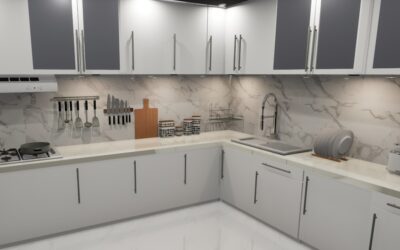
The contemporary kitchen aesthetic has matured past the cold gray-and-white phase of 2018 into something warmer, more textural, and more livable. Contemporary kitchen ideas in 2026 emphasize natural materials, integrated appliances, mixed metal finishes, and storage solutions that hide clutter without feeling sterile. This guide covers the design choices that define current contemporary kitchens, real material costs, and the design moves that age gracefully versus the ones that look dated within five years.
Part of our Kitchen Remodeling guide — explore the full guide →
- Defining Contemporary vs Modern
- Slab Cabinet Doors as the Foundation
- Two-Tone Cabinet Strategies
- Waterfall Islands and Stone Choices
- Integrated and Panel-Ready Appliances
- Hardware-Free Looks
- Backsplash Choices for Contemporary Spaces
- Lighting Strategies
- Flooring That Suits the Aesthetic
- Mixing Metals the Right Way
- Designing for Hidden Clutter
- Frequently Asked Questions
Defining Contemporary vs Modern
The terms get used interchangeably but they are not the same. Modern refers to a specific mid-20th-century design movement (Bauhaus, mid-century modern, Scandinavian modernism) with defined formal characteristics. Contemporary refers to current design as it evolves, drawing from modern but incorporating other influences.
A contemporary kitchen in 2026 typically features clean lines, minimal ornamentation, integrated appliances, mixed material palettes (warm woods with cool stones), and high-functioning storage. It is less rigid than modernism and more comfortable for daily family use.
Slab Cabinet Doors as the Foundation
Slab doors (flat, no profile, no panels) are the most defining contemporary design element. They read sleek without becoming cold and pair with virtually any door finish from white-painted to walnut veneer to colored lacquer.
Quality slab doors are typically 5-piece construction with a veneered MDF center panel, or solid wood with no panel detail. Pricing runs $50 to $150 per door from custom suppliers like Conestoga or Cabinet Door World. Pre-finished slab door kitchens from Semihandmade (designed for IKEA Sektion boxes) start around $4,500 for a typical galley layout.
Two-Tone Cabinet Strategies
Single-color kitchens give way to two-tone schemes that add visual interest without becoming busy. Common pairings: white uppers with walnut or oak lowers, navy or forest green lowers with white uppers, or matte black perimeter cabinets with a wood-tone island.
The 70/30 rule keeps two-tone kitchens balanced: 70% of cabinet visual mass in the dominant color, 30% in the accent. For a typical L-shaped kitchen with 18 cabinets, that means 12 to 14 cabinets in the dominant color and 4 to 6 in the accent. Going 50/50 reads choppy in most layouts.
Waterfall Islands and Stone Choices
The waterfall island (where the countertop continues vertically down both sides instead of stopping at the cabinet face) remains the signature contemporary kitchen detail. It works in stones with consistent veining (quartz) or dramatic veining (marble, quartzite).
Pricing for a waterfall edge adds $800 to $2,500 over a standard island top. The fabricator miters the corner and matches the veining for a continuous appearance. Quartz brands like Caesarstone, Cambria, and Silestone offer engineered consistency. Quartzite slabs (Taj Mahal, Macaubas Fantasy) bring natural drama at $90 to $180 per sq ft installed.
Integrated and Panel-Ready Appliances
Contemporary kitchens hide appliances behind cabinet panels for a continuous, uninterrupted visual flow. Refrigerators, dishwashers, and even some ovens are now panel-ready or fully integrated.
Panel-ready refrigerators from Sub-Zero, Thermador, Miele, and JennAir run $7,000 to $18,000 versus $2,000 to $5,000 for a standalone counter-depth refrigerator. Panel-ready dishwashers from Bosch and Miele run $1,300 to $2,500. The panels themselves add $400 to $1,200 each from your cabinet supplier.
Built-in coffee machines (Miele CM6160, Thermador TCM24DS) are increasingly common at $3,500 to $7,000. They eliminate countertop clutter and signal premium positioning.
Hardware-Free Looks
Push-to-open mechanisms (Blum Tip-On or Hettich Push to Open) eliminate cabinet hardware entirely for the cleanest possible look. Each unit costs $8 to $20 and adds about $200 to $500 across a typical kitchen.
Finger-pull edges (a routed finger-grip channel along door tops) are the alternative for kitchens that want minimal hardware without the maintenance of push-to-open mechanisms. Most cabinet shops offer finger-pull as a no-cost option on slab doors.
If you keep visible hardware, choose long linear pulls (12 to 24 inches) in brushed brass, matte black, or brushed nickel. Skip ornamental knobs and traditional cabinet pulls.
Backsplash Choices for Contemporary Spaces
Full-height stone slab backsplashes (matching the countertop) define luxury contemporary kitchens. The look eliminates grout lines entirely and reads dramatic, especially with veined materials. Cost adds $40 to $120 per linear foot of wall over standard tile.
For mid-budget contemporary kitchens, large-format porcelain tiles (24×48 inches) in a textured concrete or limestone visual provide a similar effect at lower cost. Avoid small subway tiles and busy mosaic patterns; both read traditional rather than contemporary.
Lighting Strategies
Layered lighting separates contemporary kitchens from generic builder kitchens. Three layers minimum: ambient (recessed cans on dimmers), task (under-cabinet LED strips), and accent (linear pendants over the island, toe-kick lighting, or interior cabinet lighting).
Linear pendants over the island are the contemporary go-to. Brands like Kuzco, Cerno, and Modern Forms offer LED-integrated linear pendants in 24, 36, and 48-inch lengths at $400 to $1,800 each. Plan on one pendant per 4 feet of island length.
Under-cabinet LED tape light from WAC Lighting or Diode LED at $25 to $60 per linear foot installed delivers task lighting without visible fixtures. Color temperature should match all other lights in the kitchen (typically 2700K warm or 3000K neutral white).
Flooring That Suits the Aesthetic
Wide-plank European white oak (220mm to 320mm width) in a hardwax oil finish is the most-installed flooring in contemporary kitchens. Pricing runs $9 to $18 per sq ft installed. The matt oiled finish reads sophisticated without feeling sterile.
Large-format porcelain tile in concrete or limestone visual works for kitchens that need maximum durability. 24×48 inch tiles run $7 to $14 per sq ft installed. Polished concrete is the most committed contemporary statement at $8 to $14 per sq ft.
Mixing Metals the Right Way
Contemporary kitchens accept mixed metals if the mix is intentional. The rule of thumb: pick two metal finishes maximum and use them consistently across the kitchen.
Common pairings that work: brushed brass cabinet hardware with matte black faucets, brushed nickel hardware with matte black appliances, polished chrome with brushed brass island pendants. Avoid mixing more than two finishes; the look becomes accidental rather than intentional.
Designing for Hidden Clutter
Contemporary kitchens stay clean-looking only if they have abundant closed storage. Pantry walls (full-height cabinet runs with bi-fold or pocket doors) hide everything from small appliances to dry goods.
Appliance garages built into corner cabinets keep coffee makers, toasters, and stand mixers off the counter while remaining easy to access. Charging drawers (a single drawer wired with USB outlets and a power strip) eliminate device clutter on counters.
Trash and recycling pull-outs, a designated knife block drawer, and built-in cutting boards over trash openings all contribute to the clutter-free look that defines contemporary kitchens.
Frequently Asked Questions
What defines a contemporary kitchen?
Contemporary kitchens feature clean lines, minimal ornamentation, integrated or panel-ready appliances, mixed material palettes combining warm and cool elements, and high-functioning closed storage that hides everyday clutter. The aesthetic emphasizes function and visual calm.
How much does a contemporary kitchen cost?
A mid-range contemporary kitchen runs $35,000 to $75,000 for a 150 to 200 sq ft space. Premium contemporary kitchens with panel-ready appliances, custom cabinetry, and stone slab backsplashes run $90,000 to $200,000+ depending on appliance and material selection.
Are contemporary kitchens going out of style?
No. Contemporary kitchens evolve continuously rather than going out of style. The clean-line foundation has been popular for over 30 years and continues to be the dominant aesthetic in new high-end construction. Specific finishes and colors trend, but the foundational principles age well.
What flooring works best in a contemporary kitchen?
Wide-plank European white oak with a hardwax oil finish is the most popular contemporary kitchen flooring. Large-format porcelain tile, polished concrete, and luxury vinyl plank in oak visuals also fit the aesthetic. Avoid busy patterns and small-format tiles.
What color cabinets are most popular in contemporary kitchens?
White and warm wood tones (white oak, walnut) lead. Two-tone schemes pairing wood lowers with white uppers, or deep colors (navy, forest green, charcoal) with white uppers, are increasingly common. Single-color all-white kitchens have softened toward off-whites and warm whites.