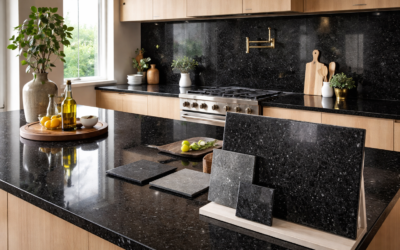
Many people search for Daltile Molten Grey expecting a floor tile, and then discover it is something else entirely. Molten Grey is an engineered quartz surface color from Daltile’s ONE Quartz line, which dealer listings place under the Nature Flecks look with the color code NQ95. It is sold as a slab for countertops, vanities and wall applications, not as a floor tile you set with thinset in a hallway.
Part of our Tile & Grout guide — explore the full guide →
That distinction matters before you plan a room around it. Daltile states that its ONE Quartz surfaces do not meet the recommended friction thresholds for floors, and that the material is not suitable for exterior use because sunlight can damage the surface. So the best rooms for Molten Grey are kitchens, baths, laundry rooms and bars, where it works as the counter or a backsplash, paired with a floor tile chosen separately.
- Daltile Molten Grey at a Glance
- What Molten Grey Looks Like in Person
- Best Rooms for a Dark Flecked Quartz
- Pairing Ideas, Backsplash Choices and Grout Colors
- Tools and Materials for a Quartz Countertop Project
- How to Plan and Install Molten Grey Counters
- Safety: Silica Dust From Quartz and Tile
- Care and Cleaning
- Troubleshooting Common Problems
- Cost Ranges and Alternatives
- When to Call a Pro
- Frequently Asked Questions
One more caution up front: Daltile’s current website no longer shows a standalone product page for Molten Grey, and at least one slab dealer lists it as no longer available. Treat it as a color that may be limited or discontinued, and confirm stock with a local slab yard before you fall in love with a sample.
Daltile Molten Grey at a Glance
The spec table pulls together what can be confirmed from Daltile’s own pages for the ONE Quartz line and from dealer listings for this specific color. Where a value could not be confirmed on the manufacturer’s site, it is marked as something to check on the current spec sheet.
| Spec | Value | What it means |
|---|---|---|
| Material | Engineered quartz (ONE Quartz) | Crushed quartz bound with a small amount of resin; nonporous and does not need sealing |
| Color code | NQ95 (per dealer listings) | Use this code when asking a dealer, since names get reused across brands |
| Look | Nature Flecks: dark grey with speckled pattern | A granular, flecked look rather than marble veining |
| Format | Slab, variable nominal size | Fabricated to your layout; not sold in tile cartons |
| Thickness | ONE Quartz is offered in 2 cm and 3 cm; dealers list Molten Grey in 3 cm | 3 cm usually needs no plywood buildup or laminated edge |
| Finish | Polished (per dealer listings) | Reflective surface; confirm with the current spec sheet |
| Floor use | Not recommended | Does not meet recommended floor friction thresholds |
| Exterior use | Not recommended | Sun exposure can damage the surface |
| Typical installed cost | About $50 to $100 per sq ft | General range for mid-market quartz, fabrication and install included |
Because Daltile has no live page for the color, there are no published numbers here for slab dimensions or warranty terms. Ask the dealer for the current ONE Quartz technical data sheet and the written warranty before you sign a fabrication contract.
What Molten Grey Looks Like in Person
Dealers describe Molten Grey as a dark grey quartz, and one listing tags it as a taupe, which tells you the undertone can read slightly warm in some light. The Nature Flecks look relies on small specks of contrasting tone scattered across the slab rather than long veins. Think of the granular texture of a fine-grained granite, but more even from one end of the slab to the other.
That uniformity is the main reason people choose a flecked quartz. Seams are easier to hide than on a veined slab, because there is no vein that has to line up across the joint. Crumbs and water spots also disappear into the pattern far better than on a solid white or a solid black counter.
Always view a full slab or a large sample rather than a 4 inch chip. A small chip under showroom lighting can look nearly charcoal, while the same slab under warm kitchen bulbs may read closer to a mid grey with brown hints. Hold the sample next to your cabinet door and your floor sample in the actual room, at different times of day.
Best Rooms for a Dark Flecked Quartz
Kitchens
Kitchens are the natural home for Molten Grey. A dark counter grounds white or light painted cabinets, and the flecked pattern hides the everyday clutter of a working kitchen. It also pairs well with stainless appliances and matte black hardware. If the room is small or has limited daylight, consider using it only on the island and a lighter quartz on the perimeter so the space does not feel heavy.
Bathrooms and vanities
A vanity top in a dark grey quartz looks crisp against a white undermount sink. Quartz does not need sealing, which is a real advantage in a bath where toothpaste, hair dye and makeup land on the counter. Keep strong solvents and drain cleaners off the surface, since the resin binder can discolor.
Laundry rooms, bars and built-ins
Molten Grey suits a laundry folding counter, a basement bar, or a desk built-in. These are spots where durability and stain resistance matter more than a dramatic pattern, and where a remnant piece may be enough. Ask the fabricator about remnants, since a small project can sometimes use leftover pieces at a lower price.
Where it does not belong
Skip it for floors, stair treads, outdoor kitchens and sunny patios. ONE Quartz is rated for countertops and walls only. If you love the color, use a porcelain floor tile in a coordinating grey instead.
Pairing Ideas, Backsplash Choices and Grout Colors
A dark, speckled counter gives you a lot of freedom with the backsplash. A few combinations that work reliably:
- White glossy ceramic subway tile with a light grey grout. Classic, bright, and it lets the counter be the darker anchor.
- Warm white handmade-look tile with an off-white grout if Molten Grey reads warm in your light. It softens the contrast.
- Full-height quartz backsplash in the same slab. Clean, easy to wipe, and it removes grout lines entirely.
- Light grey large-format porcelain on the floor, so the counter is the darkest element in the room.
For grout around a tile backsplash, pick a shade between the tile and the counter. A mid grey or warm grey grout hides staining near the counter line far better than a bright white. Run a bead of color-matched silicone caulk where the backsplash meets the quartz, rather than grout, since that joint moves with seasonal changes.
Cabinet colors that work well include white, light greige, natural white oak, and muted sage or navy. Avoid pairing it with a floor tile of nearly the same depth of grey; the room loses contrast and the counter disappears into the floor.
If your project includes a new large-format porcelain floor to go with the counters, a tile leveling system helps keep long tiles flat at the edges, which matters when a dark counter and a light floor draw the eye to every line.
Tools and Materials for a Quartz Countertop Project
Most homeowners do not fabricate quartz themselves, and they should not. You will still handle prep and some finishing work:
- Level and straightedge for checking cabinet tops
- Shims and screws for leveling base cabinets
- Cardboard or thin plywood for templates (if the fabricator allows)
- Neutral cure silicone caulk in a matching color
- pH-neutral cleaner and soft microfiber cloths
- Trivets and cutting boards
- For any tile backsplash: notched trowel, thinset or mastic per the tile maker, spacers, grout float, sponge, and a wet saw
How to Plan and Install Molten Grey Counters
- Confirm availability first. Give the dealer the code NQ95 and ask whether full slabs, 2 cm or 3 cm, are in stock or orderable. Reserve the slab before the template date.
- Level the cabinets. Base cabinets should be level within about 1/8 inch across a run. Quartz does not flex, so a high spot can crack a slab during install.
- Set appliances and fixtures. Have the sink, cooktop and faucet models on site or the cut-out specs in hand. Fabricators template off real dimensions.
- Template. The fabricator measures with a digital or physical template. Decide seam locations here; a flecked pattern hides seams well, but place them away from the sink if possible.
- Fabrication. The shop cuts, edges and polishes the slab, ideally with wet cutting and dust controls.
- Install. The crew sets the tops, bonds the seams with color-matched epoxy, and mounts undermount sinks.
- Finish. Caulk the backsplash joint, reconnect plumbing, and let adhesives cure for the time the installer gives you before heavy use.
Safety: Silica Dust From Quartz and Tile
Engineered quartz contains a very high share of crystalline silica. Cutting, grinding or polishing it releases fine dust that can cause serious, permanent lung disease. Leave fabrication to a shop that uses wet cutting and proper dust controls, and do not dry cut quartz in your garage.
For any on-site work that creates dust, including cutting a porcelain backsplash or floor tile to go with your counters:
- Use a wet saw or wet cutting method whenever possible.
- Wear a fitted N95 at minimum, or a half-mask with P100 filters for heavier cutting.
- Clean up with a HEPA-filtered vacuum, never by dry sweeping or blowing dust with compressed air.
- Keep children and pets out of the work area until cleanup is done.
Care and Cleaning
Daily care is simple. Wipe with warm water and a pH-neutral cleaner, then dry with a soft cloth. A dark polished surface shows streaks if you leave soapy water to dry, so a final buff with a dry microfiber pays off.
Daltile’s ONE Quartz data shows the material passed a thermal shock test, but quartz resin can still scorch from a pan straight off a burner. Use trivets every time. Avoid bleach, oven cleaner, paint stripper and nail polish remover on the surface. If something dries on, scrape gently with a plastic putty knife rather than an abrasive pad.
Troubleshooting Common Problems
- Cloudy streaks: Usually cleaner residue. Rinse with plain water and dry with a clean microfiber.
- Visible seam: Ask the fabricator to recolor and repolish the epoxy. Most seam complaints are fixable on site.
- Dull or discolored ring: Often heat or a harsh chemical. Minor marks may polish out by a pro; deep scorch marks may need a patch.
- Chip on an edge: Save the chip if you find it. A fabricator can fill edge chips with tinted resin.
- Color does not match the sample: Quartz lots vary slightly. Always approve the actual slab before cutting.
Cost Ranges and Alternatives
Mid-market quartz like ONE Quartz typically lands around $50 to $100 per square foot installed, depending on your region, edge profile, cut-outs and slab thickness. A full-height backsplash, waterfall ends and mitered edges push the total up. Remnant pieces for a small vanity can cost much less.
If Molten Grey is unavailable, look for another dark grey quartz with a fine fleck or salt-and-pepper look from the same line or another maker, or a honed dark granite if you prefer natural stone. Bring your cabinet and floor samples to compare in person.
When to Call a Pro
Call a professional fabricator for all cutting, templating and installation of quartz slabs. Hire a licensed plumber if you are moving a sink or adding a dishwasher line, and a licensed electrician for any new outlets in the backsplash, which must be GFCI-protected in kitchens and baths. If the cabinets are out of level by more than you can shim, bring in a carpenter before template day.
Frequently Asked Questions
Is Daltile Molten Grey a tile or a countertop?
It is an engineered quartz countertop color in the ONE Quartz line, listed by dealers under code NQ95, sold as slabs. It is not a floor tile and is not rated for floors.
Is Molten Grey discontinued?
Daltile’s site no longer shows a product page for it and at least one dealer lists it as no longer available. Ask your local slab yard for current stock using the NQ95 code.
Does Molten Grey quartz need sealing?
No. Engineered quartz is nonporous and does not need sealing. Clean it with a pH-neutral cleaner and avoid harsh chemicals.
Can I use Molten Grey outdoors?
No. Daltile states its ONE Quartz products are not suitable for exterior use because sunlight can damage the surface.
What backsplash goes with Molten Grey?
White or warm white subway tile, a light grey porcelain, or a full-height backsplash in the same quartz all work well. Pick a grout tone between the tile and the counter.