The weathered, sun-bleached look of wood washed up on a beach has been one of the dominant interior trends for nearly a decade, and laminate manufacturers responded with dozens of decor options chasing it. Driftwood laminate flooring covers a wide spectrum — from cool gray-blue planks that read like genuine seashore lumber to warmer beige-gray hybrids that fit transitional and farmhouse interiors. The category includes everything from $1.79 per sq ft big-box options to $4.49 per sq ft premium AC5 products. Knowing what separates a convincing driftwood print from an obviously cheap one — and what AC rating you actually need — keeps you from buying a floor you regret in two years.
- What Driftwood Laminate Actually Looks Like
- The AC Rating You Need
- Top Driftwood Laminate Products in 2026
- The Pros That Make Driftwood Laminate a Strong Pick
- The Cons That Drive Some Buyers to LVP Instead
- Installation: What Pros Watch For
- Daily Care and What to Avoid
- Pairing Driftwood Floors With Your Interior
- Who Should Buy Driftwood Laminate
What Driftwood Laminate Actually Looks Like
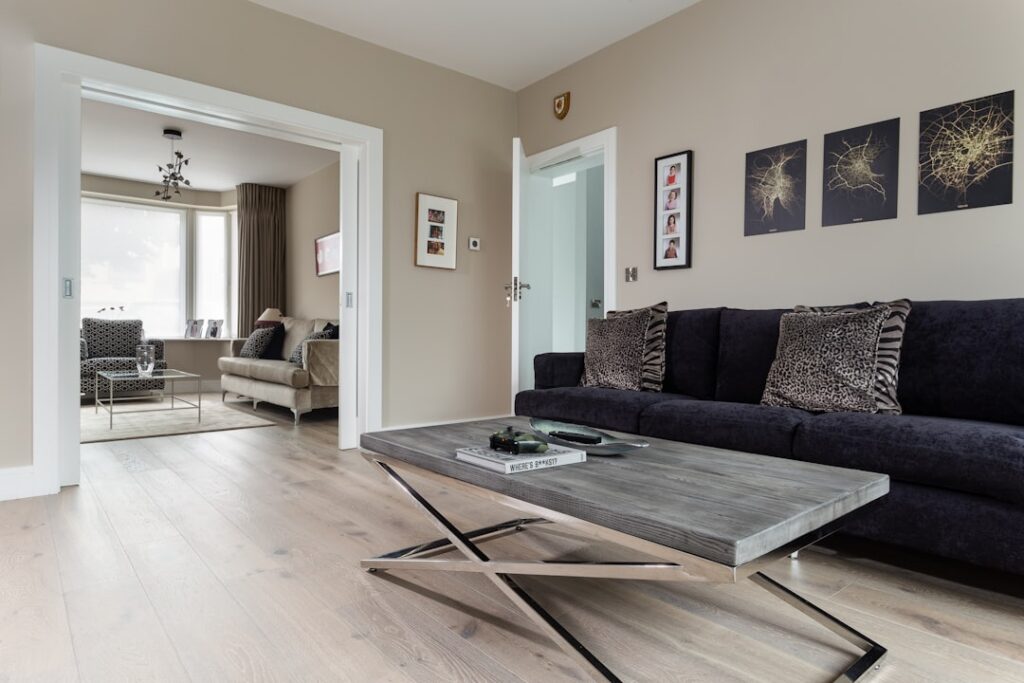
The “driftwood” decor in laminate refers to a specific visual treatment — weathered grain with desaturated gray, taupe, or beige base tones, often with hints of warm undertone showing through the cool gray. The print should show variation across planks, with some boards lighter and some darker, mimicking how genuine driftwood weathers unevenly from sun, salt, and water exposure.
The convincing products show roughly 10 to 16 distinct plank variations across a single carton. Cheap driftwood laminate repeats the same 4 to 6 patterns, which becomes visually obvious within a few rows of install.
The AC Rating You Need
The AC (Abrasion Class) rating determines how much traffic the laminate handles before the wear layer dulls or scratches through. For driftwood specifically — usually installed in active rooms with beach-house aesthetics like mudrooms, sunrooms, and family rooms — go for AC4 or higher:
- AC3 — bedrooms and light-traffic residential only; do not use in entries or kitchens
- AC4 — general residential including kitchens, family rooms, and entries
- AC5 — heavy residential and light commercial, the safest choice for active households
- AC6 — heavy commercial, overkill for almost any residential application
The price difference between AC3 and AC4 is typically $0.50 to $0.80 per sq ft. The performance difference is significant.
Top Driftwood Laminate Products in 2026
The dominant US options:
- Pergo Outlast Plus Vintage Pewter Oak — AC4, 12mm core, $2.99 to $3.79 per sq ft
- Mohawk RevWood Plus Coastal Couture Driftwood — AC5, hybrid waterproof, $3.49 to $4.49 per sq ft
- Shaw Repel Anvil Plus Bistro Driftwood — AC4, water-resistant 24-hour warranty, $2.79 to $3.49 per sq ft
- Mannington Restoration Collection Treeline Driftwood — AC4, 12mm core, $3.29 to $4.19 per sq ft
- Quick-Step Reclaime Old Town Driftwood — AC4, 12mm, $3.49 to $4.29 per sq ft
For waterproof driftwood laminate, Mohawk RevWood Plus and Shaw Repel both carry 24-hour waterproof warranties, which puts them ahead of standard laminate for kitchens and mudrooms where occasional water exposure is realistic.
The Pros That Make Driftwood Laminate a Strong Pick
Laminate delivers a more convincing wood-grain print than vinyl at the same price point, especially in textured surface finishes that include embossed-in-register (EIR) detail aligning the visual grain with the physical texture. For driftwood specifically, the weathered grain reads very convincingly under EIR treatment.
Pricing is the other major advantage. AC4 driftwood laminate at $2.99 to $3.79 per sq ft is significantly cheaper than comparable LVP at $3.49 to $4.99 per sq ft, and dramatically cheaper than driftwood-look engineered hardwood at $6.99 to $9.99 per sq ft. For whole-home installs where total square footage exceeds 1,500 sq ft, the savings reach $5,000 to $8,000.
The Cons That Drive Some Buyers to LVP Instead
Laminate is not fully waterproof. Even the 24-hour waterproof products from Mohawk and Shaw will swell at the seams if water sits for longer than the warranty period. For genuine wet spaces — bathrooms, laundry rooms, basements with flood history — LVP remains the safer choice.
Sound transmission is also higher. Laminate over a hard subfloor sounds louder underfoot than LVP, which usually includes an attached IXPE or cork foam underlayment. For upstairs installs, a separate sound-dampening underlayment like QuietWalk Plus adds $0.50 to $0.85 per sq ft and bridges most of the gap.
Installation: What Pros Watch For
Driftwood laminate installs as a click-lock floating floor over almost any subfloor, with a few constraints:
- Subfloor flatness within 3/16 inch over 10 feet, measured with a long straightedge
- Moisture content under 12 percent for wood subfloors, under 75 percent RH for concrete
- 1/4-inch expansion gap at every wall, doorway, pipe, and obstruction
- Foam or cork underlayment with attached vapor barrier over concrete slabs
- Acclimation 48 to 72 hours on-site in the room at install temperature and humidity
The most common driftwood laminate failure I see is gaps appearing between planks 6 to 12 months after install. The cause is almost always insufficient expansion gap or a subfloor outside the 3/16 inch tolerance — not a defect in the planks themselves.
Daily Care and What to Avoid
Driftwood laminate cleans like any laminate — soft-bristle broom or dust mop daily, barely-damp microfiber mop with Bona Stone, Tile and Laminate cleaner weekly. The matte and low-satin finishes typical of driftwood decors hide dust and footprints well, but they can show greasy residue from over-wetting.
Avoid steam mops, oil-soap cleaners, and vinegar. Steam forces moisture through seams into the HDF core. Oil-soaps leave a film that dulls the matte finish. Vinegar etches the aluminum oxide topcoat over time. Bona, Pergo Floor Care, and Shaw R2X are all formulated specifically for laminate and will not void the warranty.
Pairing Driftwood Floors With Your Interior
The cool gray-beige of driftwood pairs well with white shiplap walls, navy or sage cabinetry, warm brass or matte black hardware, and sisal or jute rugs. It struggles next to warm yellow oak cabinets or red-brown leather furniture because the undertone clash reads as visual noise.
For coastal, farmhouse, and modern transitional homes, driftwood laminate is one of the most versatile floor choices on the market. For traditional Colonial or Mediterranean homes leaning warm, a honey oak or hickory laminate would serve the architecture better.
Who Should Buy Driftwood Laminate
This is the right pick for budget-conscious homeowners who want the beachy weathered-wood aesthetic in active spaces where genuine driftwood-look hardwood would be impractical. Active families, vacation rental owners furnishing coastal properties, and anyone with a 1,500-plus sq ft install where saving $5,000 against LVP matters all benefit. For wet rooms specifically, step up to a waterproof rigid-core LVP in a driftwood print instead. For everything else, AC4 driftwood laminate delivers the look at a price that is hard to argue with.
Prefer to explore on your own?
See how new flooring looks in your actual room in seconds — free, no signup.
Try the free Floor Studio →