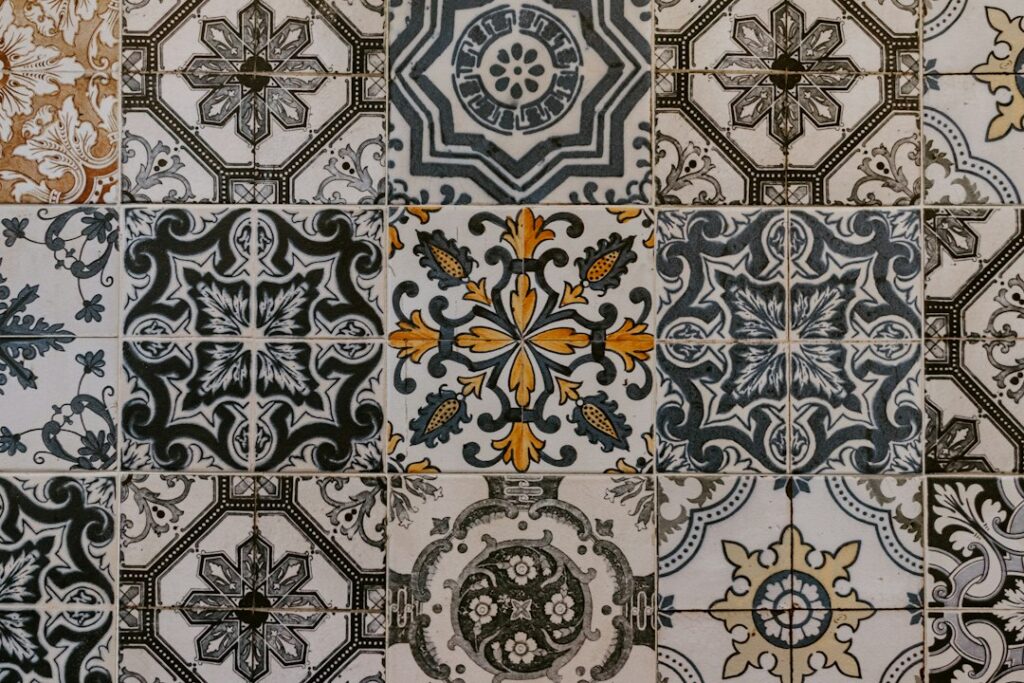
Walk into any luxury hotel lobby and look down. The floor is rarely an afterthought. Fancy floor tiles are the single most cost-effective way to make an ordinary room feel custom, and the range of available looks has exploded over the past decade. You no longer need a stonemason and a five-figure budget to get marble veining, hand-painted patterns, or terrazzo speckle underfoot. The trick is knowing which materials deliver the look without the maintenance headaches.
Part of our Tile & Grout guide — explore the full guide →
For kitchens, bathrooms, and entryways, the same few categories come up again and again when homeowners want something with presence. Here is how the most popular options stack up.
- What Makes a Floor Tile “Fancy”
- Marble-Look Porcelain
- Encaustic and Patterned Cement Tile
- Large-Format and Slab Tile
- Terrazzo and Speckled Looks
- Mosaic and Decorative Accents
- Choosing the Right Tile for Each Room
- Understanding Tile Ratings and Durability
- Grout: The Detail That Makes or Breaks the Look
- Trends Worth Considering
- Final Thoughts
What Makes a Floor Tile “Fancy”
Fancy is less about price and more about visual impact. A $4 per square foot porcelain that mimics Calacatta marble can read as far more luxurious than a plain $9 natural stone. Three qualities separate premium-looking tile from builder-grade stock: pattern complexity, surface finish, and format. Large-format slabs, bold geometric patterns, and high-gloss or honed finishes all signal a designer hand.
Texture matters too. A tile with subtle relief, a metallic glaze, or a polished glass face catches light in a way matte field tile never will. When you are choosing, view samples in the actual room at different times of day before committing.
Marble-Look Porcelain
If you want the high-end look without the cost or upkeep of real marble, marble-look porcelain is the workhorse. Brands like Daltile’s Marble Attache and MSI’s Eden collection print realistic veining on a porcelain body that is essentially waterproof. Expect to pay $5 to $12 per square foot for quality versions.
The advantages over genuine marble are significant. Porcelain does not etch when you spill lemon juice or wine, it never needs sealing, and it resists scratches that would dull a soft stone. For a busy kitchen or a bathroom that sees daily use, this is almost always the smarter choice.
Encaustic and Patterned Cement Tile
Encaustic tiles carry their pattern through the body of the tile rather than on a printed surface, so the design never wears off. Originally made from pigmented cement, today you can buy both authentic cement versions and porcelain reproductions. They shine in entryways, powder rooms, and as a “rug” inset in a larger floor.
True cement encaustic runs $12 to $25 per square foot and requires sealing before grouting and periodically afterward. Porcelain look-alikes from companies like Bedrosians cost less and need no sealing, but a discerning eye can sometimes spot the repeating digital print.
Large-Format and Slab Tile
Few things make a room feel more expensive than minimal grout lines. Large-format tiles measuring 24×48 inches, or full slabs up to 5×10 feet, reduce visual clutter and read as continuous stone. They demand a dead-flat subfloor and an experienced installer who can manage lippage, so budget for skilled labor at $10 to $18 per square foot on top of materials.
- 24×24 inch — a safe, modern default for living areas
- 24×48 inch — dramatic in open-plan kitchens and great rooms
- Gauged slabs — seamless walls and waterfall countertops
Terrazzo and Speckled Looks
Terrazzo went from mid-century institutional flooring to a sought-after design feature. Modern porcelain terrazzo packs chips of marble, glass, and quartz into a neutral base, available in everything from subtle gray to bold confetti color. It pairs well with both contemporary and retro interiors and hides crumbs and dust between cleanings.
Mosaic and Decorative Accents
You do not have to tile an entire floor in a fancy pattern to get the effect. A mosaic border, a penny-round inset, or a hexagon medallion at an entry delivers high impact at a fraction of the material cost. Glass and metal mosaics run $15 to $40 per square foot, but you only need a few feet of it.
Choosing the Right Tile for Each Room
Match the material to the demands of the space. For wet areas, prioritize a slip rating of R10 or higher and avoid polished finishes near showers. In high-traffic entries, choose porcelain with a PEI rating of 4 or 5. Powder rooms and accent walls are where you can splurge on the delicate, dramatic options.
A few practical reminders before you order: always buy 10 to 15 percent extra for cuts and future repairs, confirm the dye-lot number matches across boxes, and order one extra box to store. Fancy floor tiles reward planning, and the result is a floor that looks designed rather than defaulted.
Understanding Tile Ratings and Durability
A tile’s beauty means nothing if it cracks or wears out in a high-traffic hall. Two ratings matter most when you shop. The PEI scale runs from 1 to 5 and measures surface abrasion resistance; for residential floors, choose PEI 3 or higher, and PEI 4 to 5 for entryways and kitchens. Water absorption rating tells you whether a tile is suitable for wet areas, with porcelain at under 0.5 percent absorption being the most waterproof option available.
Slip resistance is measured by the coefficient of friction, often listed as a DCOF value. For floors that get wet, look for a DCOF of 0.42 or higher, and avoid high-gloss polished finishes in showers and around pools where falls are a real risk. A gorgeous polished marble-look tile belongs in a dry foyer, not a steamy bathroom floor.
Grout: The Detail That Makes or Breaks the Look
Homeowners obsess over the tile and forget the grout, yet grout color dramatically changes the final appearance. A matching grout makes the floor read as a continuous surface and lets the tile pattern shine. A contrasting grout, like dark gray with white tile, emphasizes the geometry and gives a graphic, modern look. For fancy floors, an epoxy or high-performance grout is almost always the better choice. It resists staining, never needs sealing, and holds its color far better than standard cement grout, which yellows and cracks over time.
Keep grout lines tight on large-format and marble-look tiles, typically 1/16 to 1/8 inch, to maintain that seamless, high-end feel. Wider joints suit rustic and handmade-look tiles where a little irregularity is part of the charm.
Trends Worth Considering
A few directions dominate high-end tile right now. Fluted and three-dimensional tiles add tactile depth to floors and feature walls. Zellige-style handmade tiles bring subtle color variation and an artisanal, imperfect glaze. Bold checkerboard floors in marble or terrazzo have returned in a big way for entryways and kitchens. And oversized hexagons continue to feel fresh in powder rooms. Pick a trend you genuinely love rather than chasing fashion, since a quality tile floor should last decades.
Final Thoughts
The best fancy floor tiles balance beauty with the realities of daily life. Lead with marble-look porcelain or large-format slabs when you want durability, reach for encaustic and mosaic accents when you want personality, and never skimp on installation or grout choice. Check the PEI and slip ratings before you fall in love with a finish. A stunning tile installed poorly will always look cheaper than a modest tile installed with care, so spend on the labor as readily as on the material itself.
Prefer to explore on your own?
See how new flooring looks in your actual room in seconds — free, no signup.
Try the free Floor Studio →