Walk into almost any modern workspace and you’ll notice the floor before anything else, and there’s a reason it’s so often the same color. Grey office carpet has become the default choice for commercial and home offices alike because it hides dirt, pairs with virtually any decor, and projects a clean, professional look. Whether you’re outfitting a home office, a basement workspace, or a small commercial suite, choosing the right grey carpet involves more than picking a shade. This guide covers the carpet types, fibers, traffic ratings, costs, and the practical decisions that lead to a floor you won’t have to think about again.
- Why Grey Dominates Office Spaces
- Carpet Tiles vs. Broadloom
- Choosing the Right Fiber
- Understanding Pile and Traffic Ratings
- What Grey Office Carpet Costs
- Picking the Right Shade of Grey
- Maintenance for a Lasting Look
- Installing Carpet Tiles Yourself
- Why Grey Works for Resale and Branding
- Making the Right Choice
Why Grey Dominates Office Spaces
Grey isn’t just a trend; it’s a practical default. The reasons it wins in workspaces are concrete:
- Hides dirt and wear: Mid-tone greys camouflage tracked-in soil, coffee splashes, and traffic patterns far better than light or bold colors.
- Neutral and timeless: Grey works with any wall color, furniture, and branding, so it never looks dated or clashes.
- Professional and calm: It reads as clean and focused, ideal for a productive work environment.
- Resale and flexibility: A neutral floor appeals to the widest range of future users or buyers.
From silver and dove to charcoal and slate, the grey family gives you a huge range of moods within one safe, versatile palette.
Carpet Tiles vs. Broadloom
The first big decision is format, and for offices, carpet tiles often win:
- Carpet tiles (modular): Squares, typically 18 or 24 inches, that you can install, replace, and rearrange individually. If one tile gets stained or damaged, you swap just that piece. They’re DIY-friendly and ideal over concrete in basements and offices.
- Broadloom (roll carpet): Wall-to-wall rolls that give a seamless look and a slightly more residential feel, but a stain or burn means patching or replacing a large area.
For a working office that sees rolling chairs, foot traffic, and the occasional spill, modular grey carpet tiles are usually the smarter, more maintainable choice.
Choosing the Right Fiber
Fiber determines durability, stain resistance, and feel. The main options:
- Nylon: The toughest and most resilient fiber, ideal for heavy traffic. It bounces back from crushing and resists wear, though it costs more.
- Polypropylene (olefin): Naturally stain- and moisture-resistant and budget-friendly, common in commercial carpet tiles, though it crushes more easily under heavy loads.
- Polyester (PET): Soft and stain-resistant with rich color, often made from recycled content, but less resilient in very high-traffic zones.
For a busy office, solution-dyed nylon offers the best balance of durability and stain resistance. For a low-traffic home office on a budget, polypropylene tiles are a sensible, economical pick.
Understanding Pile and Traffic Ratings
Office carpet favors a low, dense, tightly looped pile rather than a plush, deep cut pile. Low-loop and level-loop constructions resist crushing, let rolling chairs glide easily, and clean up more readily. A dense pile, measured by face weight and tuft density, holds up far longer than a thin, sparse one.
Look for carpet rated for commercial or heavy residential traffic if your space sees regular use. Many commercial carpet tiles carry traffic and wear ratings that tell you exactly how much abuse they’re built to handle, which is worth checking before you buy.
What Grey Office Carpet Costs
Pricing spans a wide range based on quality. Budget commercial carpet tiles start around $1.50 to $3 per square foot, mid-range solution-dyed nylon tiles run $3 to $6, and premium designer or high-performance lines climb to $6 to $10 or more. Broadloom commercial carpet falls in a similar range plus padding.
Installation adds roughly $1 to $3 per square foot for tiles (often DIY-able with peel-and-stick or glue-down) and a bit more for stretched broadloom. A 200-square-foot home office in solid mid-range grey carpet tiles might total $700 to $1,500 installed, with DIY pushing the low end down further.
Picking the Right Shade of Grey
Not all greys behave the same. A few practical pointers:
- Mid-tone greys hide dirt best, the sweet spot between showing every speck (light grey) and showing lint and dust (dark charcoal).
- Multi-tone or flecked greys camouflage soil and wear even better than solid colors, ideal for high-traffic zones.
- Cool greys suit modern, tech-forward spaces; warm greige tones feel softer and more inviting for a home office.
- Always view samples under your actual office lighting, since grey shifts noticeably between warm and cool light.
Maintenance for a Lasting Look
Grey carpet is forgiving, but routine care keeps it sharp. Vacuum high-traffic areas a few times a week, blot spills immediately rather than rubbing, and use a chair mat under rolling desk chairs to prevent crushing and wear. Schedule a professional deep clean once or twice a year for commercial spaces. With modular tiles, keep a few spares from the original lot so you can swap out any tile that stains beyond cleaning.
Installing Carpet Tiles Yourself
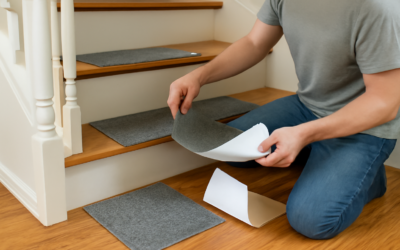
One of the biggest advantages of modular grey carpet tiles is that a capable homeowner can install them without hiring a pro. The process is straightforward over a clean, dry, level subfloor, especially concrete in a basement or home office:
- Acclimate the tiles in the room for 24 to 48 hours so they adjust to the temperature and humidity.
- Find the center of the room by snapping chalk lines between the midpoints of opposing walls, so your layout stays square.
- Dry-lay a few tiles from the center outward to check the pattern and plan your border cuts before sticking anything down.
- Secure with the manufacturer’s method, whether peel-and-stick backing, adhesive dots, or glue, following the recommended tile direction arrows on the back.
- Cut border tiles with a sharp utility knife and a straightedge for clean edges against walls.
Following the directional arrows matters: laying all tiles the same way creates a uniform look, while alternating them produces a subtle checkerboard effect. Either can look great, but it should be a deliberate choice, not an accident.
Why Grey Works for Resale and Branding
If your office is part of a commercial space or a home you may sell, grey carpet is a safe long-term bet. Its neutrality means it won’t clash with future furniture, wall colors, or company branding, and it appeals to the widest range of buyers and tenants. Bold or trendy carpet colors date quickly and can turn off prospects, while a clean mid-tone grey reads as professional and move-in ready. Pairing grey carpet tiles with the flexibility to swap individual damaged squares also means the floor stays presentable for years without a full replacement, which protects your investment whether you’re staying put or moving on.
Making the Right Choice
For a workspace that stays clean-looking, comfortable, and professional with minimal fuss, grey office carpet is hard to beat. Lean toward dense, low-loop nylon carpet tiles in a mid-tone or flecked grey, match the traffic rating to your usage, and keep a few spare tiles on hand. The result is a versatile, hardworking floor that handles daily office life and still looks polished years down the road.