Most landscape fabric failures are not fabric failures at all — they are buying failures. The thin 1.5-ounce roll sold for $15 at the end cap tears during installation, degrades in two years, and convinces homeowners the entire product category is junk. Real heavy duty landscape fabric is a different material entirely: 3.2 to 6 ounces per square yard, woven from polypropylene tapes or needle-punched into a dense mat, and capable of suppressing weeds under gravel for 15 to 20 years. This guide covers how to read the specs, which type fits which job, and what separates contractor-grade rolls from the consumer stuff that gives fabric a bad name.
- What "Heavy Duty" Actually Means
- Woven vs. Non-Woven vs. Perforated
- Brands and Prices Worth Knowing
- Where Heavy Duty Fabric Earns Its Keep
- Installation: Where Jobs Succeed or Fail
- Fabric Under Gravel Driveways and Hardscape
- Common Mistakes That Kill Good Fabric
- Realistic Lifespan and Maintenance
- Choosing a Garden Weed Barrier by Bed Type
What “Heavy Duty” Actually Means
Fabric weight, listed in ounces per square yard, is the fastest quality signal on the label. Consumer-grade fabric runs 1.5 to 2.5 oz and is best treated as disposable. Heavy duty starts around 3.2 oz, and true commercial or “professional” grades run 4 to 6 oz. A 5 oz woven fabric can withstand wheelbarrow traffic, sharp crushed granite, and the root pressure of aggressive perennials without punching through.
Two other numbers matter if the manufacturer publishes them. Tensile strength (often called grab strength) above 100 pounds means the fabric survives stretching and stapling without tearing at the pins. UV resistance ratings tell you how long the fabric survives if sunlight reaches it through thin mulch — quality fabrics carry stabilizers rated for 5+ years of exposure, while cheap rolls become brittle confetti in one summer of direct sun.
Woven vs. Non-Woven vs. Perforated
Heavy duty fabrics come in three constructions, and matching construction to application matters more than brand.
Woven Polypropylene
Flat plastic tapes woven into a basket pattern, usually black with a green or yellow stripe grid for plant alignment. Wovens are the workhorse for planting beds and general weed control: strong (typically 80 to 150 lb grab strength), moderately permeable through the needle holes and weave gaps, and priced around $0.10 to $0.25 per sq ft. The limitation is water flow — in a downpour, wovens shed some water sideways, so avoid them where drainage is the whole point.
Non-Woven (Needle-Punched)
Fibers mechanically felted into a thick, cloth-like mat. Non-wovens pass water in all directions at far higher rates, which makes 4 oz and heavier grades the right choice under French drains, behind retaining walls, beneath rock mulch, and under paver bases as a soil separator. Expect $0.15 to $0.35 per sq ft. They stretch more than wovens, so they conform to irregular ground but hold staples slightly less firmly.
Perforated Film
Thin punched plastic sheeting. It shows up in the heavy duty aisle but does not belong there — it tears at the perforations and belongs only in throwaway annual vegetable rows, if anywhere.
Brands and Prices Worth Knowing
A few products come up repeatedly on contractor trucks:
- DeWitt Pro 5: The benchmark 5 oz woven. A 4 ft x 250 ft roll runs $130 to $180 and carries a 20-year warranty when buried.
- DeWitt Sunbelt 3.2 oz: Woven ground cover built for exposed use in nurseries; rated 5 years in direct sun, roughly $60 to $90 per 4 ft x 100 ft roll.
- Vevor and ECOgardener 5 oz-class wovens: Budget-friendly heavy grades, commonly $40 to $70 per 4 ft x 100 ft roll; quality is decent though UV stabilization trails DeWitt.
- Mutual Industries and US Fabrics non-wovens: True geotextiles (4 oz NW is the common spec) for drainage and separation work, sold at landscape supply yards rather than big-box stores.
As a rule of thumb, budget $0.10 to $0.35 per sq ft for material. Covering a 500 sq ft bed with contractor-grade fabric costs $50 to $175 — trivial against the cost of the rock going on top of it.
Where Heavy Duty Fabric Earns Its Keep
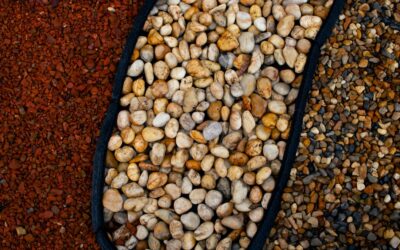
Fabric performs best where the covering above it is inorganic and permanent. Under lava rock, river rock, crushed granite, and rubber mulch, a 4 to 5 oz fabric keeps stone from sinking into soil and blocks weeds from below for decades. It is equally valuable as an engineering layer: separating gravel driveways from clay subgrade (which can cut gravel loss dramatically), wrapping drain pipe trenches, and lining the back of retaining walls to keep soil out of the drainage stone.
Skip fabric — even the good stuff — under organic mulch in beds you replant often. Shredded mulch decomposes into an inch of compost sitting on top of the fabric within three or four years, and windblown seeds germinate happily in that layer, rooting through the fabric and defeating the purpose. Vegetable gardens and annual beds are also poor candidates, since you slice the fabric to ribbons with every planting change.
Installation: Where Jobs Succeed or Fail
Even 6 oz fabric fails if it is thrown over live weeds. Do the prep:
- Kill and clear. Remove existing vegetation by the roots or treat with herbicide two weeks ahead. Fabric suppresses seeds; established bermuda grass, bindweed, and nutsedge will find seams and punch through pinholes.
- Grade and smooth. Rake out rocks and sticks. Sharp debris under load is how punctures start.
- Roll with overlap. Overlap parallel runs 6 inches minimum — 12 inches on slopes. Seam gaps are the number-one weed entry point.
- Pin generously. Use 6-inch steel sod staples every 3 to 4 feet along edges and seams, more on slopes. A 500 sq ft job needs 75 to 100 staples; buy the 8-inch pins for sandy soil.
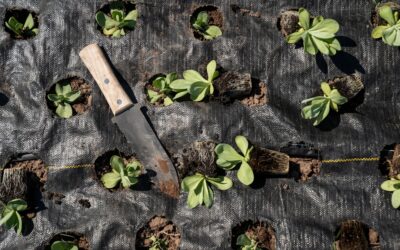
- Cut planting holes, not flaps. Cut an X just large enough for the root ball and fold the flaps back tight to the stem after planting.
- Cover promptly. Apply 2 to 3 inches of rock or mulch the same day. UV exposure is the clock that kills uncovered fabric.
Fabric Under Gravel Driveways and Hardscape
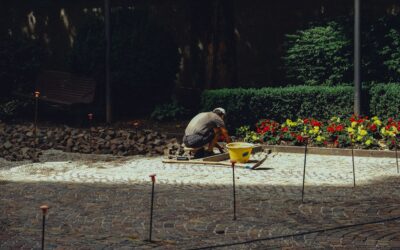
The most underrated use of heavy duty fabric has nothing to do with weeds. Laid between soil and gravel on a driveway or parking pad, a 4 to 6 oz woven geotextile works as a separation layer: it stops the gravel from being pressed down into soft clay and stops clay from pumping up into the gravel during wet weather. Highway departments have measured the effect for decades — separated gravel sections can need substantially less replacement stone over their life, because the aggregate stays aggregate instead of slowly becoming muddy soup. For a 12 x 40 foot residential driveway, the fabric adds roughly $60 to $150 to the project and can save a full re-graveling cycle within ten years. The same logic applies under paver patios on questionable subgrades and beneath dry creek beds, where fabric keeps decorative stone from disappearing into the earth one rainy season at a time. Use non-woven where water must pass vertically at high volume; use woven where strength under wheel loads is the priority.
Common Mistakes That Kill Good Fabric
Three errors account for most failed installs. Laying fabric over unkilled perennial weeds tops the list — bermuda and bindweed treat pinholes as doorways. Second is leaving fabric exposed for weeks before covering it; UV degradation begins immediately, and even a 5-year-rated fabric loses strength sitting naked through a summer while the rock delivery gets postponed. Third is stingy overlaps: a 2-inch overlap looks fine on day one and opens into a weed highway after the first season of soil settling. None of these cost money to avoid; they cost attention.
Realistic Lifespan and Maintenance
Buried under rock, a 5 oz woven honestly delivers 15 to 20 years; a 4 oz non-woven under drainage stone can outlast the wall it protects. The maintenance task people skip is surface hygiene: blow leaves and debris off rock beds each fall, because decomposed litter filling the voids becomes a rooting medium for weeds that no fabric can stop. Pull the occasional surface weed when it is small, before its roots thread into the weave.
One last buying tip — measure, then buy 15 percent extra. Overlaps, edge tucks, and cutting around curves consume more material than square footage math suggests, and matching a partial roll of a different brand mid-project leaves a visible seam line in the finished bed. Heavy duty landscape fabric is one of those materials where the second-cheapest mistake is buying too little, and the most expensive one is buying too light.
Choosing a Garden Weed Barrier by Bed Type
Heavy duty fabric is only one kind of garden weed barrier, and it is the wrong one for several common beds. The better question is not “which fabric is strongest” but “what will this bed look like in three years, and how often will I dig in it?” Match the barrier to the answer and weed control gets easier instead of turning into a yearly fight with torn plastic.
| Bed type | Best barrier | Why |
|---|---|---|
| Rock, gravel, or rubber mulch beds | Woven or heavy non-woven fabric | Inorganic cover never breaks down into soil, so the fabric stays clean and effective for years. |
| Shrub and tree beds with wood mulch | Non-woven fabric or sheet mulch | Permanent plantings mean few new holes; non-woven lets water and air reach roots. |
| Vegetable and annual beds | Cardboard or newspaper sheet mulch | It rots into the soil by the next season, so replanting never means cutting fabric. |
| Perennial borders with spreaders | Sheet mulch plus organic mulch | Plants that spread by runners or rhizomes need open soil to fill in; fabric traps and strangles them. |
Sheet Mulching With Cardboard or Newspaper
Sheet mulching is the garden weed barrier most home growers overlook. Strip off tape and glossy labels, lay plain brown cardboard or a stack of newspaper about six to eight sheets thick directly over mowed or flattened weeds, and soak it thoroughly. Overlap every edge by several inches so no light reaches the soil, then cover with two to four inches of wood chips, shredded leaves, or compost. The layer smothers existing growth, feeds soil life as it decays, and can be planted through by cutting a small hole once it softens. Expect to renew it every season or two, which is the tradeoff for never pulling up degraded plastic.
Fabric struggles anywhere the bed changes. In vegetable gardens, every new transplant and every pulled crop tears another hole. Around perennials that spread, such as groundcovers and clumping flowers that expand outward, fabric blocks new shoots and can girdle crowns as they grow. And under organic mulch, the decaying layer on top eventually becomes a seedbed of its own.
When fabric is the right call, the install basics still apply: overlap seams generously, pin edges and seams with landscape staples, cut small X openings for plants, and cover the fabric with mulch the same day so sunlight never reaches it. A barrier chosen for the bed, not the aisle display, is the one that actually keeps weeds down.