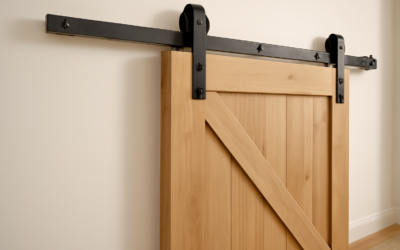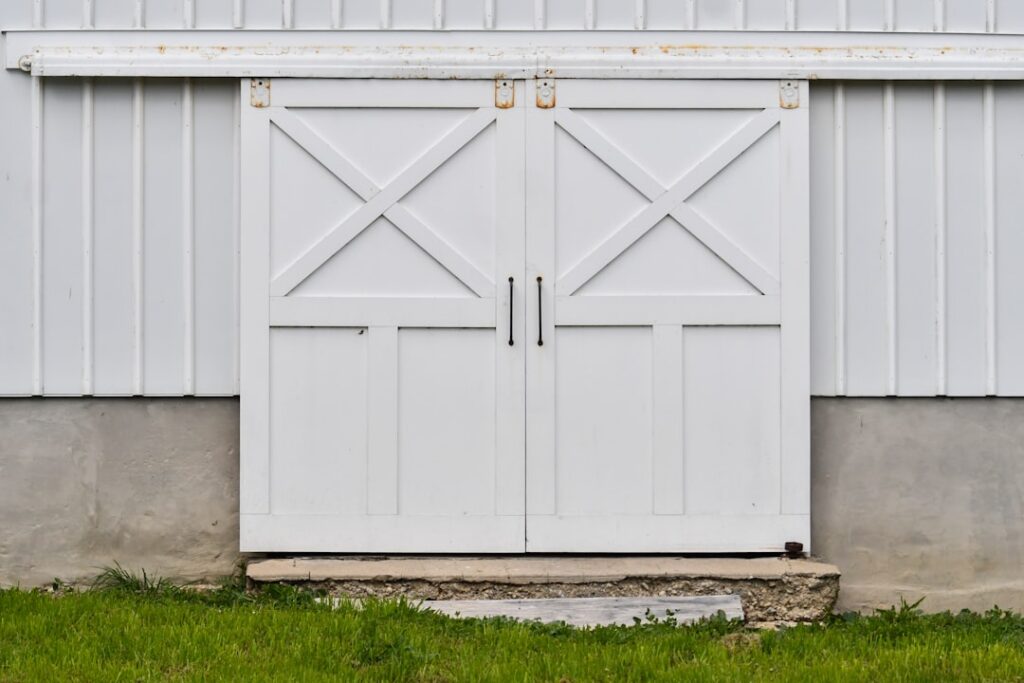
The sliding barn door earned its place in modern homes, but the exposed black rollers and industrial track are not for everyone. A hidden barn door hardware kit delivers the same space-saving slide with none of the visible metal — the track and rollers tuck up behind a valance or into the header, so the door appears to glide as if by magic. If you love barn-door function but want a cleaner, more architectural look, this concealed-track approach is the upgrade to know. Here is how these kits work, what to look for, and how to install one.
Part of our Windows & Doors guide — explore the full guide →
- What Makes a Barn Door “Hidden”
- Why Choose a Concealed System
- What’s Inside a Typical Kit
- Sizing the Door and Track
- Weight Capacity Matters
- The Header and Blocking: Don’t Skip This
- Step-by-Step Installation Overview
- Features Worth Paying For
- Where Hidden Barn Doors Work Best
- Finishing the Door for a Seamless Look
- Cost and Value
- The Bottom Line
What Makes a Barn Door “Hidden”
A traditional barn door hangs from two exposed roller wheels riding on a face-mounted metal rail — the look is deliberately industrial and rustic. A hidden or concealed kit changes the geometry so the hardware disappears. This is achieved one of two ways: either the track is recessed inside a pocket or soffit above the door, or a decorative valance board covers the track and rollers so only the door itself is visible. Some systems mount the track behind a fascia that matches your trim, making the door read as a seamless sliding panel rather than a farmhouse feature.
Why Choose a Concealed System
Homeowners pick hidden hardware for several reasons:
- Cleaner aesthetic: Fits modern, transitional, and minimalist interiors where exposed black steel would clash.
- Less visual clutter: The eye sees a clean door and wall, not hardware.
- Quieter, protected mechanism: Enclosing the track shields the rollers from dust and can dampen sound.
- Architectural feel: The door looks built-in and intentional rather than added-on.
You keep the core benefit — a door that slides flat against the wall instead of swinging into the room — while losing the rustic hardware many find dated.
What’s Inside a Typical Kit
Most hidden barn door hardware kits include the essential components to hang and guide the door. Expect to find:
- A steel track or rail sized to twice your door width
- Two roller hangers or trolleys that attach to the top of the door
- A mounting board or header bracket system
- Anti-jump blocks or a top guide to keep rollers on the track
- A floor guide to keep the door’s bottom from swinging
- End stops to prevent the door from rolling off either end
- Mounting hardware and a spacer set
A valance or fascia board to conceal the track is sometimes included and sometimes supplied separately or built on site to match your trim.
Sizing the Door and Track
Correct sizing is the foundation of a smooth-sliding, privacy-providing door. Follow these proven guidelines:
- Door width: Make the door 2 to 3 inches wider than the opening on each side so it fully covers the gap and provides privacy and light blocking.
- Door height: Add about 1 inch above the opening so the door overlaps the top of the trim.
- Track length: The rail must be twice the width of the door so the door can slide completely clear of the opening.
- Wall clearance: Confirm you have enough blank wall beside the opening for the door to slide onto — a barn door needs that landing space.
Measure twice; an undersized door leaves privacy gaps, and a too-short track will not let the door open fully.
Weight Capacity Matters
Every kit lists a maximum door weight, and matching it to your door is critical. A hollow-core door may weigh 30 to 40 pounds, while a solid-core or solid-wood slab can hit 80 to 150 pounds. Choose a kit rated comfortably above your door’s weight so the rollers and track are not stressed. Heavier doors slide more smoothly and quietly but demand robust hardware and, crucially, solid mounting — which brings us to the most important structural point.
The Header and Blocking: Don’t Skip This
A barn door’s entire weight hangs from the wall above the opening, so the track must anchor into something solid. Drywall alone will not hold it. The best practice is to mount the track to a continuous backer board — a 1×6 or similar board lag-screwed into the wall studs — which spreads the load and gives you solid attachment points anywhere along its length. In new construction or a remodel with the wall open, adding solid blocking between the studs at track height is even better and lets a truly hidden, boardless install work. Never mount a barn door track to drywall anchors alone; a falling door is dangerous and destructive.
Step-by-Step Installation Overview
The install is within reach of a confident DIYer over an afternoon:
- Locate and mark the wall studs above the opening.
- Mount the backer board or confirm your blocking, screwing into every stud.
- Attach the track to the board or header, checking it is perfectly level — a tilted track makes the door drift open or closed on its own.
- Bolt the roller hangers to the top of the door at the specified spacing.
- Lift the door and set the rollers onto the track.
- Install anti-jump blocks, end stops, and the floor guide.
- Add the concealing valance or fascia to hide the track.
- Test the slide and adjust the floor guide so the door does not rub.
Leveling the track is the make-or-break step; a self-sliding door almost always traces back to an out-of-level rail.
Features Worth Paying For
Not all kits are equal. Look for these upgrades:
- Soft-close dampers: Cushion the door at each end so it glides to a gentle stop instead of banging.
- Nylon-sealed bearings: Quieter, smoother rollers that resist dust.
- Adjustable hangers: Let you fine-tune the door height and reveal after hanging.
- A quality floor guide: A wall-mounted or floor-mounted guide that does not require routing a groove in the door is easier to live with.
Soft-close in particular transforms the daily experience and protects both the door and the wall.
Where Hidden Barn Doors Work Best
Concealed sliding doors shine in specific spots around the home. They are ideal for a pantry or laundry closet where a swinging door would eat floor space, for a home-office or den entry where you want privacy without a bulky door arc, and for a primary bathroom or walk-in closet where the clean look complements a modern suite. They also solve tricky layouts — an opening too close to a corner for a swing door, or a hallway where a standard door would block traffic when open. Where they do not work is any opening that needs to seal for sound, fire, or full privacy, since a barn door hangs slightly off the wall and never seals tight around its perimeter. For a bathroom shared by guests or a bedroom needing real sound isolation, a traditional or pocket door is the better call.
Finishing the Door for a Seamless Look
The magic of a hidden kit is undercut if the door itself looks like an afterthought, so treat the slab as a design element. A flat, paint-grade MDF or flush wood door painted to match your walls makes the whole assembly recede for a truly minimal effect, while a slab stained to match your flooring or trim ties it into the room’s palette. Add a discreet flush pull rather than a chunky handle so nothing protrudes when the door slides against the wall — a recessed edge pull or a simple finger notch keeps the clean line intact. If you want the door to make a statement instead of disappearing, a paneled, reeded, or glass-insert slab turns it into a feature, though that moves away from the fully hidden aesthetic. Decide up front whether you want the door to vanish or to shine, and choose the slab and pull to match that intent.
Cost and Value
Hidden barn door hardware kits typically run $150 to $400 depending on weight rating, soft-close features, and finish — more than basic exposed kits, which start around $60 to $100. Add the door itself, which ranges from $100 for a simple slab to several hundred for a solid or custom panel. Even at the higher end, a concealed sliding door is a fraction of the cost of reframing for a pocket door, while delivering a similarly clean, hardware-free look.
The Bottom Line
A hidden barn door hardware kit gives you the space-saving slide of a barn door with the refined, hardware-free appearance of a built-in — perfect for modern and transitional homes. Size the door 2 to 3 inches wider than the opening, buy a kit rated above your door’s weight, and above all anchor the track into a solid backer board or wall blocking, dead level. Add soft-close dampers for the finishing touch, and you will have a door that appears to glide on its own, quietly and cleanly, for years.