
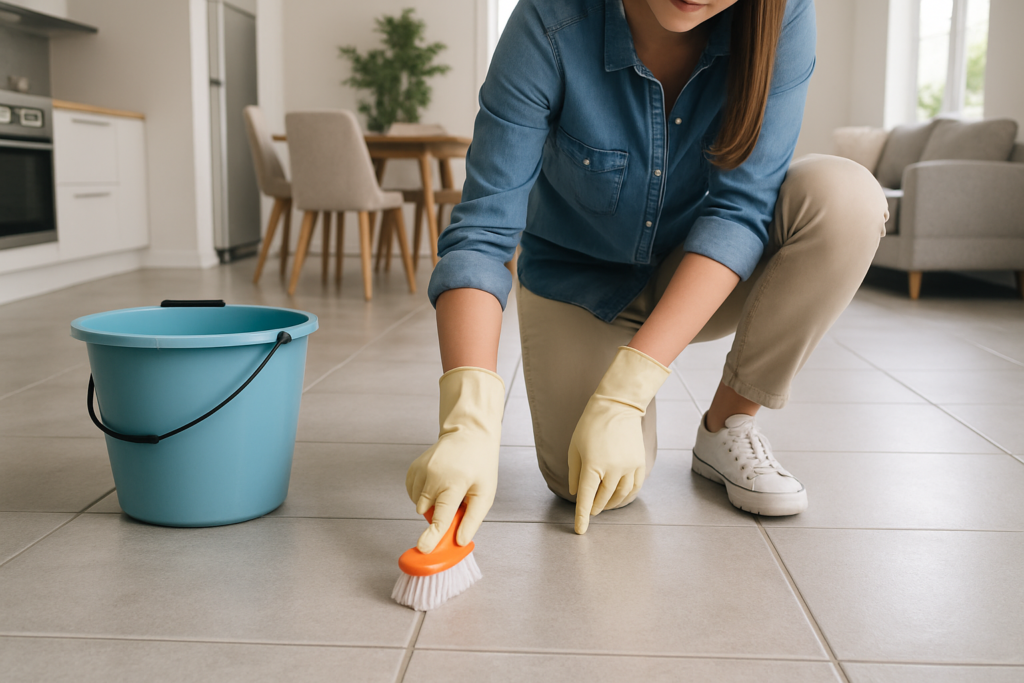
Knowing how to clean grout on floor tile is essential for keeping any tiled surface looking fresh. Grout is porous — even sealed grout absorbs dirt, spills, and bacteria over time. The result is discolored, dingy grout lines that make an otherwise clean tile floor look dirty. The good news is that most grout cleaning requires only household products and a little effort.
Part of our Tile & Grout guide — explore the full guide →
This guide covers every floor grout cleaning method, from daily prevention and simple baking soda paste to professional-grade steam cleaning. We also cover grout color sealing — the permanent solution for grout that is too stained to clean.
- Daily Prevention
- Baking Soda Paste Method
- Hydrogen Peroxide Method
- Oxygen Bleach (OxiClean) Method
- Steam Cleaner Method
- Best Commercial Grout Cleaners
- Dealing with Discolored Grout
- Grout Color Sealing (The Permanent Solution)
- Professional Grout Cleaning Cost
- Cleaning Method Comparison
- Frequently Asked Questions
- What is the best homemade grout cleaner for floors?
- How often should I clean floor grout?
- Does vinegar clean grout?
- Why does my grout keep getting dirty?
- Can I use bleach on floor grout?
- How much does professional grout cleaning cost?
- Should I seal grout after cleaning?
- Can discolored grout be fixed without re-grouting?
- How do you clean floor grout without scrubbing?
- How do you remove grout haze from floor tile?
- How do you get white grout white again?
- How do you clean grout without damaging it?
- How do you get food debris out of deep grout lines?


Daily Prevention
Preventing grout discoloration is far easier than restoring already-stained grout. These daily habits make a significant difference.
- Sweep or vacuum daily. Loose dirt, dust, and grit grind into grout lines under foot traffic. A quick sweep removes surface debris before it embeds in the grout
- Mop weekly. Use warm water with a mild pH-neutral tile cleaner. Avoid oil-based or wax-based cleaners — they leave a film that attracts dirt and darkens grout
- Wipe spills immediately. Coffee, wine, tomato sauce, and other colored liquids stain grout within minutes if not wiped up. Keep a towel or paper towels accessible in the kitchen
- Use door mats. Mats at exterior doors catch the dirt and grit that would otherwise be tracked across tile floors and ground into grout lines
- Seal grout annually. A penetrating grout sealer prevents moisture and stains from absorbing into the grout. Reapply once a year for best results. See our grout sealer guide for product recommendations
Baking Soda Paste Method
The baking soda paste is the most widely recommended DIY grout cleaning method. It is safe, inexpensive, and effective for light to moderate grout discoloration.
What You Need
- 1/2 cup baking soda
- Enough water to make a thick paste (about 1/4 cup)
- Stiff-bristle grout brush or old toothbrush
- Spray bottle with warm water
- Clean towel or mop
Steps
- Mix baking soda and water to a toothpaste-like consistency
- Apply the paste directly onto the grout lines. Be generous — the paste should fill the grout joint
- Let the paste sit for 10 to 15 minutes. For heavy staining, leave it for 30 minutes
- Scrub each grout line with a stiff brush, working in small sections. Use circular motions for stubborn spots
- Spray warm water to rinse the paste
- Wipe the entire area with a clean, damp towel or mop
- Repeat on heavily stained sections
Why it works: Baking soda is a mild abrasive that physically scrubs away surface stains without scratching tile. Its alkaline pH also helps break down grease and organic stains.
Boosted version: Add white vinegar as the liquid instead of water. The fizzing reaction helps lift embedded dirt. However, do not use vinegar on natural stone tile (marble, travertine, limestone) — the acid etches and damages stone surfaces.
Hydrogen Peroxide Method
Hydrogen peroxide is a mild bleaching agent that lightens stained grout without harsh chemicals. It is especially effective on mold and mildew stains.
Steps
- Pour 3 percent hydrogen peroxide (standard drugstore strength) into a spray bottle
- Spray directly onto stained grout lines until saturated
- Let sit for 10 to 15 minutes
- Scrub with a grout brush
- Rinse with clean water and dry
Boosted version: Mix 1/2 cup baking soda with 1/4 cup hydrogen peroxide to create a cleaning paste. Apply to grout, let sit 15 minutes, scrub, and rinse. This combination is more effective than either product alone and is safe for most tile types.
Caution: Hydrogen peroxide can lighten colored grout. Test on an inconspicuous area first. It is ideal for white or light gray grout but may bleach darker grout colors unevenly.
Oxygen Bleach (OxiClean) Method
Oxygen bleach is one of the most effective grout cleaners for heavily soiled floors. It works through oxidation — the same principle as hydrogen peroxide but stronger.
Steps
- Dissolve 2 tablespoons of oxygen bleach powder (OxiClean, Zep Oxy, or generic sodium percarbonate) in 2 cups of warm water
- Pour or spray the solution onto the grout lines
- Let it sit for 15 to 30 minutes. For severe staining, leave it for up to 1 hour
- Scrub with a stiff brush
- Mop the floor with clean water to remove all residue
Why it works: Oxygen bleach releases hydrogen peroxide when dissolved in water. It is safe for colored grout (unlike chlorine bleach), safe for most tile types, and does not produce harsh fumes. It is one of the best options for large floor areas where working on hands and knees with a paste is impractical.
Do not use chlorine bleach (Clorox) on floor grout. Chlorine bleach is too harsh — it can erode grout over time, damage colored grout, discolor some tile types, and produce dangerous fumes in enclosed spaces. Oxygen bleach achieves the same cleaning effect without these risks.
Steam Cleaner Method
Steam cleaning is the most effective chemical-free grout cleaning method. High-temperature steam (200+ degrees Fahrenheit) kills mold, bacteria, and mildew while loosening embedded dirt from grout pores.
What You Need
- A steam cleaner with a grout attachment (narrow nozzle or brush attachment)
- Microfiber towels or mop attachment
Steps
- Fill the steam cleaner with water and heat to operating temperature
- Direct the steam nozzle along the grout lines, moving slowly (about 1 inch per second)
- Immediately wipe the loosened dirt with a microfiber towel
- Work in small sections for the best results
- Allow the floor to dry completely
Best steam cleaners for grout: The Bissell PowerFresh, McCulloch MC1275, and Dupray Neat are popular home-use models with grout-specific attachments. Expect to spend $80 to $200 for a quality steam cleaner.
Limitation: Steam cleaning removes surface dirt and biological growth but may not restore deeply stained or discolored grout to its original color. For permanent discoloration, color sealing is a better solution.
Best Commercial Grout Cleaners
When DIY methods are not enough, commercial grout cleaners provide stronger cleaning chemistry. For a comprehensive product comparison, visit our best grout cleaner guide.
| Product | Type | Best For | Price |
|---|---|---|---|
| Black Diamond Stoneworks Ultimate Grout Cleaner | Spray | General grout cleaning, safe for all tile | $10 – $15 |
| Zep Grout Cleaner and Brightener | Spray | Heavy-duty, acidic formula for tough stains | $8 – $12 |
| StoneTech KlenzAll | Concentrate | Natural stone tile floors (pH neutral) | $15 – $25 |
| Rejuvenate Grout Deep Cleaner | Spray | Kitchen and bathroom floors | $8 – $12 |
| Mapei UltraCare Grout Refresh | Paint-on colorant | Stained grout that cannot be cleaned | $15 – $25 |
Always test first. Apply any commercial cleaner to a small, inconspicuous area and wait 10 minutes. Check for discoloration, etching, or damage to the tile surface before treating the entire floor. Acidic cleaners (like Zep) can etch natural stone and damage some glazed tiles.
Dealing with Discolored Grout
If cleaning does not restore your grout to an acceptable color, the discoloration may be permanent. Grout staining happens when contaminants penetrate deep into the porous cement material where surface cleaning cannot reach.
Common causes of permanent discoloration:
- Never-sealed grout that has absorbed years of dirt and spills
- Mop water that was dirty — effectively pushing dirty water into the grout pores
- Wax-based or oil-based cleaners that leave residue in the grout
- Hard water mineral deposits (yellowish discoloration)
- Mold and mildew growth deep within the grout (dark spots, especially in bathrooms)
When grout is permanently discolored, you have three options: aggressive cleaning (oxygen bleach followed by steam), color sealing, or re-grouting.
Grout Color Sealing (The Permanent Solution)
Grout color sealing applies a pigmented, waterproof coating directly onto the grout surface. It covers stains, restores a uniform color, and seals the grout against future staining in a single step. It is the most effective solution for permanently discolored floor grout.
How It Works
- Clean the grout thoroughly (oxygen bleach or steam) and let dry completely
- Apply the color sealant along the grout lines using a small applicator brush or a dedicated grout pen
- Wipe excess sealant off the tile surface before it dries (within 5 to 10 minutes)
- Allow 24 hours to cure before foot traffic
- Apply a second coat for maximum coverage and durability
Best products: Mapei UltraCare Grout Refresh, StoneTech Grout Color Seal, and Custom Building Products Polyblend Grout Renew. Available in multiple colors — you can change your grout color entirely (for example, refreshing white grout to dark gray for a modern look).
Lifespan: Quality color sealants last 3 to 7 years before needing reapplication. Professional color sealing typically lasts 7 to 15 years.
Cost: DIY color sealing costs $0.50 to $1.50 per square foot of floor area. Professional color sealing costs $2 to $5 per square foot. For a 100-square-foot bathroom, that is $50 to $150 DIY or $200 to $500 professional.
Professional Grout Cleaning Cost
Professional tile and grout cleaning uses truck-mounted or portable hot water extraction systems and commercial-grade cleaning solutions. The results are significantly better than DIY methods, especially for heavily soiled floors.
| Service | Cost per Sq Ft | 200 Sq Ft Room | What It Includes |
|---|---|---|---|
| Basic cleaning | $0.75 – $1.50 | $150 – $300 | Alkaline cleaner, scrub, extraction |
| Deep cleaning | $1.50 – $3.00 | $300 – $600 | Degreaser, steam, heavy scrubbing |
| Cleaning + sealing | $2.00 – $4.00 | $400 – $800 | Full clean plus penetrating sealer |
| Cleaning + color sealing | $3.00 – $6.00 | $600 – $1,200 | Full clean plus colored sealant |
Professional cleaning is worth considering when DIY methods have failed, when the floor area is large, or when you want the grout sealed properly after cleaning. Most professional services combine cleaning and sealing in a single visit for the best long-term value. For more on tile maintenance, visit our tile flooring care section.
Cleaning Method Comparison
| Method | Effectiveness | Time (100 sq ft) | Cost | Best For |
|---|---|---|---|---|
| Baking soda paste | Good | 45 – 90 min | $2 – $5 | Light staining, small areas |
| Hydrogen peroxide | Good | 30 – 60 min | $3 – $5 | Mold, mildew, light staining |
| Oxygen bleach | Very Good | 30 – 60 min | $5 – $10 | Heavy staining, large areas |
| Steam cleaner | Very Good | 30 – 45 min | $80 – $200 (machine) | Chemical-free, mold, bacteria |
| Commercial cleaner | Good to Excellent | 30 – 60 min | $8 – $25 | Stubborn stains, specific issues |
| Professional cleaning | Excellent | 1 – 2 hours | $150 – $600 | Severe staining, large areas |
| Color sealing | Permanent fix | 2 – 4 hours | $50 – $500 | Permanently discolored grout |
Frequently Asked Questions
What is the best homemade grout cleaner for floors?
A paste of 1/2 cup baking soda mixed with 1/4 cup hydrogen peroxide is the most effective homemade grout cleaner. Apply to grout lines, let sit 15 minutes, scrub with a stiff brush, and rinse. For large floor areas, dissolve oxygen bleach powder in warm water and mop the solution onto the floor instead.
How often should I clean floor grout?
Sweep and mop weekly to prevent buildup. Deep clean grout lines every 1 to 3 months depending on traffic and exposure. Kitchen floors near cooking areas and bathroom floors need more frequent attention. Sealed grout stays cleaner longer and requires less frequent deep cleaning.
Does vinegar clean grout?
Vinegar can clean grout on ceramic and porcelain tile, but it is acidic and should not be used on natural stone (marble, travertine, limestone) or on grout that is cracked or deteriorating. The acid can etch stone surfaces and erode damaged grout further. Baking soda and hydrogen peroxide are safer alternatives for most situations.
Why does my grout keep getting dirty?
Unsealed grout absorbs moisture and dirt with every mopping and spill. Seal your grout with a penetrating sealer to prevent absorption. Also check your mop water — mopping with dirty water pushes contaminants into the grout. Change your mop water frequently and use a clean, wrung-out mop.
Can I use bleach on floor grout?
Avoid chlorine bleach (Clorox). It is too harsh and can erode grout, discolor colored grout, and produce harmful fumes. Use oxygen bleach instead — it provides similar whitening and cleaning power without the damage. Oxygen bleach is safe for colored grout and does not produce toxic fumes.
How much does professional grout cleaning cost?
Professional tile and grout cleaning costs $0.75 to $3 per square foot, or $150 to $600 for a typical room. Cleaning plus sealing costs $2 to $4 per square foot. Cleaning plus color sealing costs $3 to $6 per square foot. Most companies charge a minimum service fee of $150 to $200.
Should I seal grout after cleaning?
Yes. Sealing grout after a thorough cleaning locks in the clean appearance and prevents future staining. Apply a penetrating (impregnating) grout sealer — not a topical sealer — for the best protection without changing the grout’s appearance. Reapply annually for continued protection. Visit our how to clean grout guide for complete sealing instructions.
Can discolored grout be fixed without re-grouting?
Yes. Grout color sealing applies a pigmented, waterproof coating over existing grout. It covers permanent stains, restores a uniform color, and seals against future staining. Color sealing is much easier and cheaper than removing and replacing grout. DIY color sealing costs $0.50 to $1.50 per square foot.
How do you clean floor grout without scrubbing?
Use an oxygen bleach soak. Dissolve oxygen bleach powder in warm water, flood the grout lines, let it sit for 15 to 30 minutes, then mop the floor with clean water. The oxidizing action lifts most dirt on its own. A steam cleaner with a narrow nozzle is the other low-effort option, since the steam loosens grime that can simply be wiped away.
How do you remove grout haze from floor tile?
Buff fresh haze off with a dry microfiber cloth or cheesecloth within the first day or two after grouting. Once it has fully cured, use a dedicated grout haze remover made for the tile type. Acid-based removers work on ceramic and porcelain but etch natural stone, so marble, travertine, and limestone need a stone-safe, non-acidic remover. Always follow the label’s cure-time wait.
How do you get white grout white again?
Start with oxygen bleach or a paste of baking soda and 3 percent hydrogen peroxide, let it dwell for 15 minutes, scrub, and rinse well. These lighten most graying and yellowing on white grout. If the grout stays discolored after two rounds, the stain is in the grout itself, and a white grout color sealer is the reliable way to restore a uniform bright color.
How do you clean grout without damaging it?
Use a nylon brush, not a wire brush, and stick to pH-neutral cleaners, oxygen bleach, or baking soda for routine cleaning. Wire bristles and repeated acidic cleaners wear away the cement surface and widen the joints over time. Rinse thoroughly so no residue stays in the pores, let the grout dry fully, and reseal it once it is clean.
How do you get food debris out of deep grout lines?
Vacuum the joints first with a crevice tool to pull out loose crumbs and grit. Loosen anything stuck with a stiff nylon brush or an old toothbrush dampened with warm water, then vacuum again and wipe the lines with a damp microfiber cloth. Deep, recessed grout traps debris easily, so regular vacuuming and an annual sealer keep it from packing in.
Prefer to explore on your own?
See how new flooring looks in your actual room in seconds — free, no signup.
Try the free Floor Studio →

