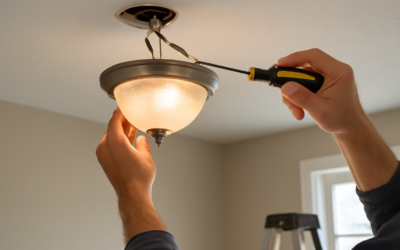
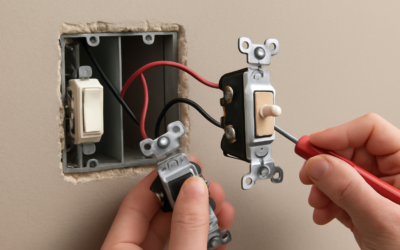
Most ceiling fixture problems come down to one mismatch: the colors coming out of the fixture do not look like the colors coming out of the ceiling. Knowing how to connect light fixture wires is mostly about decoding those colors. In a typical modern setup, the fixture’s black (or smooth) wire joins the house black hot wire, the fixture’s white (or ribbed) wire joins the house white neutral, and the bare copper or green ground goes to the green screw on the mounting bracket, which is then tied to the house ground.
That covers the majority of fixtures installed in homes built since the 1960s. Things get trickier with cloth-covered wiring, fixtures with two identical-looking wires, boxes with extra cables, and older ceilings with no ground wire at all. This guide walks through each case, with the safety steps first, because every connection below is made with the breaker off.
- How to Connect Light Fixture Wires by Color
- Safety First: Kill the Power and Verify
- Tools and Materials
- Step-by-Step: Making the Connections
- Lamp Cord and Cloth Wire: Finding the Neutral
- Ground Wire in Light Fixture: What If the Box Has None?
- How to Wire a New Light Fixture With Extra Wires
- Troubleshooting
- When to Call a Licensed Professional
- Frequently Asked Questions
- Which wire is hot on a light fixture with two same-color wires?
- Where does the ground wire go in a light fixture?
- What does a red wire in the ceiling box mean?
- Can I connect a new light fixture to old two-wire wiring?
- Do I need a permit to replace a light fixture?
- Can you install a light fixture without a junction box?
- How do you connect a heavy chandelier safely?
- How do you wire multiple ceiling lights to one switch?
If you are installing a brand-new fixture where none existed, or adding a switch, you are adding wiring, not just connecting it, and that usually calls for a permit and often a licensed electrician.
How to Connect Light Fixture Wires by Color
Use this as the standard map for US residential wiring when working out how to connect light fixture wires. Always confirm by looking at what is actually in your box.
| House wire | Fixture wire | Role |
|---|---|---|
| Black (sometimes red) | Black, or smooth side of lamp cord | Hot |
| White | White, or ribbed side of lamp cord | Neutral |
| Bare copper or green | Green or bare, or green screw | Ground |
A red wire in the ceiling box usually means a second switched hot, such as a three-way switch leg or a separate switch for a fan and light. If your fixture has only one hot, the red is typically capped off, but confirm how it is used before you ignore it. A white wire marked with black tape has been re-identified as a hot, commonly in switch loops. Never connect a taped white to the fixture neutral.
Safety First: Kill the Power and Verify
A wall switch is not a safe shutoff. Depending on how the circuit was wired, the fixture box may still have constant power even with the switch off.
- Turn off the breaker for the circuit at the panel. If the breakers are not labeled, turn the light on and flip breakers until it goes out, then leave that one off.
- Confirm power is off with a non-contact voltage tester. Check the tester on a known live outlet first, then hold it near every wire in the box, including the ones you do not plan to touch. Then check the tester on a live outlet again.
- Put tape over the breaker or leave a note so no one flips it back on.
- Use a sturdy ladder and have someone hold the fixture, or hang it from the bracket with a wire hook while you work.
If any wire still lights up the tester with the breaker off, stop. The box may be fed from two circuits, which is a job for an electrician.
Tools and Materials
- Non-contact voltage tester
- Wire strippers sized for 14 and 12 AWG, plus 18 AWG fixture wire
- Twist-on wire connectors or lever-style connectors rated for the wire sizes you are joining
- Green ground screw (10-32) and a short green or bare copper pigtail if needed
- Screwdrivers, needle-nose pliers, and electrical tape
- Ladder and safety glasses
Fixture leads are often thin, stranded 18-gauge wire, while house wiring is solid 14- or 12-gauge. Check the connector package to confirm it is listed for mixing stranded and solid wire in those sizes.
Step-by-Step: Making the Connections
- Remove the old fixture. With power verified off, remove the canopy and take a clear photo of the existing connections before undoing them.
- Inspect the house wiring. Look for brittle or cracked insulation, scorch marks, or aluminum (dull silver) conductors. Any of these is a reason to stop and call a pro.
- Install the mounting bracket that comes with the new fixture onto the electrical box. The box must be securely fastened and rated for the fixture’s weight; ceiling fans need a fan-rated box.
- Prep the wire ends. Strip about 1/2 to 3/4 inch from the house wires (follow the connector’s strip gauge) and make sure fixture leads have clean, untwisted strands.
- Connect the ground first. Join the house ground and fixture ground together with a connector, along with a short pigtail to the bracket’s green screw if the fixture ground does not attach there directly.
- Connect neutral to neutral. Fixture white or ribbed wire to house white wire.
- Connect hot to hot. Fixture black or smooth wire to house black (or the switched red, if that is what controls the light).
- Check each splice. A trick for stranded-to-solid joins: let the stranded fixture wire extend about 1/8 inch past the solid wire before twisting the connector on. Tug each wire firmly; nothing should pull out, and no bare copper should show below the connector.
- Tuck and mount. Fold the wires neatly into the box, grounds to the back, and secure the canopy without pinching any wire.
- Restore power and test. Turn the breaker on and operate the switch. If the light works, you are done.
Lamp Cord and Cloth Wire: Finding the Neutral
Many pendants, chandeliers, and older fixtures use two-conductor lamp cord where both wires are the same color, clear, gold, or silver. Look closely: one conductor has ribs, ridges, or a stripe molded into the insulation. The ribbed side is the neutral. The smooth side is hot. Some cords use silver-colored copper on the neutral side and gold-colored copper on the hot side; others have printed text on the neutral. Run your fingernail along the insulation if you cannot see the ribs.
Getting this right matters: when the neutral lands on the socket’s threaded shell, the shell stays at neutral potential, reducing shock risk when someone changes a bulb.
Older houses sometimes have cloth-covered house wiring in the ceiling, where both insulations have faded to the same dull gray. The neutral in these systems was originally white, and a close look at a protected section inside the cable jacket often reveals the original color. If you cannot identify hot and neutral with certainty, or the cloth insulation crumbles when bent, stop there. Brittle insulation should be evaluated by an electrician and may need a new box and cable run.
Ground Wire in Light Fixture: What If the Box Has None?
New fixtures almost always include a green or bare ground wire, but many homes built before the mid-1960s have two-wire circuits with no ground in the box. Here is how to handle the ground wire in a light fixture in that situation:
- Check for a grounded metal box. Some older systems used metal conduit or armored cable (BX) that may bond the metal box to ground. A grounded metal box accepts the fixture ground on a green screw in its threaded hole. Whether the conduit or armor actually provides a reliable ground path is something an electrician should verify with proper testing.
- Do not connect the fixture ground to the neutral. Bonding ground to neutral at a fixture is unsafe and not permitted.
- Do not cut off the fixture’s ground wire and discard it. If there is no ground available, cap it off neatly with a connector and fold it into the box, and plan to have the circuit upgraded.
- Consider running a ground. An electrician can add an equipment grounding conductor back to the panel or to an approved grounding point. This is especially important for metal fixtures in bathrooms and kitchens.
How to Wire a New Light Fixture With Extra Wires
When you open the ceiling and find two or three cables, you are looking at a box that also passes power on to other devices. Keep every existing bundle together exactly as it was: all the whites that were spliced together stay together, and the fixture white joins that bundle. The same goes for grounds. Only the switched hot goes to the fixture’s black. That is the key to how to wire a new light fixture into an existing box without breaking the rest of the circuit. Photograph the original layout before undoing anything.
Troubleshooting
- Light will not turn on: Check the bulb, confirm the breaker is on, and then (with power off again) verify no connector has loosened.
- Light stays on regardless of the switch: You connected to a constant hot instead of the switched leg. Turn power off and recheck the photo.
- Breaker trips immediately: A hot is touching ground or neutral, often a pinched wire behind the canopy. Power off and inspect.
- Flickering: Usually a loose splice or incompatible dimmer. Make sure LED fixtures are used with an LED-rated dimmer.
When to Call a Licensed Professional
Call a licensed electrician for aluminum branch wiring, crumbling cloth insulation, boxes fed from more than one circuit, any sign of heat damage, or whenever you need a new circuit, new switch location, or panel work. Adding a fixture where none existed generally requires running new cable, and most jurisdictions require a permit under the National Electrical Code as adopted locally. Rules on homeowner electrical work vary by city and county, so check with your building department. Never work on energized wires; if you are unsure whether power is off, stop and get help. Typical electrician rates run $50 to $130 per hour, and a simple fixture swap often falls in the $100 to $250 range.
Frequently Asked Questions
Which wire is hot on a light fixture with two same-color wires?
The smooth wire is hot and the ribbed or striped wire is neutral. On some cords the hot has gold-colored copper and the neutral silver-colored copper, or the neutral has printing on its insulation.
Where does the ground wire go in a light fixture?
It connects to the green screw on the mounting bracket and to the house ground wire, joined with a wire connector. If the box has no ground, cap the fixture ground rather than connecting it to the neutral.
What does a red wire in the ceiling box mean?
It is usually a second switched hot, such as a three-way switch leg or a separate fan control. If your fixture needs only one hot, identify which wire the switch controls before capping the other.
Can I connect a new light fixture to old two-wire wiring?
You can often connect hot and neutral to a two-wire circuit, but you will lack a ground. Have an electrician evaluate the wiring, particularly if the insulation is brittle or the fixture is metal.
Do I need a permit to replace a light fixture?
A like-for-like replacement often does not need one, but rules vary by location. Installing a fixture in a new location or adding a circuit usually requires a permit.
Can you install a light fixture without a junction box?
No, every wire splice for a light fixture must sit inside an approved electrical box that is fastened to the framing or held by a listed retrofit bracket. Some slim LED wafer lights include their own listed junction box, which counts. Turn off the breaker and confirm power is off with a non-contact voltage tester. If the ceiling has bare spliced wires with no box, have a licensed electrician add one before mounting anything.
How do you connect a heavy chandelier safely?
Turn off the breaker and confirm power is off with a non-contact voltage tester. Then check the ceiling box: a standard fixture box is rated for fixtures up to 50 pounds, and anything heavier needs a box listed for that weight or independent support from the framing. Use a helper or a hook to hold the chandelier while the hot, neutral and ground connections are made, and let a licensed electrician handle questionable boxes.
How do you wire multiple ceiling lights to one switch?
Turn off the breaker and confirm power is off with a non-contact voltage tester. Household lights on one switch are wired in parallel, not in series: the switched hot and the neutral run from fixture to fixture, so each light gets full voltage and one failure does not darken the rest. Adding new fixtures or recessed lights means running new cable, which usually needs a permit and is best left to a licensed electrician.