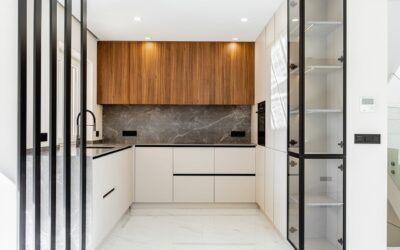
Walk through any modern showroom and you’ll find that the crisp, seamless cabinet fronts you’re admiring often aren’t painted wood at all. Laminate kitchen cabinet doors deliver that flawless, uniform surface at a fraction of the cost of painted hardwood, and they shrug off the scratches, moisture, and daily abuse that make a real kitchen hard on cabinetry. For budget-minded renovators and rental-property owners alike, they’re one of the smartest value plays in the kitchen.
Part of our Kitchen Remodeling guide — explore the full guide →
Here’s how the two main laminate types differ, what they cost, how they hold up, and when they make sense versus solid wood or paint.
- What “Laminate” Actually Means Here
- Thermofoil vs. HPL: Which to Choose
- What Laminate Doors Cost
- Durability and Everyday Care
- Colors, Finishes, and Style Range
- Laminate vs. Painted Wood vs. Solid Wood
- Installation and Ordering Tips
- Refacing With Laminate Doors
- Spotting Quality in a Laminate Door
- Final Word
What “Laminate” Actually Means Here
Laminate doors start with an engineered core, usually MDF or particleboard, wrapped or bonded with a decorative surface layer. The word covers two genuinely different products that behave differently in a kitchen, and confusing them leads to disappointment.
- Thermofoil — A vinyl (PVC) film heat-pressed and vacuum-formed over an MDF core, wrapping the front and edges in one seamless skin. Common on white and solid-color Shaker doors.
- High-pressure laminate (HPL) — Multiple resin-saturated kraft-paper layers fused under heat and pressure, then bonded to a substrate. This is the tough, commercial-grade material used on countertops and hardwearing flat-slab doors.
Both are “laminate,” but HPL is denser and more heat-resistant, while thermofoil gives a smoother, molded look with no visible edge seams.
Thermofoil vs. HPL: Which to Choose
The right pick depends on your kitchen’s heat exposure and the look you want.
Thermofoil Strengths and Limits
Thermofoil doors are seamless, easy to clean, and available in convincing matte and gloss finishes plus realistic wood-grain prints. The catch is heat. Prolonged high heat, such as from a wall oven, toaster, or a self-cleaning range beside the cabinet, can cause the foil to peel or delaminate at the edges over time. Keep thermofoil away from direct heat sources and use heat shields on cabinets flanking an oven.
HPL Strengths and Limits
HPL is far more heat- and impact-resistant, making it the better choice next to ovens and in hardworking kitchens. Because it’s applied as flat sheets, it excels on modern slab-front doors but can’t be molded into raised-panel profiles the way thermofoil can. Edges are finished with matching edgebanding, which can occasionally lift if quality is poor.
What Laminate Doors Cost
Cost is where laminate earns its reputation. A full set of thermofoil doors and drawer fronts for an average kitchen typically runs $900 to $2,500, versus $4,000 to $10,000 or more for painted solid-wood doors. Individual replacement doors run roughly $15 to $60 each for stock sizes, with custom sizes and colors landing higher.
If you’re refacing rather than replacing whole cabinets, laminate is a favorite because you keep the existing boxes and only swap the visible fronts. A full laminate refacing job usually falls between $4,000 and $9,000 installed, compared with $12,000 to $20,000 for all-new custom cabinetry.
Durability and Everyday Care
Laminate’s biggest selling point after price is how little it asks of you. The nonporous surface resists stains, doesn’t need refinishing, and wipes clean with a damp microfiber cloth and mild dish soap. There’s no sealing, no waxing, and no touch-up painting.
A few habits extend their life considerably:
- Wipe up standing water at seams and edges promptly, since moisture is the main enemy of the MDF core if the skin is ever breached.
- Skip abrasive scrubbing pads and harsh solvents, which can dull gloss finishes and scratch matte ones.
- Add heat shields or leave a gap beside ovens and toasters to protect thermofoil edges.
- Tighten hinges periodically so doors close square and don’t rub.
Treated reasonably, quality laminate doors hold their finish for 15 to 20 years, though a badly delaminated thermofoil door can’t be repaired and must be replaced.
Colors, Finishes, and Style Range
Modern laminate has shed its dated 1990s reputation. Today you’ll find deep matte blacks, soft sage greens, warm greiges, and remarkably realistic wood-grain textures with tactile embossing that follows the printed grain. High-gloss laminate delivers a lacquer-like European look for a tiny fraction of true lacquer cost.
Slab and Shaker profiles dominate. For contemporary kitchens, a handleless slab door with an integrated finger pull in matte laminate reads high-end. For transitional spaces, a thermofoil Shaker in warm white pairs beautifully with quartz counters. The main limitation is intricate detail; deeply carved traditional door styles are still the domain of wood.
Laminate vs. Painted Wood vs. Solid Wood
Choosing between them comes down to priorities.
- Laminate — Lowest cost, most uniform finish, easiest care, best moisture resistance. Can’t be refinished and can chip at edges.
- Painted MDF or wood — Beautiful and repairable, but pricier and prone to hairline cracks at joints over time.
- Solid wood — Warmest natural look and endlessly refinishable, but the most expensive and the most reactive to humidity swings.
For a rental, a first home, or any budget-driven remodel, laminate usually wins on total value. For a forever kitchen where you want the depth of real wood grain and the option to repaint later, solid wood or painted MDF may justify the premium.
Installation and Ordering Tips
If you’re replacing doors on existing boxes, measure each opening precisely and note your hinge type, since Euro-style concealed hinges require specific cup bore holes. Order doors bored for your hinges when possible to save drilling. Many suppliers sell laminate doors made to your exact dimensions, so provide width and height to the sixteenth of an inch.
When mounting, use adjustable soft-close concealed hinges so you can dial in even reveals across the whole run. Take your time aligning the first door; every door beside it should follow the same gap for a clean, factory-built look.
Refacing With Laminate Doors
One of laminate’s best uses is a cabinet refacing project, where you keep your existing cabinet boxes and replace only the doors, drawer fronts, and visible end panels. If your boxes are structurally sound but the doors are dated or worn, refacing delivers a brand-new look for far less than full replacement.
The process involves measuring each opening precisely, ordering new laminate doors and drawer fronts to size, and often applying a matching laminate or veneer skin over the exposed face frames and cabinet ends so everything coordinates. A pro refacing job runs $4,000 to $9,000 for an average kitchen, while a determined DIYer with accurate measurements can do it for the cost of materials, often $1,500 to $3,500. The key is precise measurement to the sixteenth of an inch and ordering doors bored for your existing hinge type.
Spotting Quality in a Laminate Door
Not all laminate doors are built to the same standard, and a few tells separate a door that lasts from one that peels within a couple of years. Check these before buying:
- Edge treatment: On thermofoil, the foil should wrap the edges seamlessly with no lifting; on HPL, the edgebanding should be tightly bonded with no gaps.
- Core density: A quality MDF core feels heavy and solid, not light and chalky. Denser cores hold hinges and hardware far better.
- Finish uniformity: Run your hand across the surface; it should be perfectly smooth on gloss finishes and evenly textured on wood-grain prints, with no bubbles or thin spots.
- Warranty: Reputable makers back thermofoil against delamination for several years. A generous warranty signals confidence in the bond.
Paying a little more for a dense core and a well-bonded edge is the single best way to avoid the peeling and swelling that give cheap laminate a bad name.
Final Word
For homeowners who want a fresh, durable kitchen without a custom-cabinetry budget, laminate kitchen cabinet doors hit a sweet spot of price, low maintenance, and modern style. Choose HPL near heat, thermofoil for seamless molded profiles, keep moisture and high heat off the edges, and you’ll get a crisp, wipe-clean kitchen that looks far more expensive than it was.
Prefer to explore on your own?
See how new flooring looks in your actual room in seconds — free, no signup.
Try the free Floor Studio →