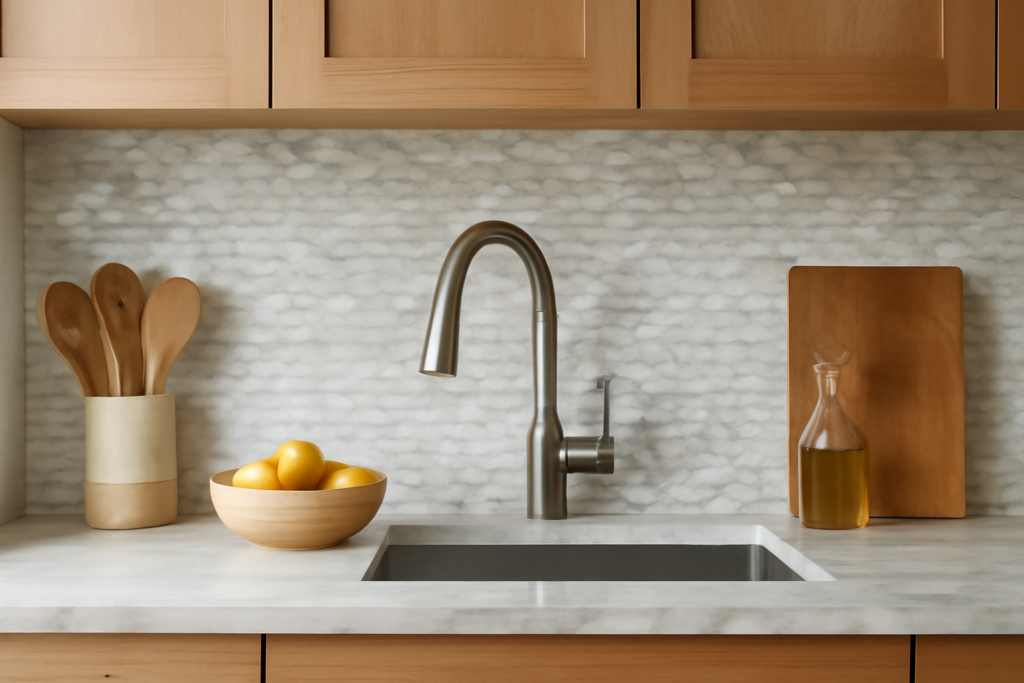
Few upgrades change the feel of a kitchen as fast as a marble mosaic backsplash. The natural veining catches light, the small tile format adds intricate detail, and the material carries a sense of permanence that ceramic subway tile can only imitate. But marble is also a soft, porous stone that demands respect. Understanding how these mosaics are made, what they cost, and how to protect them is the difference between a backsplash you admire for decades and one that stains the first time you make marinara.
What Makes a Marble Mosaic Different
A mosaic is simply small stone pieces mounted on a mesh backing sheet, usually 12 by 12 inches, so you install a grid of dozens of tiny tiles in one motion instead of setting each chip by hand. Common marbles in these sheets include Carrara with its soft gray veining, brighter Calacatta with bolder gray-and-gold streaks, warm Crema Marfil, and dramatic black-and-white Nero Marquina. The stone is honed to a matte finish or polished to a reflective shine, and each sheet is unique because natural stone never repeats a pattern.
The mesh backing is what makes this a realistic weekend project. Because the spacing is set at the factory, your grout lines stay consistent, and you can cut a sheet with a utility knife between rows to fit around outlets and cabinets.
Popular Patterns and Shapes
The mosaic format opens up designs that would be tedious to build from full tiles. Choosing the shape is the biggest style decision you will make.
- Hexagon: A classic, slightly retro geometry that reads as detailed without being busy.
- Herringbone: Small marble rectangles set in a V-pattern for movement and a tailored, upscale look.
- Basketweave: A traditional, timeless weave that suits classic and transitional kitchens.
- Penny round: Circular chips that feel playful and vintage.
- Arabesque or lantern: Curved, ornate shapes that make the backsplash itself the focal point.
For a calmer look, a straight square grid or a linear brick-set mosaic keeps the veining as the star. Busier shapes like arabesque work best when the marble is a quieter, more uniform color so the pattern and the stone do not compete.
What a Marble Mosaic Backsplash Costs
Material prices for marble mosaic sheets typically run $8 to $25 per square foot, with Carrara at the lower end and Calacatta or specialty cuts at the top. A standard kitchen backsplash covers roughly 30 square feet, putting material alone at $240 to $750. Add setting materials, sealer, and grout for another $60 to $120. If you hire a tile setter, labor for mosaic work runs higher than for large tiles because the small pieces and mesh sheets take more finesse, usually $12 to $20 per square foot in labor, so a professionally installed marble mosaic backsplash often lands between $900 and $1,800 total.
Sealing: The Step You Cannot Skip
Marble is calcium carbonate, which means acids etch it and liquids stain it. A kitchen full of lemon juice, wine, coffee, and tomato is exactly the environment marble struggles with. Sealing is not optional here. Apply a quality penetrating stone sealer before grouting to keep grout haze out of the pores, then seal again after grouting. Plan to reseal every one to two years, and test whether it is time by dripping water on the surface; if the water beads, the sealer is working, and if it soaks in and darkens the stone, it is time to reapply.
Even sealed, marble can etch from acids, leaving dull spots that no cleaner removes. Many homeowners embrace this patina as part of the material’s character, the same way a marble countertop ages. If you want zero maintenance and zero risk, a marble-look porcelain mosaic mimics the veining with none of the porosity, at a similar price point.
Installing a Marble Mosaic Backsplash
Start with a clean, flat, primed wall. Because marble is translucent, use a white thin-set mortar rather than gray, since gray can shadow through the lighter stone and dull its brightness. Comb the thin-set with a 3/16-inch V-notch trowel, then press each mesh sheet into place, keeping the factory spacing consistent from sheet to sheet. A margin trowel helps nudge sheets into alignment before the mortar sets.
After the mortar cures for 24 hours, seal the raw stone, then grout with an unsanded grout, which will not scratch the polished marble surface the way sanded grout can. Work the grout into the joints, wipe diagonally across the tiles to avoid pulling grout out of the seams, and buff off the haze. Finish with a bead of color-matched caulk where the backsplash meets the countertop, since a rigid grout line there will crack as the two surfaces move independently.
Keeping It Clean Day to Day
Living with a marble mosaic backsplash is easy as long as you match your cleaning to the material. Wipe the surface with a soft cloth and a pH-neutral stone cleaner or just warm water and a drop of mild dish soap. The cardinal rule is to avoid anything acidic: no vinegar, no lemon, no bathroom sprays, and no generic tile cleaners with citrus or bleach, all of which etch marble and leave dull spots the sealer cannot prevent. Behind a stovetop, grease and cooking splatter are the main enemies, so wipe them promptly before they settle into the honed surface or the grout lines.
Grout maintenance matters too, especially with a light marble and a contrasting grout. Seal the grout along with the stone, and refresh a grout sealer periodically so it resists staining from splashes. If a spot of grout does discolor over time, a soft brush with a gentle cleaner usually restores it, and a grout colorant can renew the lines without touching the tile. Handled this way, the backsplash stays luminous for years, and the small amount of care it asks is a fair trade for the natural depth and character that only real stone delivers in a kitchen.
Is Marble Mosaic Right for Your Kitchen?
A marble mosaic backsplash rewards homeowners who love natural material and accept a little upkeep in exchange for genuine beauty. It pairs beautifully with white and gray cabinetry, brass or matte-black hardware, and quartz or marble counters. If your household is hard on surfaces or you never want to think about sealing, choose a porcelain marble-look mosaic instead and get the same visual payoff. Either way, the small-tile detail and luminous veining deliver a high-end look that anchors the whole room.