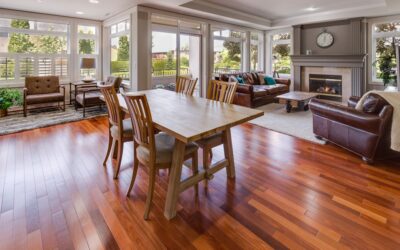
Roughly two out of every three hardwood floors installed in American homes are oak, and that dominance is no accident. Natural oak hardwood flooring hits the sweet spot of durability, price, and timeless looks that maple, walnut, and exotic species struggle to match. But “oak” covers a lot of ground — red versus white, solid versus engineered, site-finished versus prefinished — and the wrong combination for your home can cost you thousands. Here is what three decades of oak floors going in and coming out of houses has taught the trade.
Red Oak vs. White Oak: The First Decision
Red oak is the traditional American standard. It has a pinkish-salmon undertone, pronounced open grain with strong cathedral patterns, and a Janka hardness of 1,290. It takes stain evenly and its busy grain does a good job hiding small dents and scratches. If you are matching existing floors in a home built between 1950 and 2000, odds are heavy that you are matching red oak.
White oak has taken over new construction and remodels since the mid-2010s. It runs slightly harder at 1,360 on the Janka scale, carries golden-brown to gray undertones with no pink, and has tighter grain with longer, straighter figuring. Critically, white oak’s closed cellular structure (tyloses) makes it more water-resistant — it is the species used for whiskey barrels and boat building. It also takes the popular light, natural, and Euro-style finishes better because there is no red cast to fight.
On price, the market has flipped: red oak used to be cheaper, but demand for white oak has narrowed the gap and in many regions white oak now costs $0.50 to $1.50 more per square foot. If you plan a mid-brown or darker stain, red oak saves money and looks nearly identical once finished.
Solid vs. Engineered Oak
Solid oak is one piece of lumber, typically 3/4 inch thick. It can be sanded and refinished five to seven times, which translates to a 75- to 100-year service life. The limitation is moisture: solid oak must be nailed to a wood subfloor, should stay off concrete slabs and out of basements, and needs indoor humidity kept roughly between 35 and 55 percent to avoid gapping and cupping.
Engineered oak bonds a real oak wear layer (1 to 6 mm) over a plywood or multi-ply core. It is dimensionally stable, can be glued or floated over concrete, and works in basements and over radiant heat. A quality engineered floor with a 3 mm or thicker wear layer can still be refinished once or twice. The trap at the bottom of the market is paper-thin 1 mm veneer product that can never be sanded — fine for a flip, poor value for a forever home.
- Solid oak: $4 to $10 per sq ft material; nail-down install $3 to $5 per sq ft.
- Engineered oak: $4 to $12 per sq ft material; install $3 to $8 per sq ft depending on glue-down vs. float.
- Wide-plank white oak (7 inches and up): $8 to $15+ per sq ft material.
Grades and What They Actually Mean
Oak flooring is sorted by appearance, not strength. Select and Better grade shows minimal knots and uniform color — clean and formal, and the most expensive. No. 1 Common includes more knots, mineral streaks, and color variation for a classic mid-range look. No. 2 Common (often sold as “rustic” or “character” grade) embraces big knots, wormholes, and wide color swings at $1 to $3 per square foot less than Select. None of these grades wears differently underfoot; you are paying purely for looks, so buying character grade on purpose is one of the smartest ways to get real oak on a budget.
Finish Options for Natural Oak
The word “natural” gets used two ways: unstained oak showing its true color, and the broader look of matte, low-sheen floors. Both are driving current trends. Your main finish choices:
- Water-based polyurethane: Dries clear with no ambering, keeps white oak pale and modern. Durable versions like Bona Traffic HD run $100+ per gallon but hold up 8 to 12 years in family use.
- Oil-based polyurethane: Cheaper and slightly tougher against moisture, but ambers oak toward gold over time and carries strong fumes during curing.
- Hardwax oil (Rubio Monocoat, Osmo, WOCA): Penetrating matte finish with an ultra-natural look and easy spot repair, but it needs re-oiling every 2 to 5 years in busy areas.
- UV-cured prefinished: Factory aluminum-oxide finishes are the hardest available and carry 25- to 50-year warranties, though scratches are harder to repair invisibly.
Prefinished planks save days of dust and drying time; site-finished floors give you a perfectly flat, seamless surface with no micro-bevels between boards. In occupied homes, prefinished wins for convenience roughly nine times out of ten.
The Honest Downsides of Oak
Oak is hard, but it is not invincible. Dog claws, dragged appliances, and grit tracked in from outside will scratch any finish eventually. It dents under point loads — a dropped cast-iron pan leaves a mark. Water is the bigger enemy: a leaking dishwasher can cup a solid oak kitchen floor in a weekend, and repairs mean board replacement plus refinishing. Oak also moves seasonally; expect hairline gaps between boards in dry winter months, especially with forced-air heat and no humidifier.
Cost is the other reality check. A 1,000-square-foot solid oak install lands between $8,000 and $15,000 all-in. Wood-look luxury vinyl or laminate covers the same space for $3,000 to $7,000. The counterargument is lifespan and resale: real oak outlives every imitation product and remains one of the few floors that reliably adds appraisal value.
Caring for an Oak Floor
Maintenance is simple and cheap if you are consistent. Sweep or vacuum grit twice a week — dirt acts like sandpaper under foot traffic. Damp-mop monthly with a pH-neutral hardwood cleaner; never use steam mops, vinegar, or wet mopping, all of which degrade the finish or drive moisture into seams. Felt pads under furniture, walk-off mats at exterior doors, and trimmed pet nails prevent 90 percent of the damage refinishers see. Plan on a screen-and-recoat (buffing and a fresh topcoat, $1 to $2 per square foot) every 7 to 10 years to reset the wear layer before scratches reach bare wood.
Buying Checklist
- Choose white oak for light/natural finishes, wet-adjacent areas, and current styling; choose red oak to save money under mid-to-dark stains or to match older floors.
- Use solid 3/4 inch over wood subfloors above grade; use engineered over concrete, in basements, or with radiant heat.
- On engineered product, insist on a wear layer of at least 2 mm — 3 mm or more if you want a future refinish.
- Order 8 to 10 percent overage for cuts and culls, 12 percent for herringbone or diagonal layouts.
- Acclimate the wood in the installation space for 3 to 5 days, and verify subfloor moisture is within 2 to 4 percentage points of the flooring before a single board goes down.
Natural oak hardwood flooring earned its default status honestly: it is repairable, refinishable, and never goes out of style. Pick the right species and construction for your subfloor and climate, and it will be the last floor that room ever needs.
Prefer to explore on your own?
See how new flooring looks in your actual room in seconds — free, no signup.
Try the free Floor Studio →